. 2012 Aug 29;32(35):11930-41.
doi: 10.1523/JNEUROSCI.0178-12.2012.

p300/CBP-associated factor selectively regulates the extinction of conditioned fear

Affiliations

p300/CBP-associated factor selectively regulates the extinction of conditioned fear

Wei Wei et al. J Neurosci. .

Abstract

It is well established that the activity of chromatin-modifying enzymes is crucial for regulating gene expression associated with hippocampal-dependent memories. However, very little is known about how these epigenetic mechanisms influence the formation of cortically dependent memory, particularly when there is competition between opposing memory traces, such as that which occurs during the acquisition and extinction of conditioned fear. Here we demonstrate, in C57BL/6 mice, that the activity of p300/CBP-associated factor (PCAF) within the infralimbic prefrontal cortex is required for long-term potentiation and is necessary for the formation of memory associated with fear extinction, but not for fear acquisition. Further, systemic administration of the PCAF activator SPV106 enhances memory for fear extinction and prevents fear renewal. The selective influence of PCAF on fear extinction is mediated, in part, by a transient recruitment of the repressive transcription factor ATF4 to the promoter of the immediate early gene zif268, which competitively inhibits its expression. Thus, within the context of fear extinction, PCAF functions as a transcriptional coactivator, which may facilitate the formation of memory for fear extinction by interfering with reconsolidation of the original memory trace.


Figures
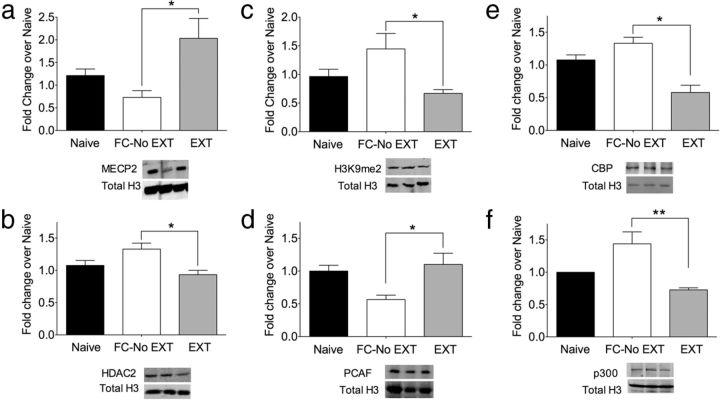
Figure 1.
Figure 1.
Nuclear expression of epigenetic regulatory proteins associated with fear extinction. a, There was a significant increase in the expression of methyl-CpG binding protein, MECP2 (microarray +1.7-fold change, Western blot validation, F(2,11) = 5.55, p < 0.05, Tukey's post hoc test, FC-No EXT vs EXT, p < 0.05). b, There was also a significant decrease in the expression of the histone deacetylase HDAC2 after fear extinction training (microarray −0.67-fold change, Western blot validation, F(2,11) = 6.31, p < 0.05, Tukey's post hoc test, FC-No EXT vs EXT, p < 0.05). c, Expression of the histone modification H3K9me2 was also decreased after extinction training (microarray −0.43-fold change, Western blot validation, F(2,11) = 15.21, p < 0.01, Tukey's post hoc test, FC-No EXT vs EXT, p < 0.05). d, We found a significant increase in the expression of PCAF (microarray +1.65-fold change, Western blot validation, F(2,11) = 5.86, p < 0.05, Tukey's post hoc test, FC-No EXT vs EXT, p < 0.05) and a corresponding decrease in both CBP and p300 after extinction training. e, CBP microarray (−0.68-fold change, Western blot validation, F(2,11) = 15.21, p < 0.01, Tukey's post hoc test, FC-No EXT vs EXT, p < 0.05). f, p300 microarray (−0.68-fold change, Western blot validation F(2,11) = 11.09, p < 0.01, Tukey's post hoc test, FC-No EXT vs EXT p < 0.01). *p < 0.05; **p < 0.01.
Figure 2.
Figure 2.
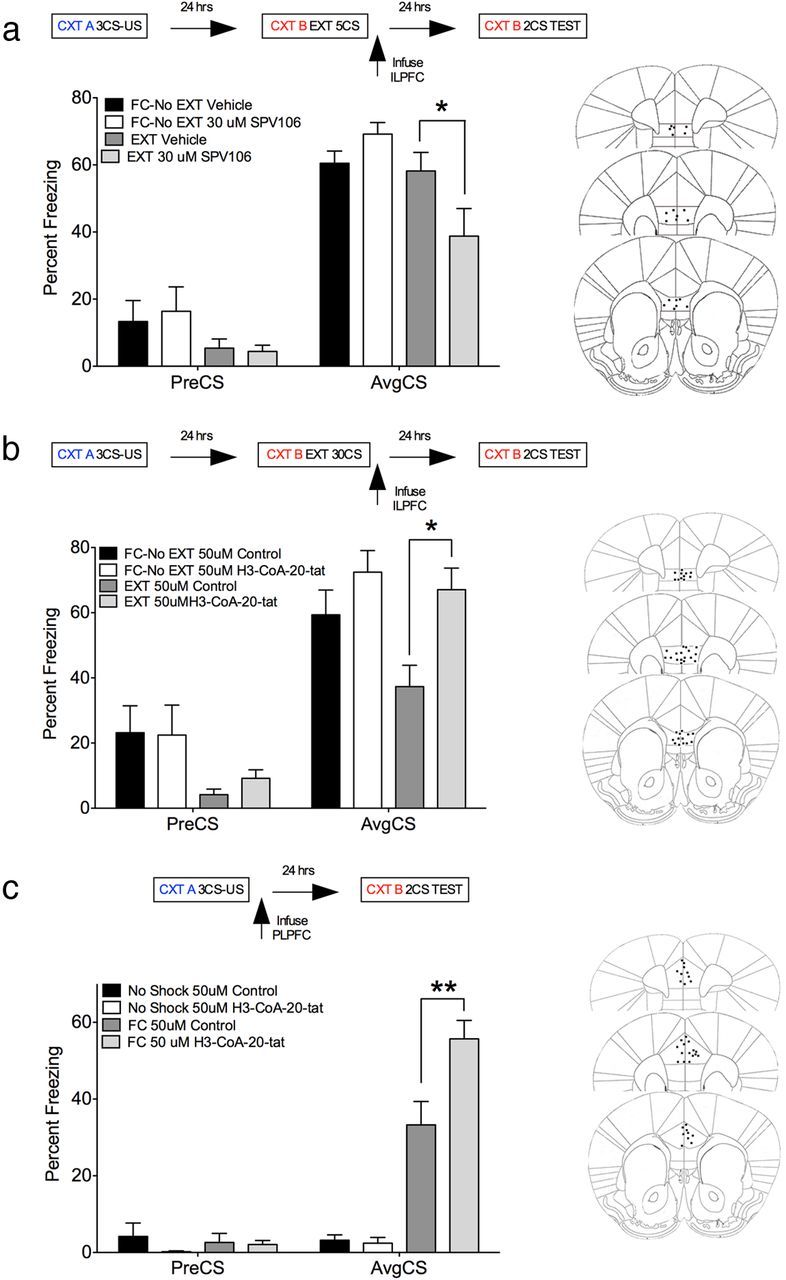
PCAF activity within the ILPFC is required for the consolidation of memory for fear extinction but not for cued fear. a, There was a significant decrease in freezing in SPV106-treated EXT mice relative to vehicle-treated FC-No EXT mice (F(3,20) = 5.43, p < 0.01, Tukey's post hoc test, FC-No EXT vehicle vs EXT SPV106, p < 0.05; vs EXT vehicle, n.s.). b, A 30-CS extinction training protocol produced a significant decrease in freezing in vehicle-treated EXT mice relative to FC-No EXT mice. This effect was eliminated in mice infused with the PCAF inhibitor H3-CoA-20-Tat (F(3,32) = 5.76, p < 0.01, Tukey's post hoc test, FC-No EXT control vs EXT control, p < 0.05; vs EXT PCAF inhibitor, n.s.). c, In a separate experiment, we infused either H3-CoA-20-Tat (3 μg, 1 μl) or Ac-DDDD-Tat (3 μg, 1 μl) directly into the PLPFC immediately after fear training. There was a significant increase in freezing in H3-CoA-20-Tat-treated FC relative to control drug-treated FC mice, an effect that was not observed in no-shock controls (F(5,31) = 35.82, p < 0.0001, Tukey's post hoc test, FC control vs FC H3-CoA-20-Tat, p < 0.01; No-shock control vs No-shock H3-CoA-20-Tat, n.s.). US, Unconditioned stimulus; CTX, context. *p < 0.05; **p < 0.01.
Figure 3.
Figure 3.
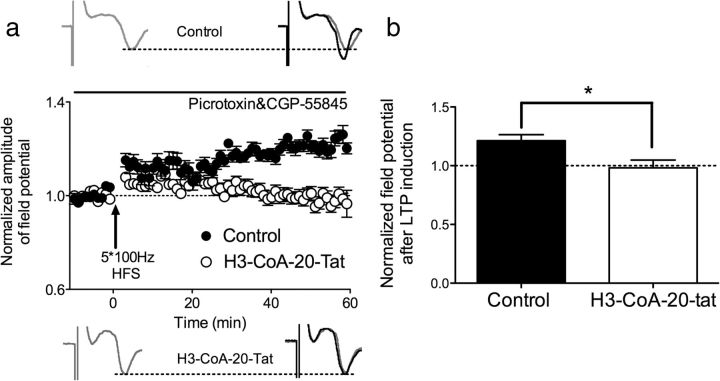
PCAF activity is necessary for synaptic plasticity within the ILPFC. a, LTP was induced by tetanic electric stimulation (100 Hz protocol) of ILPFC layer 2/3 neurons in 300 μm coronal slices, and field potentials were recorded from layer 5 neurons in the presence of GABA receptor inhibitors. b, When added to the perfusate, the PCAF inhibitor (H3-CoA-20-Tat, 25 μm) eliminated the induction of LTP (one-tailed unpaired t test for the comparison of both groups after LTP induction; Control: 121.3% ± 5.2; H3-CoA-20-Tat: 98.2% ± 6.6, *p < 0.05, n = 6/group).
Figure 4.
Figure 4.
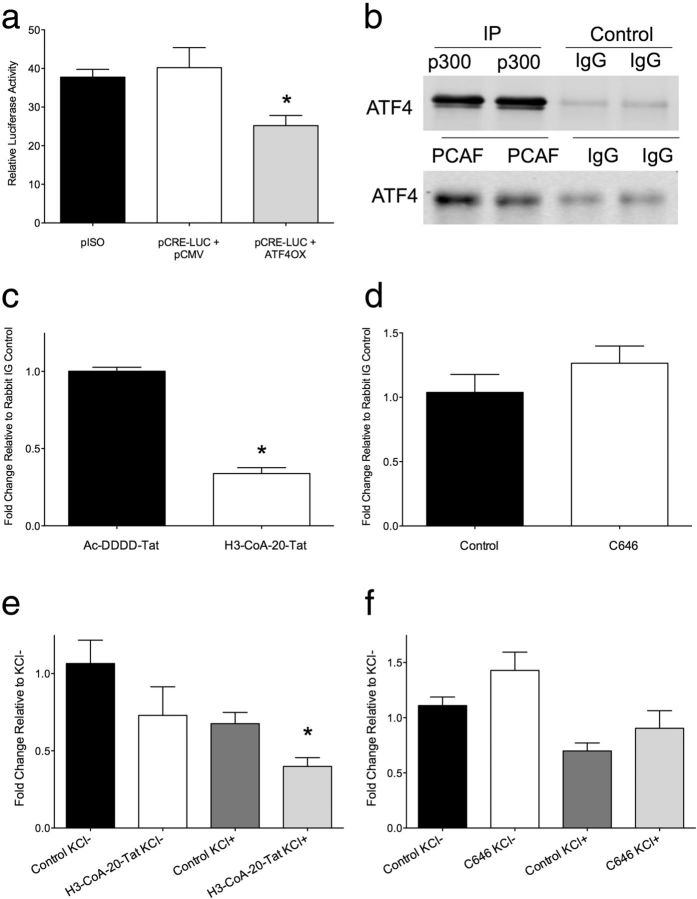
PCAF recruits ATF4 to the promoter of the immediate early gene zif268, which downregulates its expression. a, ATF4 functionally interacts with the zif268 promoter. b, ATF4 coimmunoprecipitates (IP) with p300 and PCAF in cortical neurons in vitro. c, In the presence of a PCAF inhibitor, H3-CoA-20-Tat, ATF4 binding to the CRE within the zif268 promoter is decreased (two-tailed t test, t = 14.60, df = 6, p < 0.001). d, ATF4 binding to the zif268 promoter is not affected by inhibition of p300/CBP by C646. e, Relative to nonstimulated control samples, 50 mm KCl-induced depolarization (used to mimic neural activity) led to significantly less ATF4 binding to the zif268 promoter in the presence of H3-CoA-20-Tat (F(3,21) = 4.28, p < 0.05; Tukey's post hoc test, Control KCl− vs H3-CoA-20-Tat KCl+, p < 0.05). f, Activity-dependent ATF4 binding to the zif268 promoter is not affected by inhibition of p300/CBP. *p < 0.05.
Figure 5.
Figure 5.
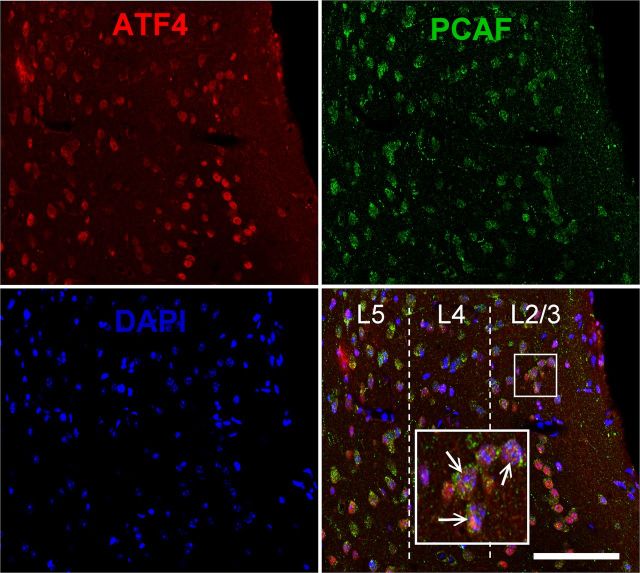
Confocal microscopic image of colabeled ATF4 and PCAF labeling within the ILPFC. Top left, ATF4 (red); top right, PCAF (green); bottom left, DAPI (blue); bottom right, merge. Dotted lines show divisions between layers (L); large inset box is magnification (3×) of small boxed area. Arrows indicate examples of colabeling. Scale bar, 100 μm.
Figure 6.
Figure 6.
Fear extinction learning induces a transient increase in ATF4 binding to the zif268 promoter and decreases zif268 mRNA expression in vivo. a, Relative to fear-conditioned mice, fear-extinction learning led to increased ATF4 binding to the zif2568 gene promoter [F(3,15) = 5.40, p < 0.05; Tukey's post hoc test, FC-No EXT (30 min) vs EXT (30 min), p < 0.05]. b, This was associated with decreased zif268 mRNA expression at the same time point [F(3,30) = 18.90, p < 0.01; Tukey's post hoc test, FC-No EXT (30 min) vs EXT (30 min), p < 0.05]. c, ATF4 binding to the zif268 promoter after fear-extinction training was inhibited when training occurs in the presence of the PCAF inhibitor H3-CoA-20-Tat (50 μm). d, In the presence of the PCAF inhibitor, fear-extinction learning did not lead to decreased zif268 mRNA expression. *p < 0.05; **p < 0.01.
Figure 7.
Figure 7.
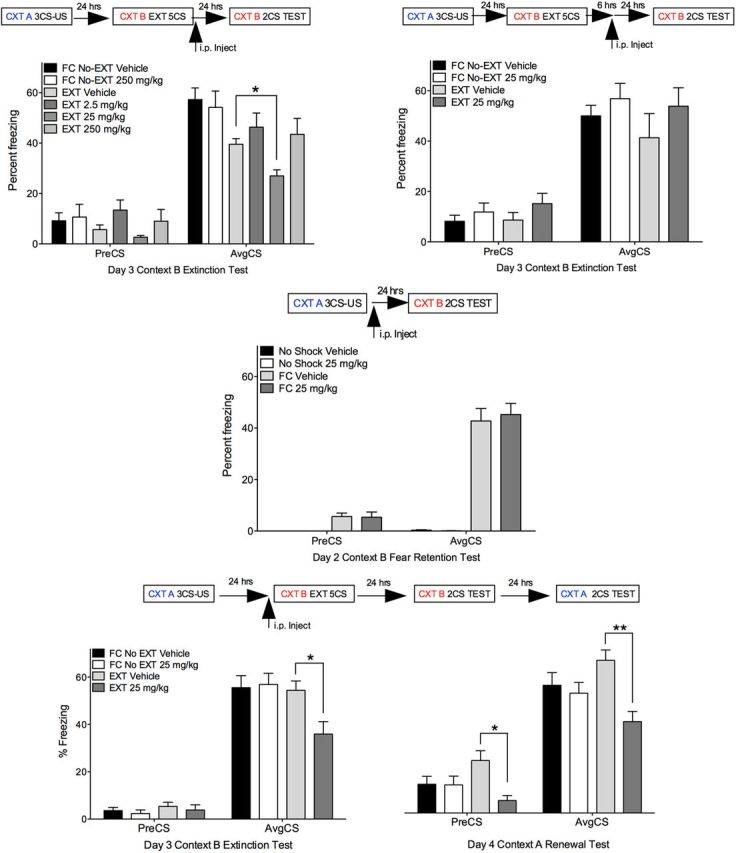
Systemic administration of a PCAF activator enhances the formation of memory for fear extinction. Top left, There was a significant decrease in freezing in EXT mice treated with SPV106 (25 mg/kg) relative to vehicle-treated FC-No EXT mice, an effect that was not observed in vehicle-treated EXT mice (Tukey's post hoc test, EXT vehicle vs EXT SPV106 25 mg/kg, p < 0.05). Top right, Systemic administration of the PCAF activator SPV106 had no effect on memory when administered 6 h after training. Middle, SPV106 did not affect cued-fear memory. Bottom, SPV106 (25 mg/kg) administered before fear-extinction training prevented the renewal of conditioned fear [Context (CTX) B: Tukey's post hoc test, AvgCS: EXT vehicle vs EXT SPV106 25 mg/kg, p < 0.05; Context A: pre-CS; EXT vehicle vs EXT SPV106 25 mg/kg, p < 0.05; AvgCS: EXT vehicle vs EXT SPV106 25 mg/kg, p < 0.01; Tukey's post hoc test, preCS: EXT vehicle vs EXT SPV106 25 mg/kg, p < 0.05; AvgCS: EXT vehicle vs EXT SPV106 25 mg/kg, p < 0.01). *p < 0.05; **p < 0.01.

References

    1. Adachi M, Autry AE, Covington HE, 3rd, Monteggia LM. MECP2-mediated transcription repression in the basolateral amygdala may underlie heightened anxiety in a mouse model of rett syndrome. J Neurosci. 2009;29:4218–4227. - PMC - PubMed
    1. Alarcón JM, Malleret G, Touzani K, Vronskaya S, Ishii S, Kandel ER, Barco A. Chromatin acetylation, memory, and ltp are impaired in cbp+/− mice: a model for the cognitive deficit in rubinstein-taybi syndrome and its amelioration. Neuron. 2004;42:947–959. - PubMed
    1. Alberini CM. Transcription factors in long-term memory and synaptic plasticity. Physiol Rev. 2009;89:121–145. - PMC - PubMed
    1. Al Sarraj J, Vinson C, Han J, Thiel G. Regulation of GTP cyclohydrolase i gene transcription by basic region leucine zipper transcription factors. J Cell Biochem. 2005;96:1003–1020. - PubMed
    1. Ameri K, Harris AL. Activating transcription factor 4. Int J Biochem Cell Biol. 2008;40:14–21. - PubMed

Publication types

Substances

LinkOut - more resources