. 2012 Aug 29;32(35):11970-9.
doi: 10.1523/JNEUROSCI.0624-12.2012.

Food intake adaptation to dietary fat involves PSA-dependent rewiring of the arcuate melanocortin system in mice

Affiliations

Food intake adaptation to dietary fat involves PSA-dependent rewiring of the arcuate melanocortin system in mice

Alexandre Benani et al. J Neurosci. .

Abstract

Hormones such as leptin and ghrelin can rapidly rewire hypothalamic feeding circuits when injected into rodent brains. These experimental manipulations suggest that the hypothalamus might reorganize continually in adulthood to integrate the metabolic status of the whole body. In this study, we examined whether hypothalamic plasticity occurs in naive animals according to their nutritional conditions. For this purpose, we fed mice with a short-term high-fat diet (HFD) and assessed brain remodeling through its molecular and functional signature. We found that HFD for 3 d rewired the hypothalamic arcuate nucleus, increasing the anorexigenic tone due to activated pro-opiomelanocortin (POMC) neurons. We identified the polysialic acid molecule (PSA) as a mediator of the diet-induced rewiring of arcuate POMC. Moreover, local pharmacological inhibition and genetic disruption of the PSA signaling limits the behavioral and metabolic adaptation to HFD, as treated mice failed to normalize energy intake and showed increased body weight gain after the HFD challenge. Altogether, these findings reveal the existence of physiological hypothalamic rewiring involved in the homeostatic response to dietary fat. Furthermore, defects in the hypothalamic plasticity-driven adaptive response to HFD are obesogenic and could be involved in the development of metabolic diseases.


Figures
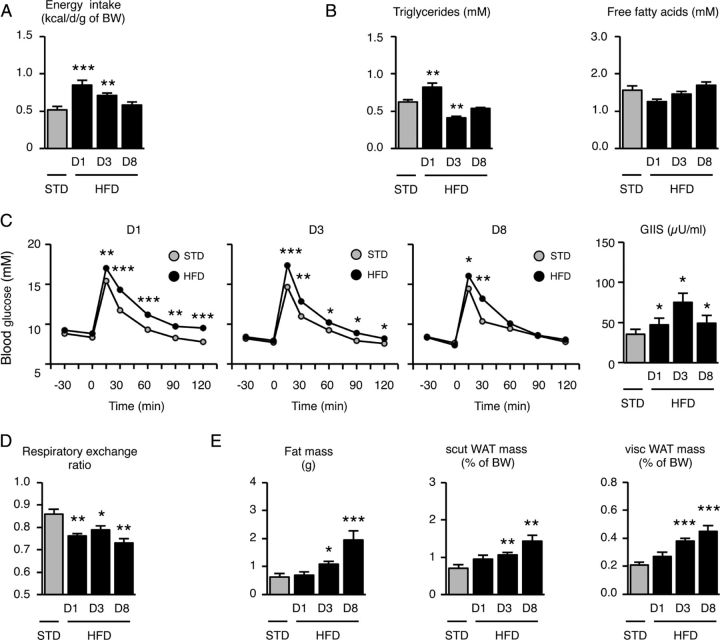
Figure 1.
Figure 1.
Energy intake and peripheral metabolism are transiently altered in mice fed HFD for 1 week. A–E, Energy intake (A), plasma triglycerides and free fatty acid levels (B), glucose tolerance with glucose-induced insulin secretion (GIIS) (C), respiratory exchange ratio (D), and adiposity assessed by EchoMRI scan and subcutaneous (scut) and visceral (visc) fat pad weight after dissection (E) were measured in standard- and HFD-fed mice. D, Day. Data are means ± SEM of n = 6–8 animals per group. In all panels, groups were compared using Dunnett's test after ANOVA, with STD mice as the reference, or using the Mann–Whitney test when appropriate. Significant difference at *p < 0.05, **p < 0.01, or ***p < 0.001, respectively.
Figure 2.
Figure 2.
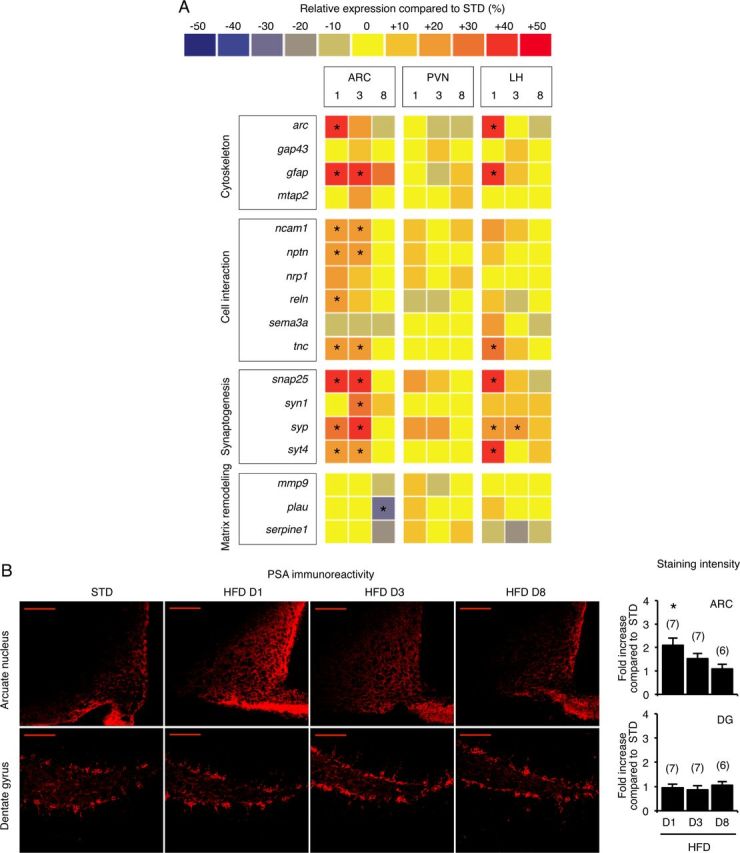
Hypothalami from mice fed an HFD for 1 d exhibit the molecular signature of plasticity. A, Simultaneous quantification of the expression of genes in hypothalamic biopsies using Taqman low density arrays. B, Representative PSA immunostaining in arcuate nucleus and dentate gyrus of standard- and HFD-fed mice. Scale bar, 100 μm. D, Day; ARC, arcuate nucleus; PVN, paraventricular nucleus; LH, lateral hypothalamic area; DG, dentate gyrus. Data are means ± SEM. In A and B, groups were compared using Bonferroni's test after ANOVA. Regarding the gene expression study, individual analysis was conducted for each gene. Significant difference at *p < 0.05.
Figure 3.
Figure 3.
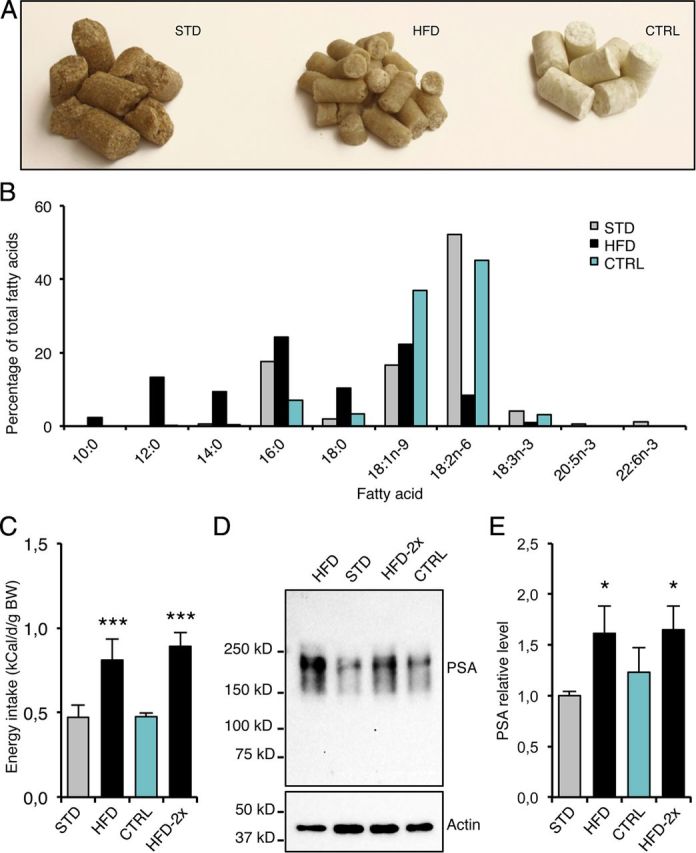
Food novelty is not sufficient to stimulate PSA production in the hypothalamus. A, Photograph of STD, HFD, and CTRL diets. B, Fatty acid composition of diets, as determined by gas chromatography. C, Energy intake after STD, CTRL, or HFD feeding for 1 d. HFD was introduced once (HFD) or twice (HFD-2x), with 1 week maintenance on STD between the two exposures. D, Representative immunoblot of PSA levels detected in protein extracts from arcuate biopsies collected after STD, CTRL, or HFD feeding. E, PSA levels in arcuate biopsies from STD, CTRL, or HFD fed mice, measured by Western blot. HFD-2x = reexposure to HFD. Data are means ± SEM of n = 9 (STD), 5 (HFD), 7 (CTRL), and 7 (HFD-2x). In C and E, groups were compared using the Mann–Whitney test. Significant difference at *p < 0.05 or ***p < 0.001, respectively.
Figure 4.
Figure 4.
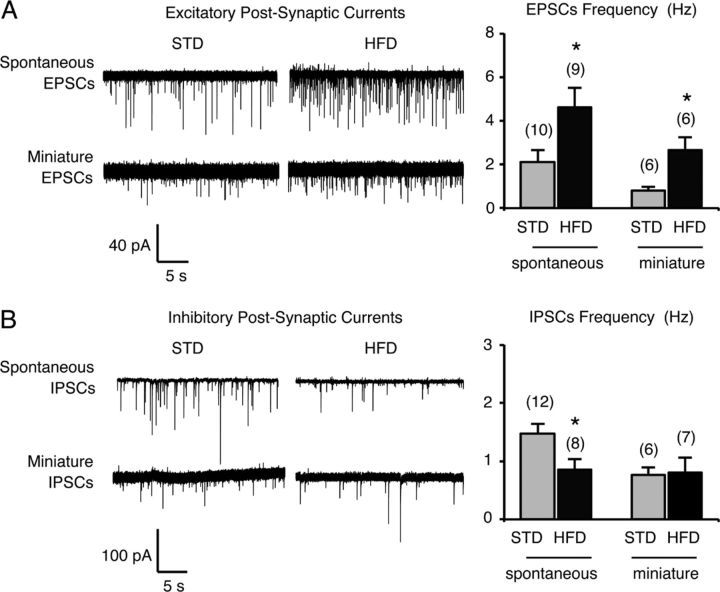
Arcuate POMC neurons of mice fed an HFD for 3 d are rewired. Postsynaptic excitatory (A) and inhibitory (B) currents in GFP-tagged POMC neurons from standard mice and mice fed an HFD for 3 d were recorded in a whole-cell voltage-clamp configuration (holding potential at −60 mV). Representative sample traces (30 s) are given in each panel. Frequencies of spontaneous and miniature currents were calculated before and after adding TTX, respectively. Data are means ± SEM. Groups were compared using Student's t test. Significant difference at *p < 0.05.
Figure 5.
Figure 5.
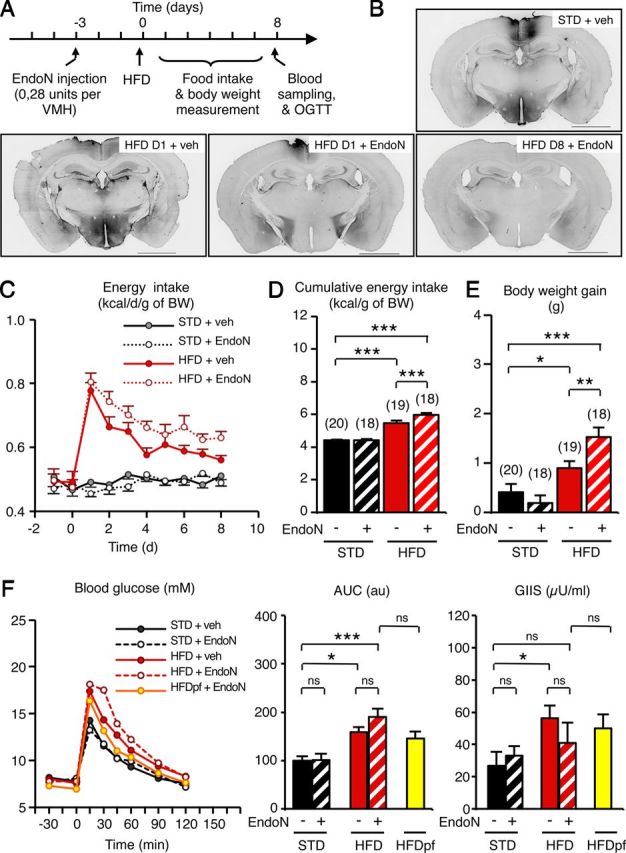
PSA removal in the hypothalamus impairs the homeostatic control of energy intake after HFD introduction. A, Experimental paradigm to remove PSA in the hypothalamus and assess energy balance in mice fed an HFD or not. B, Pictures show representative brain sections with a complete washout of PSA immunoreactivity after endoneuraminidase injection. Scale bar, 2 mm. C–F, Energy intake (C), cumulative energy intake (D), body weight gain (E), and glucose tolerance, with glucose-induced insulin secretion (F) of standard- and HFD-fed mice receiving or not a bilateral injection of EndoN into the hypothalamus 3 d before HFD introduction. D, Day; veh, vehicle; HFDpf, high fat diet, pair fed; AUC, area under curve; GIIS, glucose-induced insulin secretion. Data are means ± SEM. Groups were compared using the Newman–Keuls test after ANOVA. Significant difference at *p < 0.05, **p < 0.01, or ***p < 0.001, respectively.
Figure 6.
Figure 6.
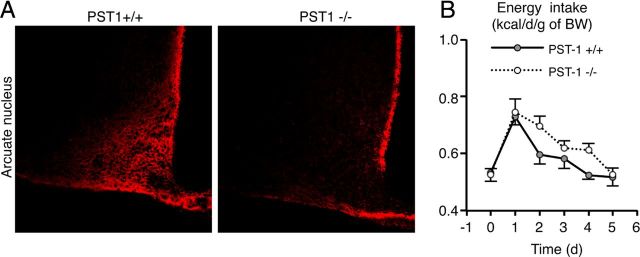
PST-1 enzyme deficiency impairs the homeostatic control of energy intake after HFD introduction. A, Representative PSA immunostaining in arcuate nucleus of PST-1+/+ and PST-1−/− mice fed an HFD for 1 d. B, Energy intake of PST-1+/+ and PST-1−/− mice fed an HFD for 5 d. Data are means ± SEM. n = 6 PST-1+/+ mice and n = 12 PST-1−/− mice. Groups were compared using Student's t test.

References

    1. Abizaid A, Liu ZW, Andrews ZB, Shanabrough M, Borok E, Elsworth JD, Roth RH, Sleeman MW, Picciotto MR, Tschöp MH, Gao XB, Horvath TL. Ghrelin modulates the activity and synaptic input organization of midbrain dopamine neurons while promoting appetite. J Clin Invest. 2006;116:3229–3239. - PMC - PubMed
    1. Andrews ZB, Liu ZW, Walllingford N, Erion DM, Borok E, Friedman JM, Tschöp MH, Shanabrough M, Cline G, Shulman GI, Coppola A, Gao XB, Horvath TL, Diano S. UCP2 mediates ghrelin's action on NPY/AgRP neurons by lowering free radicals. Nature. 2008;454:846–851. - PMC - PubMed
    1. Appelbaum L, Wang G, Yokogawa T, Skariah GM, Smith SJ, Mourrain P, Mignot E. Circadian and homeostatic regulation of structural synaptic plasticity in hypocretin neurons. Neuron. 2010;68:87–98. - PMC - PubMed
    1. Baroncini M, Jissendi P, Catteau-Jonard S, Dewailly D, Pruvo JP, Francke JP, Prevot V. Sex steroid hormones-related structural plasticity in the human hypothalamus. Neuroimage. 2010;50:428–433. - PubMed
    1. Bermudez-Silva FJ, Cardinal P, Cota D. The role of the endocannabinoid system in the neuroendocrine regulation of energy balance. J Psychopharmacol. 2012;26:114–124. - PubMed

Publication types

MeSH terms