


Outcome of small cell lung cancer (SCLC) patients with brain metastases in a routine clinical setting
- PMID: 22933980
- PMCID: PMC3423766
- DOI: 10.2478/v10019-012-0007-1
Outcome of small cell lung cancer (SCLC) patients with brain metastases in a routine clinical setting
Abstract
Background: Small cell lung cancer (SCLC) represents approximately 13 to 18% of all lung cancers. It is the most aggressive among lung cancers, mostly presented at an advanced stage, with median survival rates of 10 to12 months in patients treated with standard chemotherapy and radiotherapy. In approximately 15-20% of patients brain metastases are present already at the time of primary diagnosis; however, it is unclear how much it influences the outcome of disease according the other metastatic localisation. The objective of this analysis was to evaluate the median survival of SCLC patients treated by specific therapy (chemotherapy and/or radiotherapy) with regard to the presence or absence of brain metastases at the time of diagnosis.
Patients and methods: All SCLC patients have been treated in a routine clinical practice and followed up at the University Clinic Golnik in Slovenia. In the retrospective study the medical files from 2002 to 2007 were review. All patients with cytological or histological confirmed disease and eligible for specific oncological treatment were included in the study. They have been treated according to the guidelines valid at the time. Chemotherapy and regular followed-up were carried out at the University Clinic Golnik and radiotherapy at the Institute of Oncology Ljubljana.
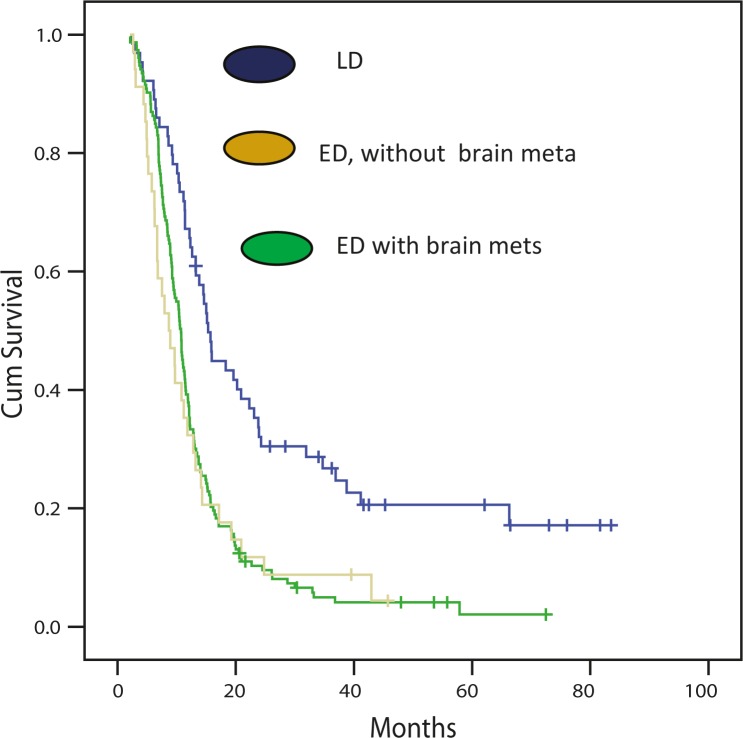
Results: We found 251 patients eligible for the study. The median age of them was 65 years, majority were male (67%), smokers or ex-smokers (98%), with performance status 0 to 1 (83%). At the time of diagnosis no metastases were found in 64 patients (25.5%) and metastases outside the brain were presented in 153 (61.0%). Brain metastases, confirmed by a CT scan, were present in 34 patients (13.5%), most of them had also metastases at other localisations. All patients received chemotherapy and all patients with confirmed brain metastases received whole brain irradiation (WBRT). The radiotherapy with radical dose at primary tumour was delivered to 27 patients with limited disease and they got 4-6 cycles of chemotherapy. Median overall survival (OS) of 34 patients with brain metastases was 9 months (95% CI 6-12) while OS of 153 patients with metastases in other locations was 11 months (95% CI 10-12); the difference did not reach the level of significance (p = 0.62). As expected, the OS of patients without metastases at the time of primary diagnosis turned out to be significantly better compared to the survival of patients with either brain or other location metastases at the primary diagnosis (15 months vs 9 and 11 months, respectively, p < 0.001).
Conclusions: In our investigated population, the prognosis of patients with extensive SCLS with brain metastases at the primary diagnosis treated with chemotherapy and WBRT was not significantly worse compared to the prognosis of patients with extensive SCLC and metastases outside the brain. In extensive SCLC brain metastases were not a negative prognostic factor per se if the patients were able to be treated appropriately. However, the survival rates of extensive SCLC with or without brain metastases remained poor and novel treatment approaches are needed. The major strength of this study is that it has been done on a population of patients treated in a routine clinical setting.
Keywords: brain metastases; prophylactic cranial irradiation; small-cell lung cancer.
Conflict of interest statement
Disclosure: No potential conflicts of interest were disclosed.
Figures
References
-
- Wahbah M, Boroumand N, Castro C, El-Zeky F, Eltorky M. Changing trends in the distribution of the histologic types of lung cancer: a review of 4,439 cases. Ann Diagn Pathol. 2007;11:89–96. - PubMed
-
- UICC International Union Against Cancer . Lung. In: Sobin LH, Gospodarowicz MK, Wittekind Ch, editors. TNM classification of malignant tumours. 7th edition. Chichester: Wiley-Blackwell; 2009. pp. 138–46.
-
- Debevec L, Jerič T, Kovač V, Sok M, Bitenc M. The progress in routine management of lung cancer patients. A comparative analysis of an institution in 1996 and 2006. Radiol Oncol. 2009;43:47–53.
-
- Vallières E, Shepherd FA, Crowley J, Van Houtte P, Postmus PE, Carney D, et al. International Association for the Study of Lung Cancer International Staging Committee and Participating Institutions The IASLC Lung Cancer Staging Project: proposals regarding the relevance of TNM in the pathologic staging of small cell lung cancer in the forthcoming (seventh) edition of the TNM classification for lung cancer. J Thorac Oncol. 2009;4:1049–59. - PubMed
-
- Micke P, Faldum A, Metz T, Beeha K, Bittingerc F, Hengstlerd J, et al. Staging small cell lung cancer: Veterans Administration Lung Study Group versus International Association for the Study of Lung Cancer - what limits limited disease? Lung Cancer. 2002;37:271–6. - PubMed
LinkOut - more resources
Full Text Sources
