


doi: 10.3389/fphys.2012.00281.
eCollection 2012.
The importance of modeling epileptic seizure dynamics as spatio-temporal patterns
Affiliations
- PMID: 22934035
- PMCID: PMC3429055
- DOI: 10.3389/fphys.2012.00281
Item in Clipboard
The importance of modeling epileptic seizure dynamics as spatio-temporal patterns
Front Physiol.
.
Abstract
The occurrence of seizures is the common feature across the spectrum of epileptic disorders. We describe how the use of mechanistic neural population models leads to novel insight into the dynamic mechanisms underlying two important types of epileptic seizures. We specifically stress the need for a spatio-temporal description of the rhythms to deal with the complexity of the pathophenotype. Adapted to functional and structural patient data, the macroscopic models may allow a patient-specific description of seizures and prediction of treatment outcome.
Keywords: computational modeling; electroencephalogram (EEG); epilepsy; heterogeneity; spatio-temporal patterns.
Figures
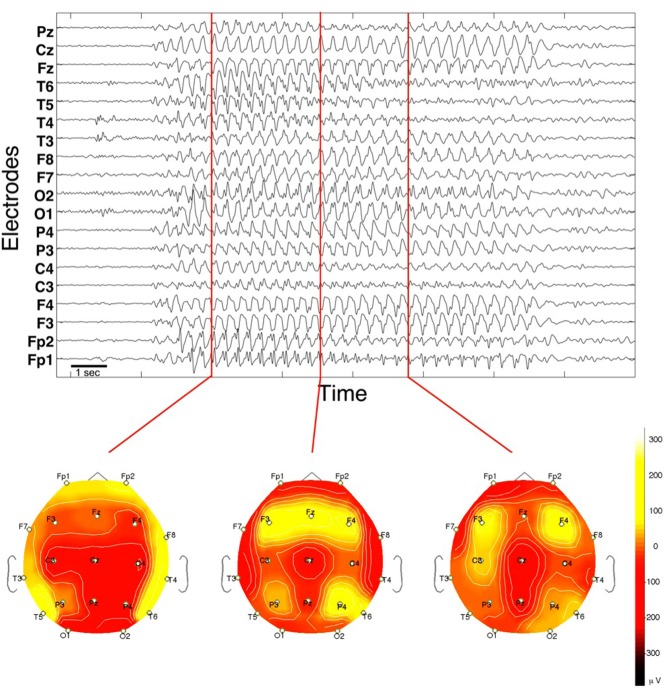
EEG of a spontaneous absence seizure in a pediatric patient. Potentials from standard surface electrodes are plotted against time. Horizontal axis spans about 16 s. Below are three topographic potential mappings projected on the scalp (seen from above).
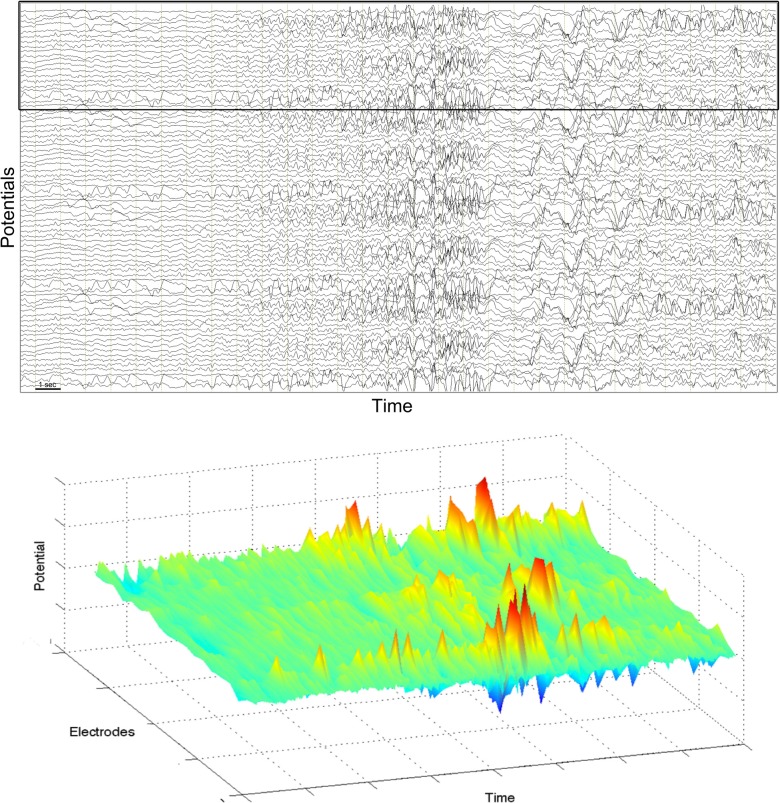
Electrocorticogram of a partial seizure in an adult patient. Top: potentials from 78 grid electrodes are plotted against time. Horizontal axis spans about 30 s. Bottom: pseudo-3D plot of 20 electrodes indicated by black frame in the top figure.
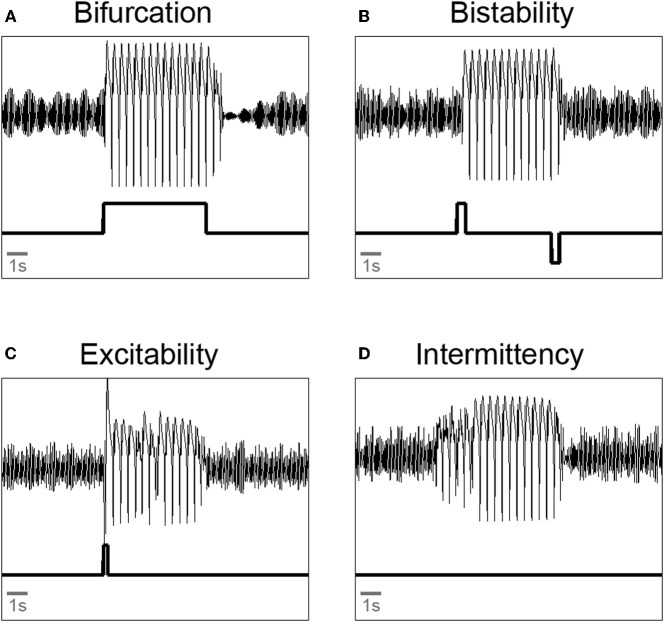
Illustration of qualitatively different transitions from background oscillations to pathological spike-wave and back again in a neural mass model. (A) Bifurcation: a parameter is changed such that it crosses a bifurcation point. (B) Bistability: two pulse perturbation are applied to start and terminate a seizure. (C) Excitability: a single pulse perturbation is applied to induce a seizure. (D) Intermittency: parameter setting allows spontaneous transitions into and out of the seizure rhythms. All simulations done with a three compartment version of the extended Jansen-Rit model (Goodfellow et al., 2011). Upper trace: model output. Lower trace: parameter protocol.
References
-
- Bai X. X., Vestal M., Berman R., Negishi M., Spann M., Vega C., Desalvo M., Novotny E. J., Constable R. T., Blumenfeld H. (2010). Dynamic time course of typical childhood absence seizures: EEG, behavior, and functional magnetic resonance imaging. J. Neurosci. 30, 5884–5893 10.1523/JNEUROSCI.5101-09.2010 - DOI - PMC - PubMed
-
- Blume W. T., Young G. B., Lemieux J. F. (1984). EEG morphology of partial epileptic seizures. Electroencephalogr. Clin. Neurophysiol. 57, 295–302 - PubMed
-
- Bojak I., Oostendorp T. F., Reid A. T., Kötter R. (2011). Towards a model-based integration of co-registered electroencephalography/functional magnetic resonance imaging data with realistic neural population meshes. Philos. Transact. A Math. Phys. Eng. Sci. 369, 3785–3801 10.1098/rsta.2011.0080 - DOI - PMC - PubMed
LinkOut - more resources
Full Text Sources
