


An affective dimension within oppositional defiant disorder symptoms among boys: personality and psychopathology outcomes into early adulthood
- PMID: 22934635
- PMCID: PMC3472086
- DOI: 10.1111/j.1469-7610.2012.02598.x
An affective dimension within oppositional defiant disorder symptoms among boys: personality and psychopathology outcomes into early adulthood
Abstract
Background: A dimension of negatively oriented affect within oppositional defiant disorder (ODD) symptoms, which has been described as irritability, has been shown to predict depression and anxiety. Related constructs have been linked to temperament and personality constructs. However, only a few studies have examined the prediction from irritability within ODD to psychopathology or personality outcomes. Further, no studies have investigated whether irritability distinguishes among classes of youth.
Methods: Data from a clinic-referred sample of 7-12-year-old boys followed up to age 18 were used. Measures included structured clinical interviews with parents through adolescence, and youth self-report of depression and personality domains at age 18.
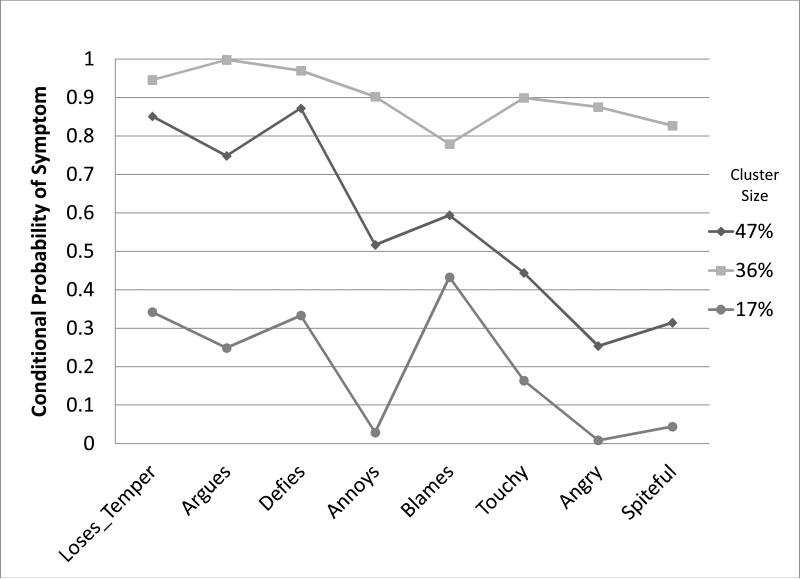
Results: Variable-oriented analyses found predictive links between irritability and outcomes of depression, anxiety, and Neuroticism. Latent classes of youth were distinguished by the presence or absence of irritability symptoms. Youth classified by irritability symptoms at baseline were significantly more likely to show anxiety and depression through adolescence and depression and Neuroticism at 18. No relationship was observed for the other of the Big Five personality factors.
Conclusion: Irritability symptoms within ODD distinguish youth at risk for persisting problems with internalizing disorders and Neuroticism into adulthood. The findings are suggestive of a model in which the early emergence of irritability marks life-course risks for specific types of psychopathology and personality problems.
© 2012 The Author. Journal of Child Psychology and Psychiatry © 2012 Association for Child and Adolescent Mental Health.
Figures
References
-
- Aebi M, Muller UC, Asherson P, Banaschewski T, Buitelaar J, Ebstein R, Steinhausen HC. Predictability of oppositional defiant disorder and symptom dimensions in children and adolescents with ADHD combined type. Psychological Medicine. 2010;40(12):2089–2100. - PubMed
-
- American Psychiatric Association . Diagnostic and Statistical Manual of Mental Disorders. 4th ed. American Psychiatric Association; Washington, D. C.: 1994.
-
- Brotman MA, Schmajuk M, Rich BA, Dickstein DP, Guyer AE, Costello EJ, Leibenluft E. Prevalence, clinical correlates, and longitudinal course of severe mood dysregulation in children. Biol Psychiatry. 2006;60(9):991–997. - PubMed
-
- Burke J, Loeber R. Oppositional Defiant Disorder and the explanation of the comorbidity between behavioral disorders and depression. Clinical Psychology-Science and Practice. 2010;17(4):319–326.
