


α-Synuclein and neuronal cell death
- PMID: 22936307
- PMCID: PMC3589663
- DOI: 10.1007/s12035-012-8327-0
α-Synuclein and neuronal cell death
Abstract
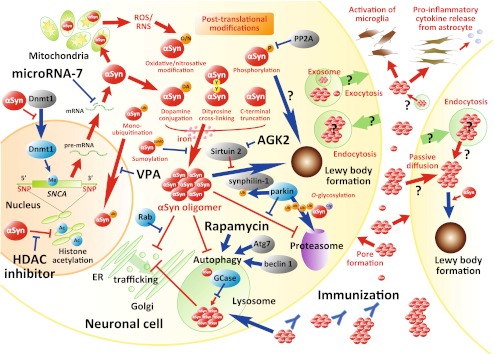
Parkinson's disease (PD) is a progressive neurodegenerative disorder affecting ~1 % of people over the age of 65. Neuropathological hallmarks of PD are prominent loss of dopaminergic (DA) neurons in the substantia nigra and formation of intraneuronal protein inclusions termed Lewy bodies, composed mainly of α-synuclein (αSyn). Missense mutations in αSyn gene giving rise to production of degradation-resistant mutant proteins or multiplication of wild-type αSyn gene allele can cause rare inherited forms of PD. Therefore, the existence of abnormally high amount of αSyn protein is considered responsible for the DA neuronal death in PD. Normally, αSyn protein localizes to presynaptic terminals of neuronal cells, regulating the neurotransmitter release through the modulation of assembly of soluble N-ethylmaleimide-sensitive factor attachment protein receptor complex. On the other hand, of note, pathological examinations on the recipient patients of fetal nigral transplants provided a prion-like cell-to-cell transmission hypothesis for abnormal αSyn. The extracellular αSyn fibrils can internalize to the cells and enhance intracellular formation of protein inclusions, thereby reducing cell viability. These findings suggest that effective removal of abnormal species of αSyn in the extracellular space as well as intracellular compartments can be of therapeutic relevance. In this review, we will focus on αSyn-triggered neuronal cell death and provide possible disease-modifying therapies targeting abnormally accumulating αSyn.
Figures
References
-
- Farrer MJ. Genetics of Parkinson disease: paradigm shifts and future prospects. Nat Rev Genet. 2006;7:306–318. - PubMed
-
- Spillantini MG, Schmidt ML, Lee VM, Trojanowski JQ, Jakes R, Goedert M. Alpha-synuclein in Lewy bodies. Nature. 1997;388:839–840. - PubMed
-
- Jenner P. Molecular mechanisms of L-DOPA-induced dyskinesia. Nat Rev Neurosci. 2008;9:665–677. - PubMed
-
- Deep-Brain Stimulation for Parkinson’s Disease Study Group Deep-brain stimulation of the subthalamic nucleus or the pars interna of the globus pallidus in Parkinson’s disease. N Engl J Med. 2001;345:956–963. - PubMed
Publication types
MeSH terms
Substances
LinkOut - more resources
Full Text Sources
Medical
