


Evidence for a bacterial mechanism for group-specific social odors among hyenas
- PMID: 22937224
- PMCID: PMC3431069
- DOI: 10.1038/srep00615
Evidence for a bacterial mechanism for group-specific social odors among hyenas
Abstract
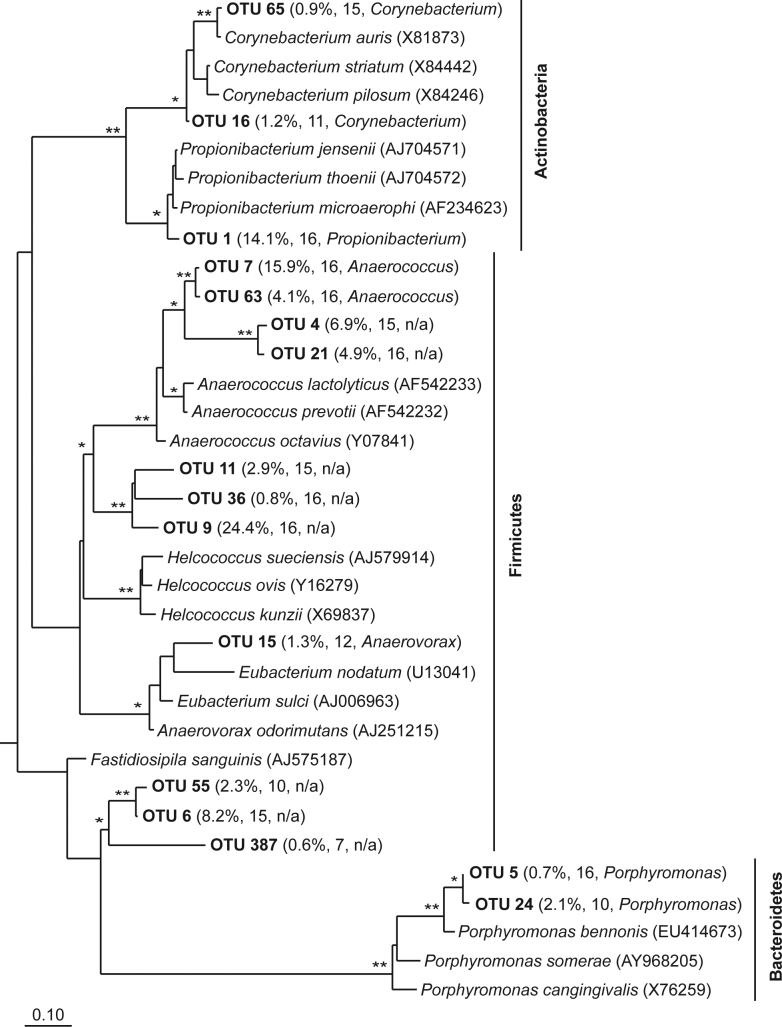
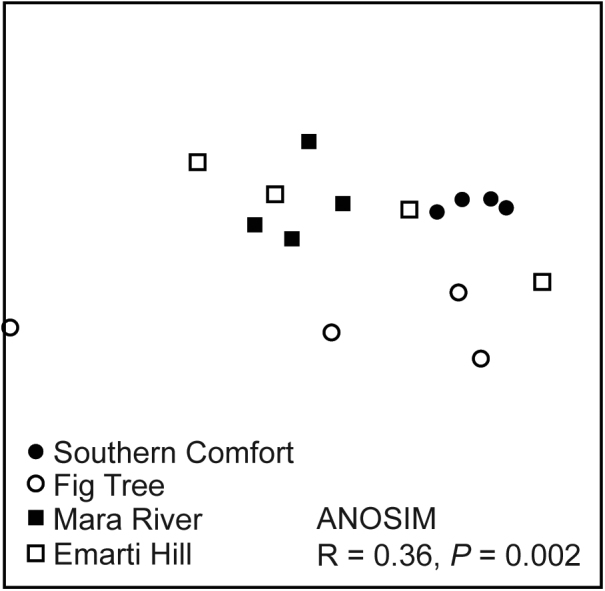
Symbiotic microbes can benefit their animal hosts by enhancing the diversity of communication signals available to them. The fermentation hypothesis for chemical recognition posits that 1) fermentative bacteria in specialized mammalian scent glands generate odorants that mammals co-opt to communicate with one another, and 2) that variation in scent gland odors is due to underlying variation in the structure of bacterial communities within scent glands. For example, group-specific social odors are suggested to be due to members of the same social group harboring more similar bacterial communities in their scent glands than do members of different social groups. We used 16S rRNA gene surveys to show that 1) the scent secretions of spotted hyenas are densely populated by fermentative bacteria whose closest relatives are well-documented odor producers, and that 2) these bacterial communities are more similar among hyenas from the same social group than among those from different groups.
Figures
References
-
- Rosenberg E., Sharon G., Atad I. & Zilber-Rosenberg I. The evolution of animals and plants via symbiosis with microorganisms. Environ. Microbiol. Rep. 2, 500–506 (2010). - PubMed
-
- Savinov A. Autocenosis and democenosis as individual- and population-level ecological categories in terms of symbiogenesis and systems approach. Russian J. Ecol. 42, 179–185 (2011).
-
- Bäckhed F., Ley R. E., Sonnenburg J. L., Peterson D. A. & Gordon J. I. Host-bacterial mutualism in the human intestine. Science 307, 1915–1920 (2005). - PubMed
-
- Fraune S. & Bosch T. C. G. Why bacteria matter in animal development and evolution. Bioessays 32, 571–580 (2010). - PubMed
Publication types
MeSH terms
Substances
LinkOut - more resources
Full Text Sources
Molecular Biology Databases
