


A decision aid to assist decisions on disclosure of mental health status to an employer: protocol for the CORAL exploratory randomised controlled trial
- PMID: 22938019
- PMCID: PMC3527227
- DOI: 10.1186/1471-244X-12-133
A decision aid to assist decisions on disclosure of mental health status to an employer: protocol for the CORAL exploratory randomised controlled trial
Abstract
Background: The UK Equality Act 2010 makes it unlawful for employers to ask health questions before making an offer of employment except in certain circumstances. While the majority of employers would prefer applicants to disclose a mental illness at the application stage, many people either wait until they have accepted the job and then disclose to an occupational health professional, or do not do so at all due to the anticipation of discrimination or a wish for privacy. However, non disclosure precludes the ability to request reasonable adjustments in the workplace or to make a claim of direct discrimination. Disclosure to employers is therefore a difficult decision. A recent pilot study by our group of the CORAL decision aid showed that it helped mental health service users clarify their needs and values regarding disclosure and led to reduction in decisional conflict. The present proof of concept trial aims to determine whether a full scale randomised controlled trial (RCT) is justifiable and feasible, and to optimise its design.
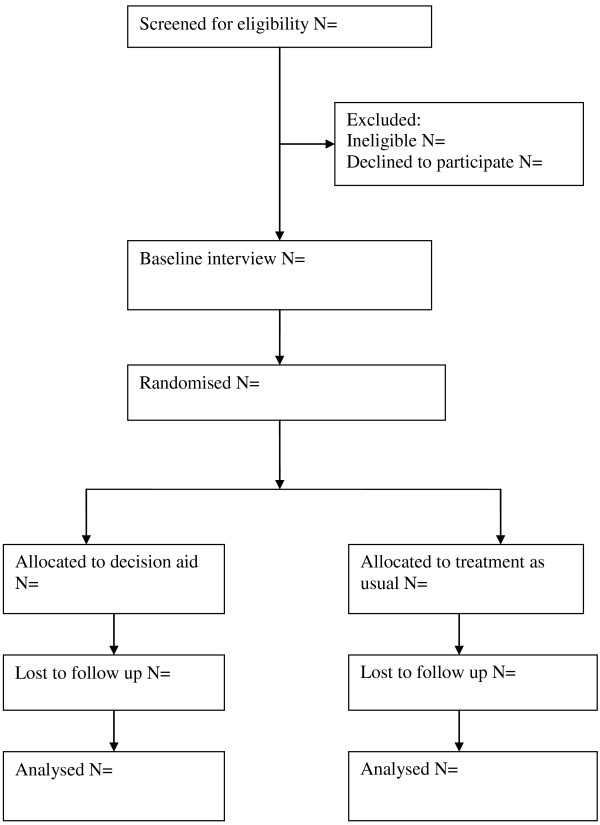
Methods: In this single blind exploratory RCT in London, a total of 80 participants (inclusion criteria: age ≥ 18 years, on the caseload of a specialist employment adviser working with people with mental illness; referred to the adviser either from primary care via Improving Access to Psychological Therapies or secondary mental health service; currently seeking or interested in either paid or voluntary employment, and a Decisional Conflict Scale score of 37.5 or greater and stage of decision score 1-5) will be recruited from vocational advice services. After completing a baseline assessment, participants will be randomly assigned to one of two conditions (1) Use of the CORAL Decision Aid (DA) in addition to treatment as usual or (2) Treatment as usual. Those allocated to the DA condition will be given it to read and complete, and the researcher will be present to record the time taken and any content that causes confusion. Intervention participants may keep the decision aid but are discouraged from showing it to other service users to avoid contamination. Follow up interviews will be conducted at 3 months. Primary outcomes are: (i) stage of decision making score; (ii) decisional conflict scores and (iii) employment related outcomes. Secondary analyses will identify predictors of disclosure and qualitative analysis will explore the impact of the intervention.
Discussion: A reduction in decisional conflict regarding disclosure leading to more effective job seeking activity could have significant economic consequences for people with mental illness in terms of employment rates and productivity.
Trial registration number: NCT01379014 (ClinicalTrials.gov Identifier).
Figures
References
-
- Mental Health Foundation. Out at Work. A Survey of the Experiences of People with Mental Health Problems within the Workplace. Mental Health Foundation, London; 2002.
-
- Little K, Henderson C, Brohan E, Thornicroft G. Employers' attitudes to people with mental health problems in the work place in Britain: changes between 2006 and 2009. Epidemiologica e Psichiatria Sociale; 2011. In press. - PubMed
Publication types
MeSH terms
Associated data
Grants and funding
LinkOut - more resources
Full Text Sources
Medical
