


Introducing the Forensic Research/Reference on Genetics knowledge base, FROG-kb
- PMID: 22938150
- PMCID: PMC3488007
- DOI: 10.1186/2041-2223-3-18
Introducing the Forensic Research/Reference on Genetics knowledge base, FROG-kb
Abstract
Background: Online tools and databases based on multi-allelic short tandem repeat polymorphisms (STRPs) are actively used in forensic teaching, research, and investigations. The Fst value of each CODIS marker tends to be low across the populations of the world and most populations typically have all the common STRP alleles present diminishing the ability of these systems to discriminate ethnicity. Recently, considerable research is being conducted on single nucleotide polymorphisms (SNPs) to be considered for human identification and description. However, online tools and databases that can be used for forensic research and investigation are limited.
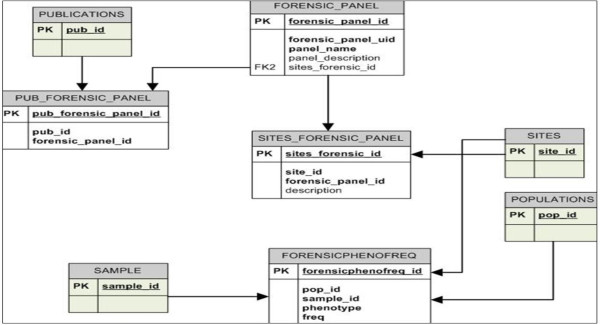
Methods: The back end DBMS (Database Management System) for FROG-kb is Oracle version 10. The front end is implemented with specific code using technologies such as Java, Java Servlet, JSP, JQuery, and GoogleCharts.
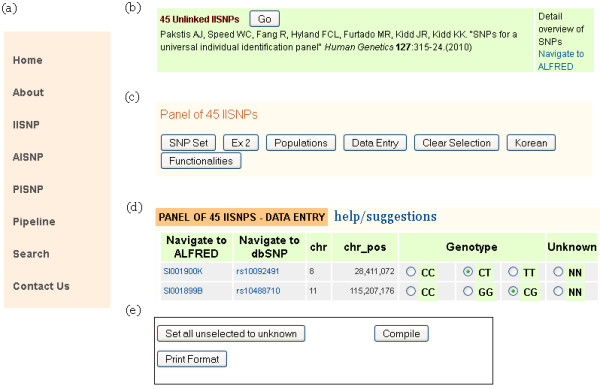
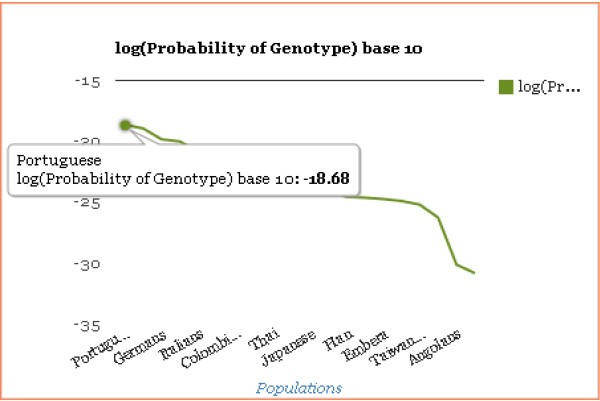
Results: We present an open access web application, FROG-kb (Forensic Research/Reference on Genetics-knowledge base, http://frog.med.yale.edu), that is useful for teaching and research relevant to forensics and can serve as a tool facilitating forensic practice. The underlying data for FROG-kb are provided by the already extensively used and referenced ALlele FREquency Database, ALFRED (http://alfred.med.yale.edu). In addition to displaying data in an organized manner, computational tools that use the underlying allele frequencies with user-provided data are implemented in FROG-kb. These tools are organized by the different published SNP/marker panels available. This web tool currently has implemented general functions possible for two types of SNP panels, individual identification and ancestry inference, and a prediction function specific to a phenotype informative panel for eye color.
Conclusion: The current online version of FROG-kb already provides new and useful functionality. We expect FROG-kb to grow and expand in capabilities and welcome input from the forensic community in identifying datasets and functionalities that will be most helpful and useful. Thus, the structure and functionality of FROG-kb will be revised in an ongoing process of improvement. This paper describes the state as of early June 2012.
Figures
References
-
- Schneider PM. Expansion of the European Standard Set of DNA Database Loci-the Current Situation. Profiles in DNA. 2009;12:6–7.
LinkOut - more resources
Full Text Sources
Miscellaneous
