Comparative Study
. 2012 Sep 7;91(3):408-21.
doi: 10.1016/j.ajhg.2012.07.004. Epub 2012 Aug 30.

Using ERDS to infer copy-number variants in high-coverage genomes

Affiliations
Comparative Study

Using ERDS to infer copy-number variants in high-coverage genomes

Mingfu Zhu et al. Am J Hum Genet. .

Abstract

Although there are many methods available for inferring copy-number variants (CNVs) from next-generation sequence data, there remains a need for a system that is computationally efficient but that retains good sensitivity and specificity across all types of CNVs. Here, we introduce a new method, estimation by read depth with single-nucleotide variants (ERDS), and use various approaches to compare its performance to other methods. We found that for common CNVs and high-coverage genomes, ERDS performs as well as the best method currently available (Genome STRiP), whereas for rare CNVs and high-coverage genomes, ERDS performs better than any available method. Importantly, ERDS accommodates both unique and highly amplified regions of the genome and does so without requiring separate alignments for calling CNVs and other variants. These comparisons show that for genomes sequenced at high coverage, ERDS provides a computationally convenient method that calls CNVs as well as or better than any currently available method.


Figures

Figure 1
Figure 1
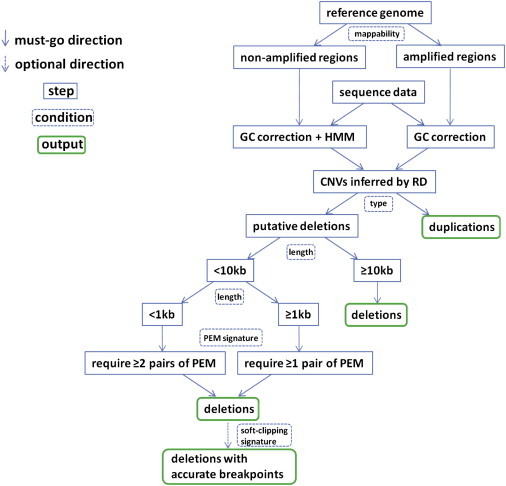
ERDS Flow Chart
Figure 2
Figure 2
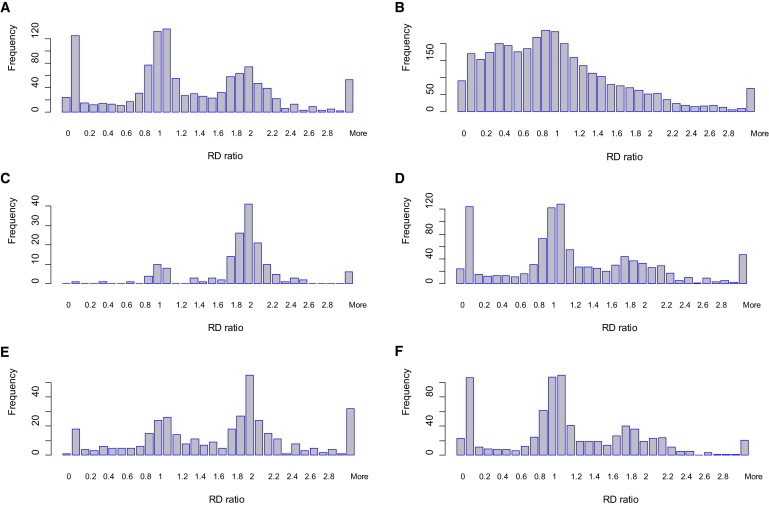
RD Assessment of Deletions in Unique Regions in the Release Set RD ratios for regions were calculated as the ratio of the observed RD to the expected RD according to the G + C percentage. A ratio of 1.5 or smaller in unique regions suggests a deletion; confidence increases as the RD ratio decreases and the length of the region increases. Histograms of counts with respect to RD ratios were plotted for different categories with a bin width of 0.1. Different sizes are compared: (A) those larger than 1 kb (n = 1197) and (B) those smaller than 1 kb (n = 3385). For deletions larger than 1 kb, (C) those that failed the heterozygosity check (n = 163) and (D) those that passed the heterozygosity check (n = 1034) are shown. With regard to the deletion results in the parents, (E) those that are putative de novo (n = 378) and (F) those seen in one of the parents (n = 819) regardless of zygosity are shown.
Figure 3
Figure 3
Sensitivity Measurements for Different Approaches The criterion of 50% reciprocal overlap was used (A) for calling deletions in NA12878 in the GSD from Mills et al. in different size classes and (B) for calling rare deletions in NA12878 with population frequencies of less than 1%, 2%, or 5% in Conrad et al.
Figure 4
Figure 4
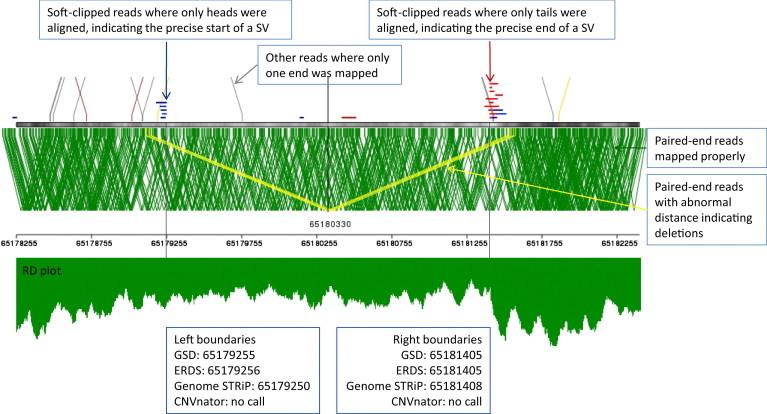
Breakpoint Resolutions of CNV Calls for a Deletion at chr10: 65179255–65181405 from the GSD. The top panel is plotted with SVviewer (Y.H., unpublished data) for displaying the aligned reads at region chr10: 65179255–65181405 along with 1 kb flanking regions at both sides. Both the PEM and SC signatures are integrated into the ERDS framework, making it possible to reach bp resolution in the breakpoint inference. The bottom panel is the RD plot for the same region. Although the RD was depleted in the middle, clear breakpoints were hard to indentify, in particular on the left-hand side. ERDS made a call at chr10: 65179256–65181405, which differed by 1 bp for the left breakpoint and matched the right breakpoint. Genome STRiP called the deletion at chr10: 65179250–65181408, which differed by 5 bp for the left breakpoint and 3 bp for the right breakpoint. CNVnator did not call this deletion.

References

    1. Sebat J., Lakshmi B., Troge J., Alexander J., Young J., Lundin P., Månér S., Massa H., Walker M., Chi M. Large-scale copy number polymorphism in the human genome. Science. 2004;305:525–528. - PubMed
    1. Iafrate A.J., Feuk L., Rivera M.N., Listewnik M.L., Donahoe P.K., Qi Y., Scherer S.W., Lee C. Detection of large-scale variation in the human genome. Nat. Genet. 2004;36:949–951. - PubMed
    1. Conrad D.F., Pinto D., Redon R., Feuk L., Gokcumen O., Zhang Y., Aerts J., Andrews T.D., Barnes C., Campbell P., Wellcome Trust Case Control Consortium Origins and functional impact of copy number variation in the human genome. Nature. 2010;464:704–712. - PMC - PubMed
    1. Cook E.H., Jr., Scherer S.W. Copy-number variations associated with neuropsychiatric conditions. Nature. 2008;455:919–923. - PubMed
    1. Stefansson H., Rujescu D., Cichon S., Pietiläinen O.P., Ingason A., Steinberg S., Fossdal R., Sigurdsson E., Sigmundsson T., Buizer-Voskamp J.E., GROUP Large recurrent microdeletions associated with schizophrenia. Nature. 2008;455:232–236. - PMC - PubMed

Publication types