


Lessons from C. elegans: signaling pathways for longevity
- PMID: 22939742
- PMCID: PMC3502657
- DOI: 10.1016/j.tem.2012.07.007
Lessons from C. elegans: signaling pathways for longevity
Abstract
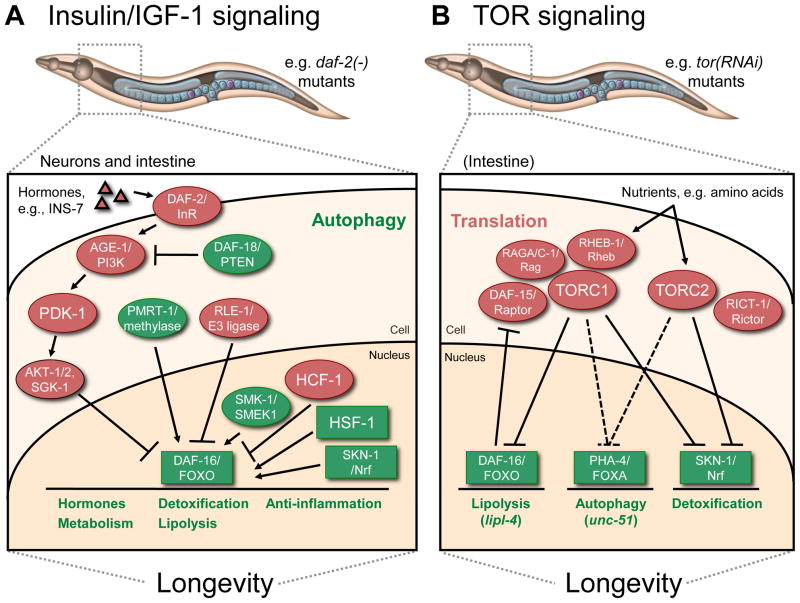
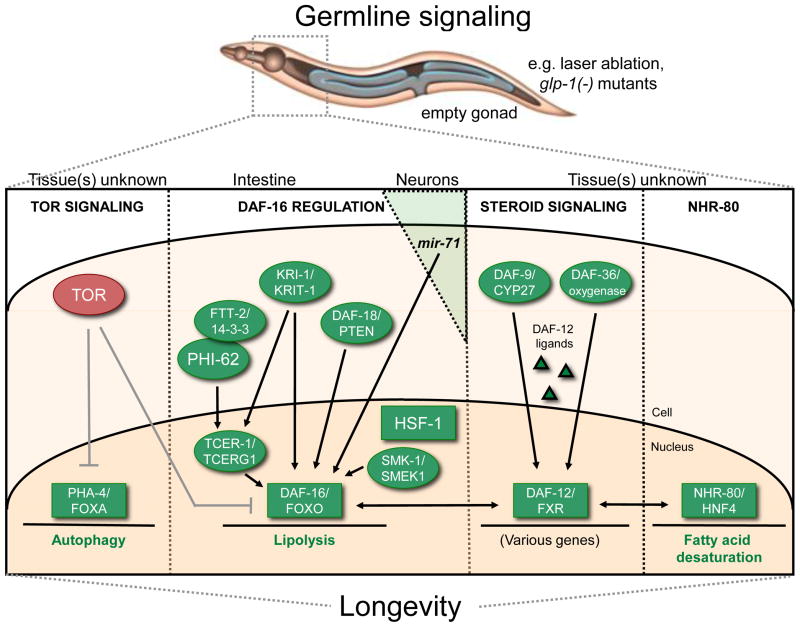
Recent research using model organisms such as the nematode Caenorhabditis elegans has highlighted a crucial role for several conserved signaling pathways in longevity determination. Here, we review three major endocrine- and nutrient-sensing signaling pathways with influence on lifespan, the insulin/insulin-like growth factor (IGF), target of rapamycin (TOR), and germline signaling pathways. Although these pathways engage distinct sets of transcription factors, the three pathways appear to modulate aging in C. elegans through partially overlapping effector mechanisms, including lipid metabolism and autophagy. This review highlights the latest advances in our understanding of how the insulin/IGF-1, TOR, and germline signaling pathways utilize different transcription factors to modulate aging in C. elegans with special emphasis on the role of lipid metabolism and autophagy.
Copyright © 2012 Elsevier Ltd. All rights reserved.
Figures
References
-
- Panowski SH, Dillin A. Signals of youth: endocrine regulation of aging in Caenorhabditis elegans. Trends Endocrinol Metab. 2009;20:259–264. - PubMed
-
- Kenyon C, Chang J, Gensch E, Rudner A, Tabtiang R. A C. elegans mutant that lives twice as long as wild type [see comments] Nature. 1993;366:461–464. - PubMed
-
- Kenyon CJ. The genetics of ageing. Nature. 2010;464:504–512. - PubMed
Publication types
MeSH terms
Substances
Grants and funding
LinkOut - more resources
Full Text Sources
