Artemisinin-resistant Plasmodium falciparum in Pursat province, western Cambodia: a parasite clearance rate study
- PMID: 22940027
- PMCID: PMC3786328
- DOI: 10.1016/S1473-3099(12)70181-0
Artemisinin-resistant Plasmodium falciparum in Pursat province, western Cambodia: a parasite clearance rate study
Abstract
Background: Artemisinin-resistant Plasmodium falciparum has been reported in Pailin, western Cambodia, detected as a slow parasite clearance rate in vivo. Emergence of this phenotype in western Thailand and possibly elsewhere threatens to compromise the effectiveness of all artemisinin-based combination therapies. Parasite genetics is associated with parasite clearance rate but does not account for all variation. We investigated contributions of both parasite genetics and host factors to the artemisinin-resistance phenotype in Pursat, western Cambodia.
Methods: Between June 19 and Nov 28, 2009, and June 26 and Dec 6, 2010, we enrolled patients aged 10 years or older with uncomplicated falciparum malaria, a density of asexual parasites of at least 10,000 per μL of whole blood, no symptoms or signs of severe malaria, no other cause of febrile illness, and no chronic illness. We gave participants 4 mg/kg artesunate at 0, 24, and 48 h, 15 mg/kg mefloquine at 72 h, and 10 mg/kg mefloquine at 96 h. We assessed parasite density on thick blood films every 6 h until undetectable. The parasite clearance half-life was calculated from the parasite clearance curve. We genotyped parasites with 18 microsatellite markers and patients for haemoglobin E, α-thalassaemia, and a mutation of G6PD, which encodes glucose-6-phosphate dehydrogenase. To account for the possible effects of acquired immunity on half-life, we used three surrogates for increased likelihood of exposure to P falciparum: age, sex, and place of residence. This study is registered with ClinicalTrials.gov, number NCT00341003.
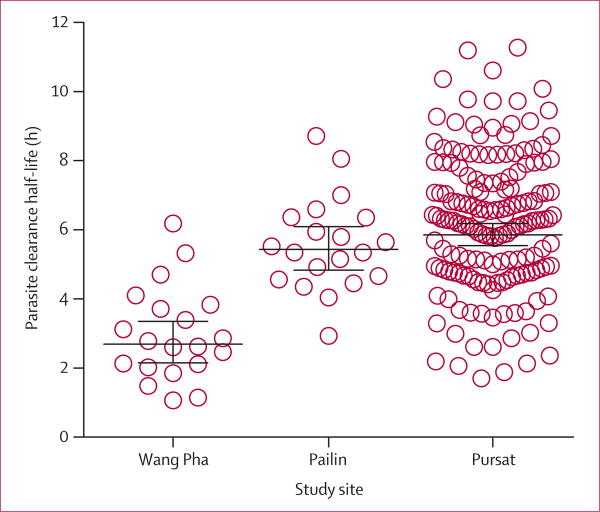
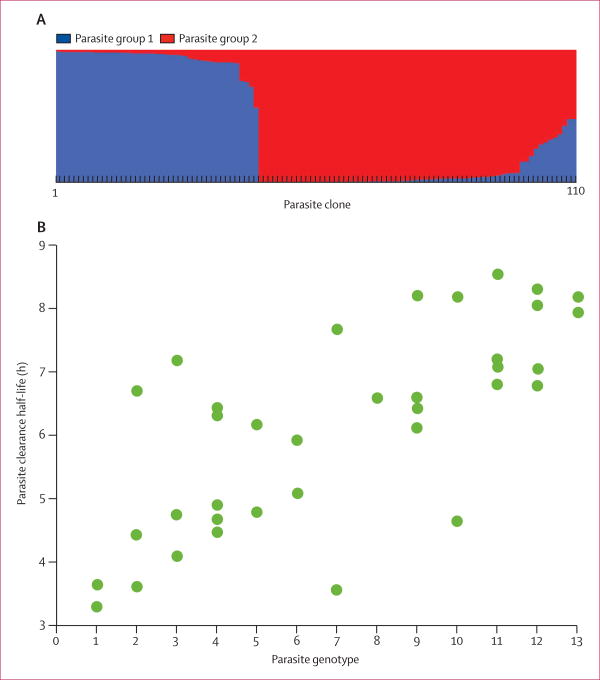
Findings: We assessed 3504 individuals from all six districts of Pursat province seeking treatment for malaria symptoms. We enrolled 168 patients with falciparum malaria who met inclusion criteria. The geometric mean half-life was 5·85 h (95% CI 5·54-6·18) in Pursat, similar to that reported in Pailin (p=0·109). We identified two genetically different parasite clone groups: parasite group 1 (PG1) and parasite group 2 (PG2). Non-significant increases in parasite clearance half-life were seen in patients with haemoglobin E (0·55 h; p=0·078), those of male sex (0·96 h; p=0·064), and in 2010 (0·68 h; p=0·068); PG1 was associated with a significant increase (0·79 h; p=0·033). The mean parasite heritability of half-life was 0·40 (SD 0·17).
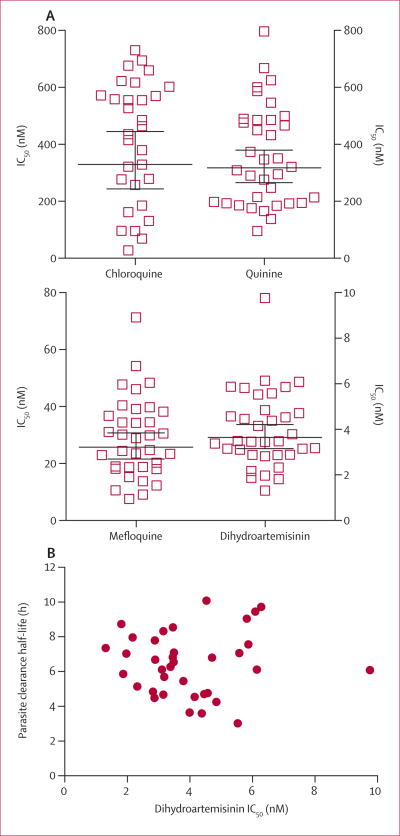
Interpretation: Heritable artemisinin resistance is established in a second Cambodian province. To accurately identify parasites that are intrinsically susceptible or resistant to artemisinins, future studies should explore the effect of erythrocyte polymorphisms and specific immune responses on half-life variation.
Funding: Division of Intramural Research, National Institute of Allergy and Infectious Diseases, National Institutes of Health.
Copyright © 2012 Elsevier Ltd. All rights reserved.
Conflict of interest statement
Figures
Comment in
-
Resistance to artemisinin-based combination therapy.Lancet Infect Dis. 2012 Nov;12(11):820-2. doi: 10.1016/S1473-3099(12)70226-8. Epub 2012 Aug 30. Lancet Infect Dis. 2012. PMID: 22940026 No abstract available.
-
Slow parasite clearance rates in response to artemether in patients with severe malaria.Lancet Infect Dis. 2013 Feb;13(2):113-4. doi: 10.1016/S1473-3099(12)70347-X. Lancet Infect Dis. 2013. PMID: 23347631 Free PMC article. No abstract available.
-
Artemisinin resistance or artemisinin-based combination therapy resistance?Lancet Infect Dis. 2013 Feb;13(2):114-5. doi: 10.1016/S1473-3099(12)70349-3. Lancet Infect Dis. 2013. PMID: 23347632 No abstract available.
-
US Department of Defense contributions to malaria surveillance.Lancet Infect Dis. 2013 Apr;13(4):293-4. doi: 10.1016/S1473-3099(13)70065-3. Lancet Infect Dis. 2013. PMID: 23538221 Free PMC article. No abstract available.
References
-
- WHO. Global plan for artemisinin resistance containment (GPARC) Geneva: World Health Organization; 2011.
-
- National Institute of Statistics. General population census of Cambodia 2008 provisional population totals. [accessed July 28, 2012];2008 Aug; http://www.stat.go.jp/english/info/meetings/cambodia/pdf/pre_rep1.pdf.
Publication types
MeSH terms
Substances
Associated data
Grants and funding
LinkOut - more resources
Full Text Sources
Other Literature Sources
Medical
Research Materials
Miscellaneous