


RECQL4 in genomic instability and aging
- PMID: 22940096
- PMCID: PMC3500627
- DOI: 10.1016/j.tig.2012.08.003
RECQL4 in genomic instability and aging
Abstract
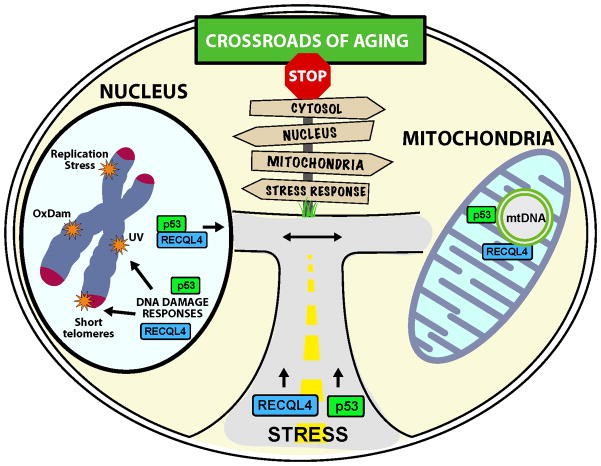
Helicases are ubiquitous proteins that unwind DNA and participate in DNA metabolism including replication, repair, transcription, and chromatin organization. The highly conserved RecQ helicase family proteins are important in these transactions and have been termed the guardians of the genome. Humans have five members of this family: WRN, BLM, RECQL4, RECQL1, and RECQL5. The first three of are associated with premature aging and cancer prone syndromes, but the latter two proteins have not yet been implicated in any human disease. Although WRN and BLM have been fairly well characterized, RECQL4 has only recently been intensively investigated. The sum of this work to date has shown that RECQL4 has helicase activity and localizes to telomeres and mitochondria. In addition, new protein partners are emerging, implicating RECQL4 in novel processes. Here, we describe these recent findings which place RECQL4 at the crossroads of genomic instability and aging processes.
Published by Elsevier Ltd.
Figures
References
-
- Wang LL, et al. Association between osteosarcoma and deleterious mutations in the RECQL4 gene in Rothmund-Thomson syndrome. J Natl Cancer Inst. 2003;95:669–674. - PubMed
-
- Larizza L, et al. Rothmund-Thomson syndrome and RECQL4 defect: splitting and lumping. Cancer Lett. 2006;232:107–120. - PubMed
-
- Kitao S, et al. Rothmund-thomson syndrome responsible gene, RECQL4: genomic structure and products. Genomics. 1999;61:268–276. - PubMed
Publication types
MeSH terms
Substances
Grants and funding
LinkOut - more resources
Full Text Sources
Medical
