


The impact of bystanding to workplace bullying on symptoms of depression among women and men in industry in Sweden: an empirical and theoretical longitudinal study
- PMID: 22940902
- PMCID: PMC3722445
- DOI: 10.1007/s00420-012-0813-1
The impact of bystanding to workplace bullying on symptoms of depression among women and men in industry in Sweden: an empirical and theoretical longitudinal study
Abstract
Background: Prospective studies on bystanding to workplace bullying and the health outcomes are scarce.
Aim: To investigate the work environmental risk factors of depressive symptoms among bystanders to bullying in both women and men in four large industrial organizations in Sweden.
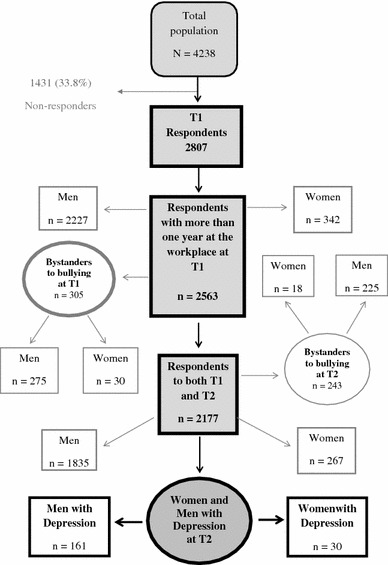
Method: The number of respondents at four large industrial enterprises with more than one year at the workplace at T1: n = 2,563 (Women: n = 342; Men: n = 2,227). Bystanders to bullying at T1: n = 305 (Women: n = 30; Men: n = 275). The total number of those with symptoms of depression at T2: Women: n = 30; Men: n = 161. Two thousand one hundred and seventy-seven employees answered the questionnaire on T1 and T2 with an 18-month interval. "To have depressive symptoms" was defined as not having depressive symptoms at T1 but having depressive symptoms at T2.
Results: The number of men who were bystanders to bullying was larger compared to women. However, the proportion of women who were bystanders to bullying and developed depressive symptoms 18 months later was higher in comparison with men (33.3 and 16.4 %, respectively). Further, "Being a bystander to bullying" 1.69 (1.13-2.53), "Rumors of changes in the workplace" 1.53 (1.10-2.14), "Reduced role clarity" 2.30 (1.21-4.32), "Lack of appreciation of being in the group" 1.76 (1.22-2.53) increased the risk of future symptoms of depression. "Job Strain" was not an adjusted risk factor for depression.
Conclusion: Our results support previous findings that bystanding to workplace bullying is related to future depressive symptoms.
Figures
Comment in
-
Can observations of workplace bullying really make you depressed? A response to Emdad et al.Int Arch Occup Environ Health. 2013 Aug;86(6):717-21. doi: 10.1007/s00420-013-0868-7. Epub 2013 Mar 30. Int Arch Occup Environ Health. 2013. PMID: 23543007
-
Comment on "can observations of workplace bullying really make you depressed? A response to Emdad et al. 2013" by Nielsen and Einarsen.Int Arch Occup Environ Health. 2013 Aug;86(6):723-4. doi: 10.1007/s00420-013-0869-6. Epub 2013 Mar 30. Int Arch Occup Environ Health. 2013. PMID: 23543008 No abstract available.
References
-
- Barling J. The prediction, experience and consequences of workplace violence. In: VanderBos GR, Bulatoao EQ, editors. Violence on the job. Washington: American Psychological Association; 1996. pp. 29–50.
-
- Beale D, Hoel H. Workplace bullying, industrial relations and the challenge for management in Britain and Sweden. Eur J Ind Relat. 2010;16(2):101–118. doi: 10.1177/0959680110364826. - DOI
-
- Bergstrom G, Bjorklund C, Fried I, Lisspers J, Nathell L, Hermansson U, et al. A comprehensive workplace intervention and its outcome with regard to lifestyle, health and sick leave: the AHA study. Work. 2008;31(2):167–180. - PubMed
-
- Bhui K, Stansfeld S, McKenzie K, Karlsen S, Nazroo J, Weich S. Racial/ethnic discrimination and common mental disorders among workers: findings from the EMPIRIC Study of Ethnic Minority Groups in the United Kingdom. Am J Public Health. 2005;95(3):496–501. doi: 10.2105/AJPH.2003.033274. - DOI - PMC - PubMed
Publication types
MeSH terms
LinkOut - more resources
Full Text Sources
Medical
