


doi: 10.1038/nchembio.1048.
Cytochrome P450–catalyzed L-tryptophan nitration in thaxtomin phytotoxin biosynthesis
Affiliations
- PMID: 22941045
- PMCID: PMC3522571
- DOI: 10.1038/nchembio.1048
Item in Clipboard
Cytochrome P450–catalyzed L-tryptophan nitration in thaxtomin phytotoxin biosynthesis
Nat Chem Biol.
2012 Oct.
Abstract
Thaxtomin phytotoxins produced by plant-pathogenic Streptomyces species contain a nitro group that is essential for phytotoxicity. The N,N'-dimethyldiketopiperazine core of thaxtomins is assembled from L-phenylalanine and L-4-nitrotryptophan by a nonribosomal peptide synthetase, and nitric oxide synthase-generated NO is incorporated into the nitro group, but the biosynthesis of the nonproteinogenic amino acid L-4-nitrotryptophan is unclear. Here we report that TxtE, a unique cytochrome P450, catalyzes L-tryptophan nitration using NO and O(2).
Figures
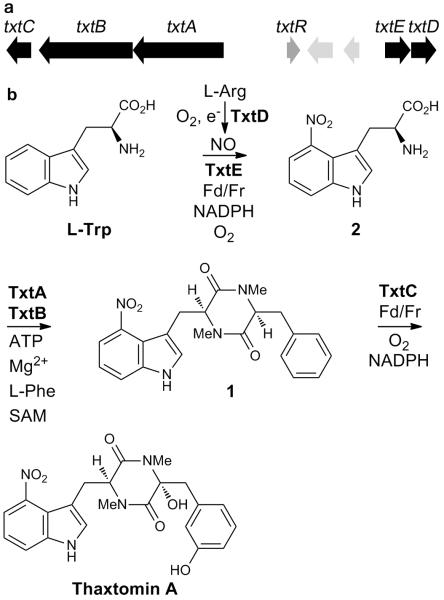
Thaxtomin biosynthesis. a: Organization of the thaxtomin biosynthetic gene cluster in S. turgidiscabies. Biosynthetic genes are in black; txtR, which encodes a cellobiose-responsive pathway specific activator, is in dark gray; two genes encoding putative transposases are in light gray. The txtAB genes encode nonribosomal peptide synthetases. The txtC and txtE genes encode CYPs. The txtD gene encodes a NOS that produces NO from L-arginine. b: Proposed pathway for thaxtomin A biosynthesis.
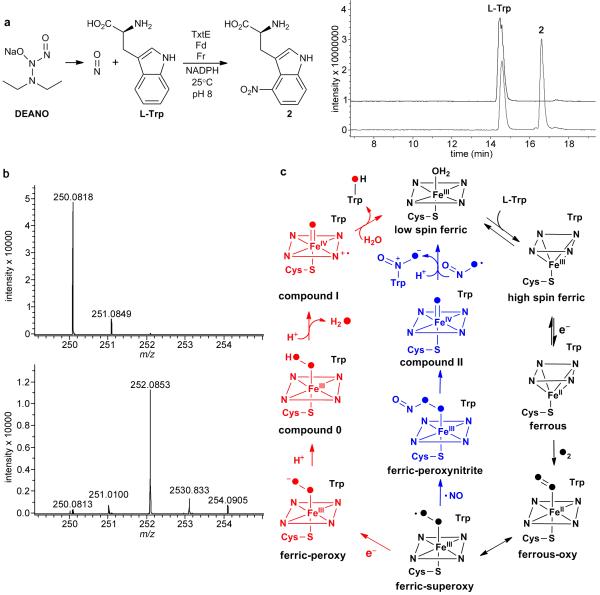
Characterization of purified recombinant TxtE. a: Extracted ion chromatograms at m/z = 204 and 250 (right) from LC-MS analyses of the enzymatic nitration reaction (left). The bottom chromatogram is from the enzymatic reaction and the top chromatogram is from a negative control containing boiled TxtE. b: High resolution mass spectra of L-4-nitrotryptophan obtained from incubation of L-tryptophan with TxtE, DEANO, ferredoxin, ferredoxin reductase and NADPH in air (top spectrum), and in an 18O2 atmosphere (bottom spectrum). The m/z = 250.0818 ion corresponds to [M+H]+ for L-4-nitrotryptophan. An ion corresponding to [M+H]+ for L-4-nitrotryptophan containing a single 18O label (m/z calculated for C11H12N3O +4: 252.0865; found: 252.0853) predominates (>90%) in the bottom spectrum c: Comparison of the proposed mechanism of TxtE-catalyzed nitration and the mechanism of CYP-catalyzed hydroxylation. Intermediates that differ in CYP-catalyzed hydroxylation and nitration are highlighted in red and blue, respectively. Common intermediates are black. The atoms of O2 are filled to illustrate their fate in the reactions.
References
Publication types
MeSH terms
Substances
Grants and funding
LinkOut - more resources
Full Text Sources
Other Literature Sources
Molecular Biology Databases
