. 2012 Oct;8(10):862-9.
doi: 10.1038/nchembio.1064.

The physical state of lipid substrates provides transacylation specificity for tafazzin

Affiliations

The physical state of lipid substrates provides transacylation specificity for tafazzin

Michael Schlame et al. Nat Chem Biol. 2012 Oct.

Abstract

Cardiolipin is a mitochondrial phospholipid with a characteristic acyl chain composition that depends on the function of tafazzin, a phospholipid-lysophospholipid transacylase, although the enzyme itself lacks acyl specificity. We incubated isolated tafazzin with various mixtures of phospholipids and lysophospholipids, characterized the lipid phase by (31)P-NMR and measured newly formed molecular species by MS. Substantial transacylation was observed only in nonbilayer lipid aggregates, and the substrate specificity was highly sensitive to the lipid phase. In particular, tetralinoleoyl-cardiolipin, a prototype molecular species, formed only under conditions that favor the inverted hexagonal phase. In isolated mitochondria, <1% of lipids participated in transacylations, suggesting that the action of tafazzin was limited to privileged lipid domains. We propose that tafazzin reacts with non-bilayer-type lipid domains that occur in curved or hemifused membrane zones and that acyl specificity is driven by the packing properties of these domains.


Figures
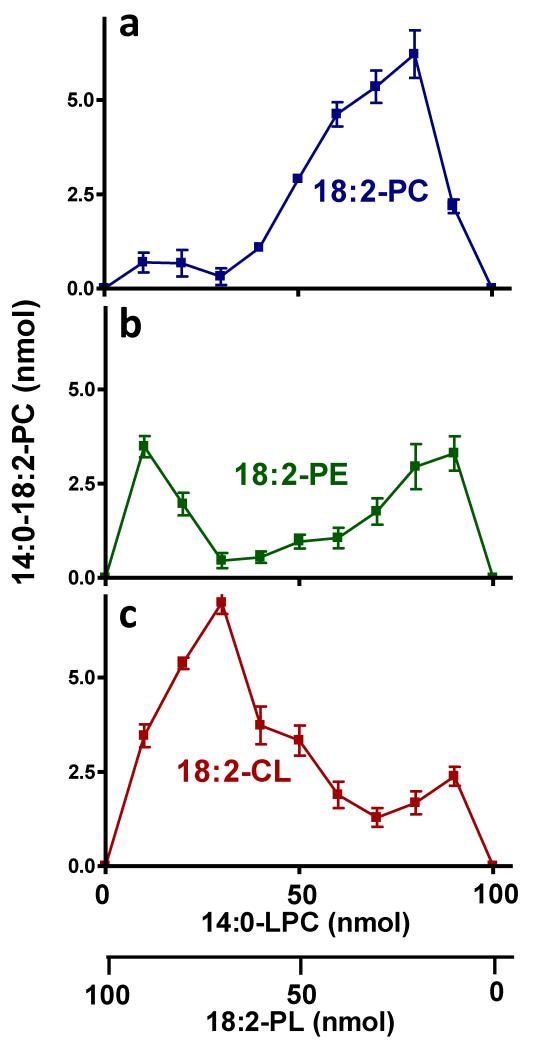
Figure 1
Figure 1. Transacylations are affected by the PL/LPL ratio
Incubations were performed with purified tafazzin, 14:0-LPC, and the indicated PL. The PL/LPC ratio was varied while maintaining a total amount of PL+LPC of 100 nmol. PLs included 18:2-18:2-PC, 18:2-18:2-PE, and bovine heart CL. The amount of transacylation product formed depends on the PL/LPC ratio.
Figure 2
Figure 2. Transacylations in PC/LPC mixtures
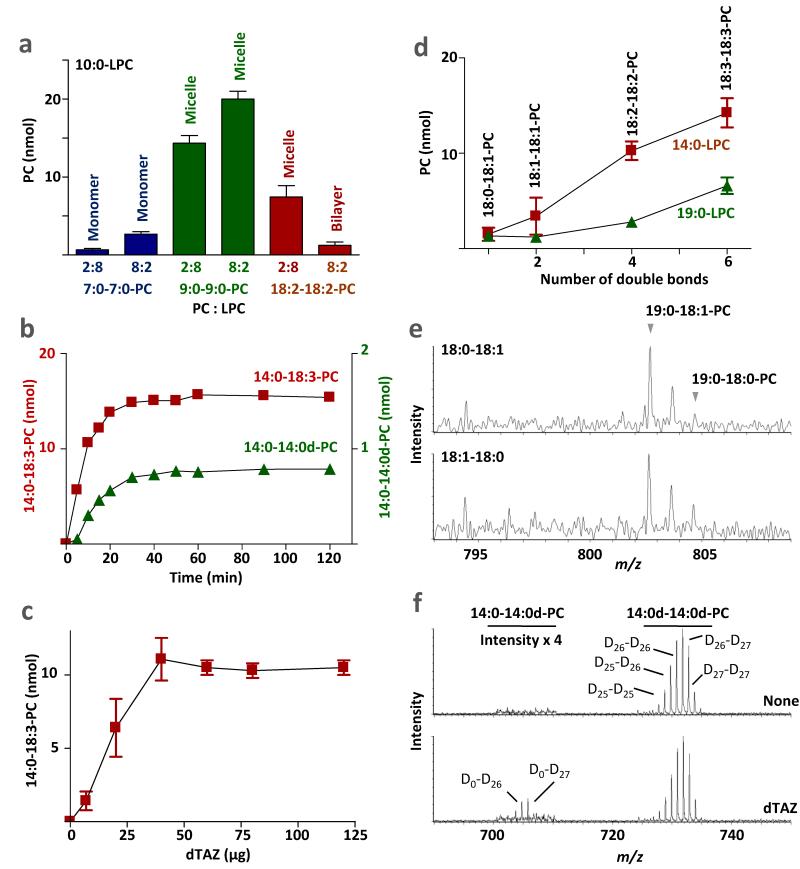
(a) Tafazzin reacts with micelles but not with monomers or bilayers. Different PC species were incubated with 10:0-LPC at the indicated PC:LPC ratio and the concentrations of new PC species were determined. Based on their critical micellar concentration, 10:0-LPC/7:0-7:0-PC mixtures are predicted to form monomers, 10:0-LPC/9:0-9:0-PC mixtures are predicted to form micelles, and 10:0-LPC/18:2-18:2-PC mixtures are predicted to form micelles or bilayers, respectively. (b) Transacylations reached the equilibrium state after about 30 min. Time progression is shown of the reaction between 80 nmol of 14:0-LPC and 20 nmol of either 18:3-18:3-PC or 14:0d-14:0d-PC (14:0d, deuterated 14:0). (c) The concentration of 14:0-18:3-PC at equilibrium depends on the amount of enzyme. 18:3-18:3-PC and 14:0-LPC (2:8) reacted in the presence of different amounts of dTAZ. Saturation was reached at 40 μg dTAZ, corresponding to 1 molecule of enzyme per 200 molecules of substrate. (d) Transacylation is promoted by unsaturation and short acyl chains. A series of C18 PC species was incubated either with 14:0-LPC or with 19:0-LPC (PC:LPC=2:8), and newly formed PC species were measured. (e) Only 18:1 but not 18:0 is transferred from 18:0-18:1-PC to 19:0-LPC. The mass spectra show transacylation products formed from 80 nmol 19:0-LPC and 20 nmol 18:0-18:1-PC. Two PC isomers were tested, having either 18:0 in sn-1 position and 18:1 in sn-2 position (18:0-18:1) or vice versa (18:1-18:0). In either case, only 18:1 was transferred, forming 19:0-18:1-PC but not 19:0-18:0-PC. (f) Tafazzin forms 14:0-14:0d-PC from 14:0-LPC and 14:0d-14:0d-PC (PC:LPC=2:8). Mass spectra show PC species in the presence (dTAZ) or absence (None) of enzyme. Note that the substrate 14:0d-14:0d-PC consists of several species each having a different number of deuterium atoms.
Figure 3
Figure 3. Transacylations of CL but not of PE and PG are affected by Ca2+
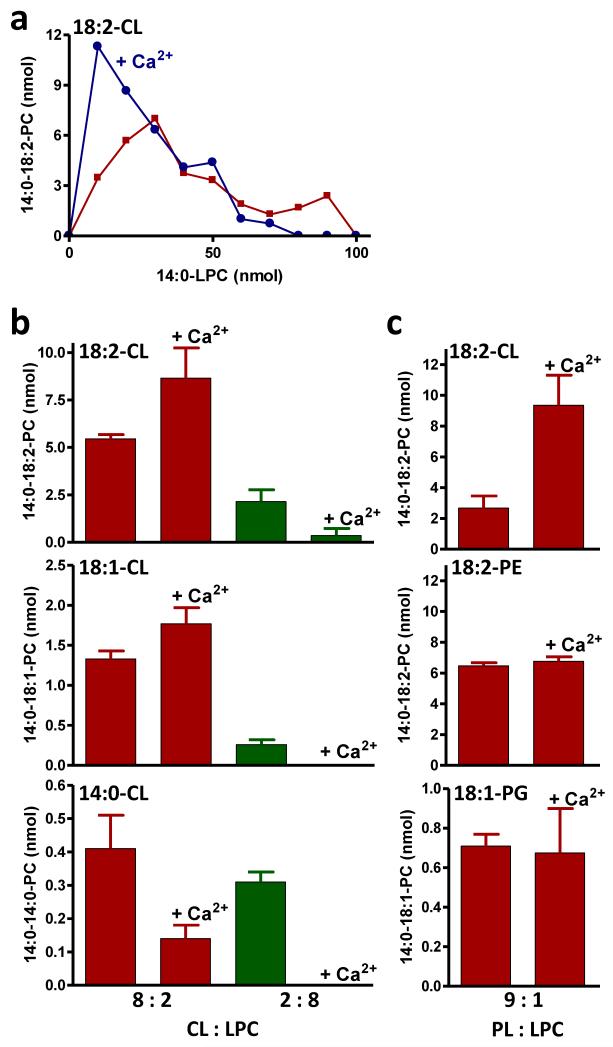
Incubations were performed in the presence of purified tafazzin, 14:0-LPC, and the indicated PL with or without 20 mM CaCl2. The proportion of PL and LPC was varied while keeping the total amount of lipids at 100 nmol. (a) Ca2+ increases CL-LPC transacylation at low LPC concentration and decreases CL-LPC transacylation at high LPC concentration. (b) The effect of Ca2+ depends on the acyl groups of CL. (c) Ca2+ has an effect on CL-LPC transacylation but not on PE-LPC and PG-LPC transacylation.
Figure 4
Figure 4. Transition into the hexagonal phase state induces acyl specificity
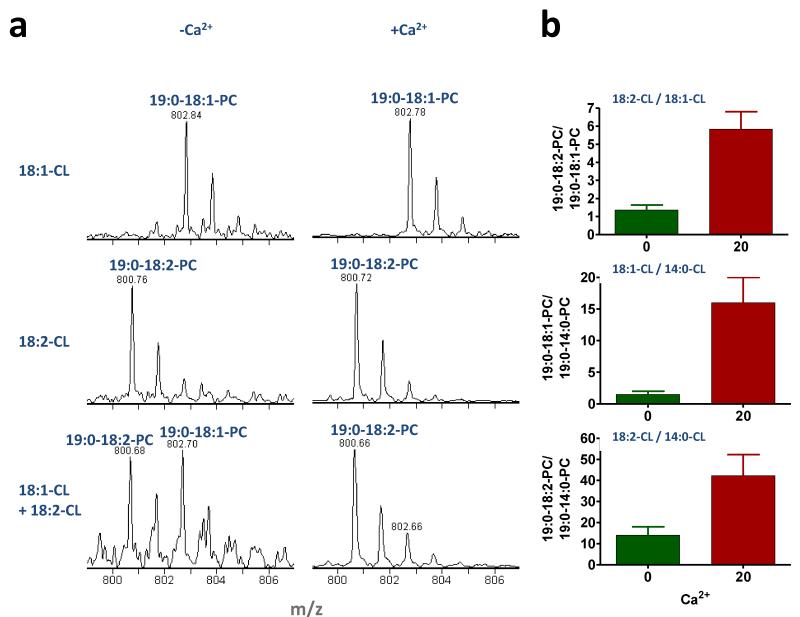
Incubations contained purified tafazzin, CL (various molecular species), and 19:0-LPC (CL:LPC=9:1). Mixtures of two CL species were supplied at a molar ratio of 1:1. CaCl2 was added at a concentration of 20 mM in order to convert lipids to the hexagonal phase. (a) Mass spectra demonstrate the composition of PC species produced by transacylation. In the presence of Ca2+, the transacylation becomes 18:2-specific. (b) Bar graphs show the ratios of PC species formed by the indicated pairs of CL species in the absence and presence of Ca2+. The data document that addition of Ca2+ alters acyl specificity.
Figure 5
Figure 5. Acyl-specific CL-PC remodeling in vitro
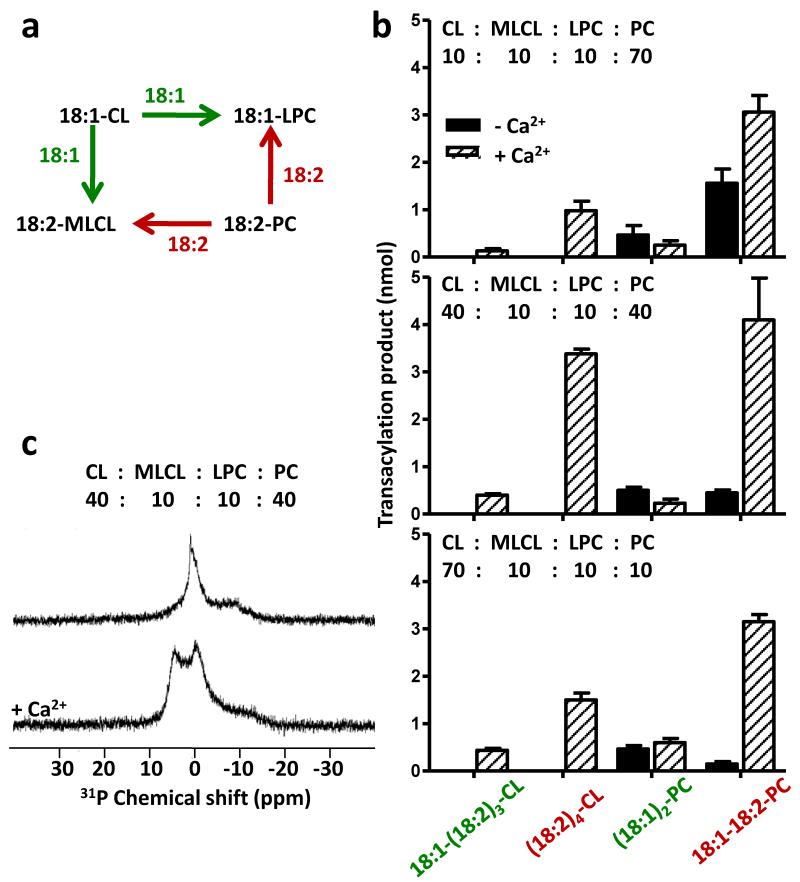
Model membranes were produced from a mixture of (18:1)4-CL, (18:2)3-MLCL, 18:1-LPC, and (18:2)2-PC in various proportions. Lipids were sonicated in aqueous buffer with and without CaCl2 followed by incubation in the presence of tafazzin. (a) The scheme shows the competing transacylation reactions of this experiment. Linoleoyl groups (18:2) can be transferred from PC to MLCL producing (18:2)4-CL, or from PC to LPC producing 18:1-18:2-PC. Oleoyl groups (18:1) can be transferred from CL to MLCL producing 18:1-(18:2)3-CL, or from CL to LPC producing (18:1)2-PC. (b) The bar graphs show the yields of four transacylation products formed either in the absence (black columns) or in the presence (hatched columns) of CaCl2. A complete list of all transacylation products is shown in Supplementary Table 3. (c) Static 31P NMR spectra were recorded of a mixture of (18:1)4-CL, (18:2)3-MLCL, 18:1-LPC, and (18:2)2-PC (40: 10: 10: 40). In the absence of Ca2+, the line shape indicates a phase that is primarily lamellar (low field shoulder). Addition of Ca2+ reversed the peak asymmetry, suggesting that a significant portion of the lipids were now in the hexagonal phase. Both the lamellar and the hexagonal phase contained an additional component with isotropic characteristics and a chemical shift close to 0 ppm.
Figure 6
Figure 6. Tafazzin and lipid packing
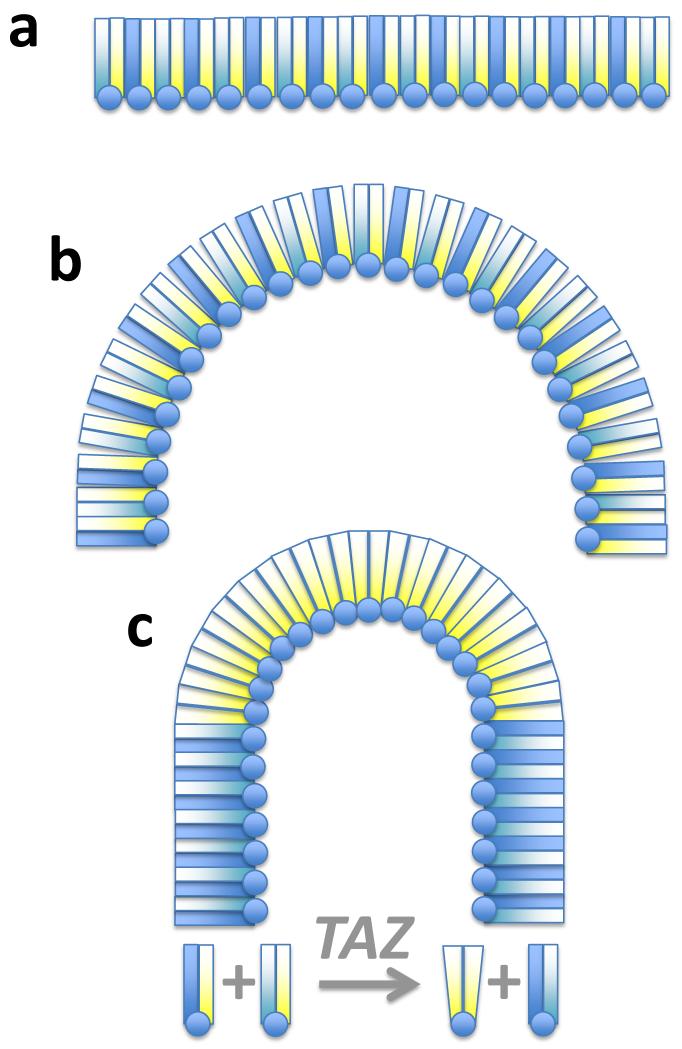
The cartoon shows our current model of how tafazzin acts on mitochondrial membranes. (a) Bilayer-prone PLs form stable arrangements of tightly packed lipid molecules. PL head groups are depicted as circles and fatty acids as color-coded rectangles. Blue and cyan represent saturated residues and yellow represents unsaturated residues. Only one leaflet of the lipid bilayer is shown. (b) Bending of the membrane will disturb the packing order of bilayer PLs, which is thermodynamically unfavorable but may facilitate intermixing with LPLs, a requirement for the tafazzin reaction. (c) In the presence of tafazzin (TAZ), transacylations will reshuffle the acyl residues in order to optimize lipid packing. In this example, diunsaturated PLs (yellow-yellow) are formed because they promote negative curvature due to their shape. We propose that highly curved membranes promote the reaction of tafazzin and tafazzin, in turn, stabilizes curvature.

Comment in

  • Tafazzin senses curvature.
    Gawrisch K. Gawrisch K. Nat Chem Biol. 2012 Oct;8(10):811-2. doi: 10.1038/nchembio.1068. Nat Chem Biol. 2012. PMID: 22987008 Free PMC article.

References

    1. Ma L, Vaz FM, Gu Z, Wanders RJA, Greenberg ML. The human TAZ gene complements mitochondrial dysfunction in the yeast taz1Δ mutant. Implications for Barth syndrome. J. Biol. Chem. 2004;279:44394–44399. - PubMed
    1. Testet E, et al. Ypr140wp, ‘the yeast tafazzin’, displays a mitochondrial lysophosphatidylcholine (lyso-PC) acyltransferase activity related to triacylglycerol and mitochondrial lipid synthesis. Biochem. J. 2005;387:617–626. - PMC - PubMed
    1. Claypool SM, McCaffery JM, Koehler CM. Mitochondrial mislocalization and altered assembly of a cluster of Barth syndrome mutant tafazzins. J. Cell Biol. 2006;174:379–390. - PMC - PubMed
    1. Xu Y, et al. Characterization of tafazzin splice variants from humans and fruit flies. J. Biol. Chem. 2009;284:29230–29239. - PMC - PubMed
    1. Xu Y, Malhotra A, Ren M, Schlame M. The enzymatic function of tafazzin. J. Biol. Chem. 2006;281:39217–39224. - PubMed

Publication types