. 2012 Nov;78(22):7946-53.
doi: 10.1128/AEM.02053-12. Epub 2012 Aug 31.

Characterization and two-dimensional crystallization of membrane component AlkB of the medium-chain alkane hydroxylase system from Pseudomonas putida GPo1

Affiliations

Characterization and two-dimensional crystallization of membrane component AlkB of the medium-chain alkane hydroxylase system from Pseudomonas putida GPo1

Hernan Alonso et al. Appl Environ Microbiol. 2012 Nov.

Abstract

The alkane hydroxylase system of Pseudomonas putida GPo1 allows it to use alkanes as the sole source of carbon and energy. Bacterial alkane hydroxylases have tremendous potential as biocatalysts for the stereo- and regioselective transformation of a wide range of chemically inert unreactive alkanes into valuable reactive chemical precursors. We have produced and characterized the first 2-dimensional crystals of the integral membrane component of the P. putida alkane hydroxylase system, the nonheme di-iron alkane monooxygenase AlkB. Our analysis reveals for the first time that AlkB reconstituted into a lipid bilayer forms trimers. Addition of detergents that do not disrupt the AlkB oligomeric state (decyl maltose neopentyl glycol [DMNG], lauryl maltose neopentyl glycol [LMNG], and octaethylene glycol monododecyl ether [C(12)E(8)]) preserved its activity at a level close to that of the detergent-free control sample. In contrast, the monomeric form of AlkB produced by purification in n-decyl-β-D-maltopyranoside (DM), n-dodecyl-β-D-maltopyranoside (DDM), octyl glucose neopentyl glycol (OGNG), and n-dodecyl-N,N-dimethylamine-N-oxide (LDAO) was largely inactive. This is the first indication that the physiologically active form of membrane-embedded AlkB may be a multimer. We present for the first time experimental evidence that 1-octyne acts as a mechanism-based inhibitor of AlkB. Therefore, despite the lack of any significant full-length sequence similarity with members of other monooxygenase classes that catalyze the terminal oxidation of alkanes, AlkB is likely to share a similar catalytic mechanism.


Figures
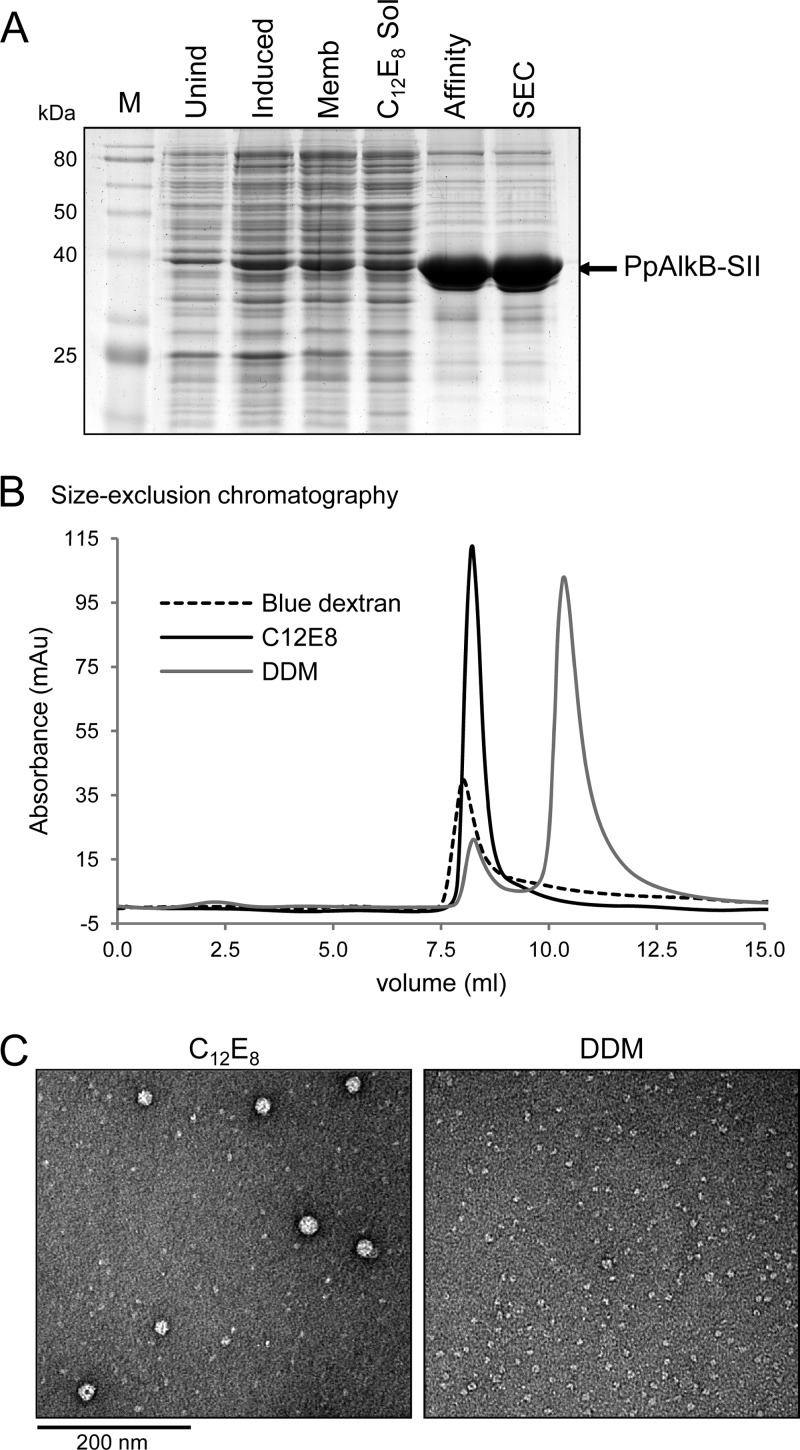
Fig 1
Fig 1
Purification of PpAlkB-SII. (A) SDS-PAGE analysis of the purification process: M, marker; Unind, uninduced total cell lysate sample; Induced, induced sample; Memb, membrane fraction of the induced sample; C12E8 Sol, C12E8-solubilized fraction; Affinity, eluate from the MacroPrep StrepTactin column; SEC, pooled peak fraction from the size exclusion chromatography step. (B) Size exclusion chromatography elution profiles of blue dextran, and C12E8- and DDM-purified PpAlkB-SII. (C) TEM images of negatively stained DDM- and C12E8-purified PpAlkB-SII (for DDM, the second [main] peak from the size exclusion chromatography step was used for this analysis).
Fig 2
Fig 2
Detergent-free purification of PpAlkB-SII. (A) SDS-PAGE analysis of the purification process: M, marker; Total, total membrane fraction; Urea, soluble protein after urea treatment; Unb, unbound (flowthrough) fraction from the MacroPrep StrepTactin column; Purif, final purified PpAlkB-SII protein. (B) TEM image of negatively stained detergent-free purified PpAlkB-SII.
Fig 3
Fig 3
Circular dichroism spectra of DDM- and C12E8-purified PpAlkB-SII at a concentration of 0.1 mg/ml. The secondary structure content calculated from these data using the DichroWeb server and the K2D program is shown in the table below the spectra.
Fig 4
Fig 4
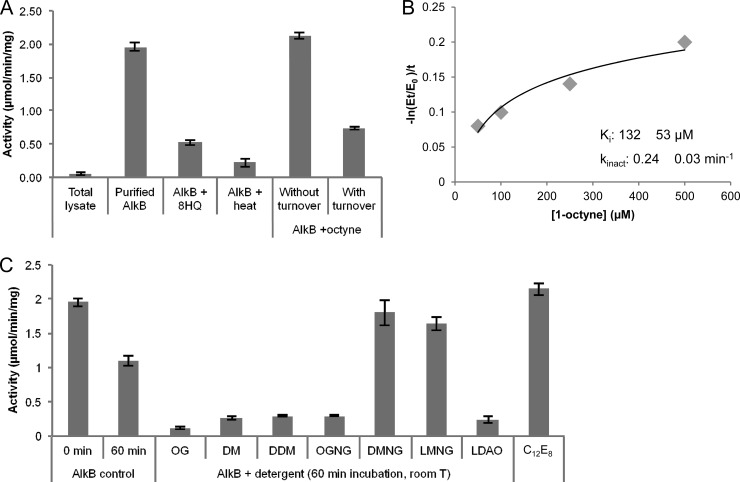
Functional characterization of PpAlkB-SII. The hydroxylation of n-octane by the PpAlkB-SII/Rd/RR system was followed spectrophotometrically by measuring the coupled NADH consumption. Results are the averages from three independent replicates, and error bars show the standard deviations. (A) The initial n-octane hydroxylase activity of the whole-cell lysate (0.05 ± 0.02 μmol/min/mg total protein) (total lysate) increased ∼40-fold after protein purification (1.95 ± 0.05 μmol/min/mg purified PpAlkB-SII) (purified AlkB). Preincubation of PpAlkB-SII with a 1 mM concentration of the inhibitor 8-hydroxyquinoline (AlkB + 8HQ) or PpAlkB-SII inactivation by heat pretreatment at 65°C for 15 min (AlkB + heat) resulted in decreased activity. The effect of 1-octyne on the activity of the PpAlkB-SII/Rd/RR system was studied by adding 0.8 mM 1-octyne under turnover conditions (0.72 μM PpAlkB-SII, 3 μM Rd, 0.6 μM RR, and 200 μM NADH) (with turnover) or without turnover (no NADH). 1-Octyne behaved as a mechanism-based inactivator, inhibiting PpAlkB-SII only under turnover conditions. (B) Determination of the 1-octyne binding affinity (KI) and inactivation rate (kinact) by measuring the remaining activity after preincubation of PpAlkB-SII with different concentrations of 1-octyne under turnover conditions. (C) The effects of different detergents on the activity of PpAlkB-SII were tested by preincubating the detergent-free PpAlkB-SII with 4 CMC of OG, DM, DDM, OGNG, DMNG, LMNG, LDAO, or C12E8 at room temperature for 60 min prior to measuring its n-octane hydroxylase activity in the presence of Rd, RR, and NADH. DMNG, LMNG, and C12E8 preserved activity at a level close to that of the control sample at time zero, thus stabilizing the PpAlkB-SII protein compared to the detergent-free control.
Fig 5
Fig 5
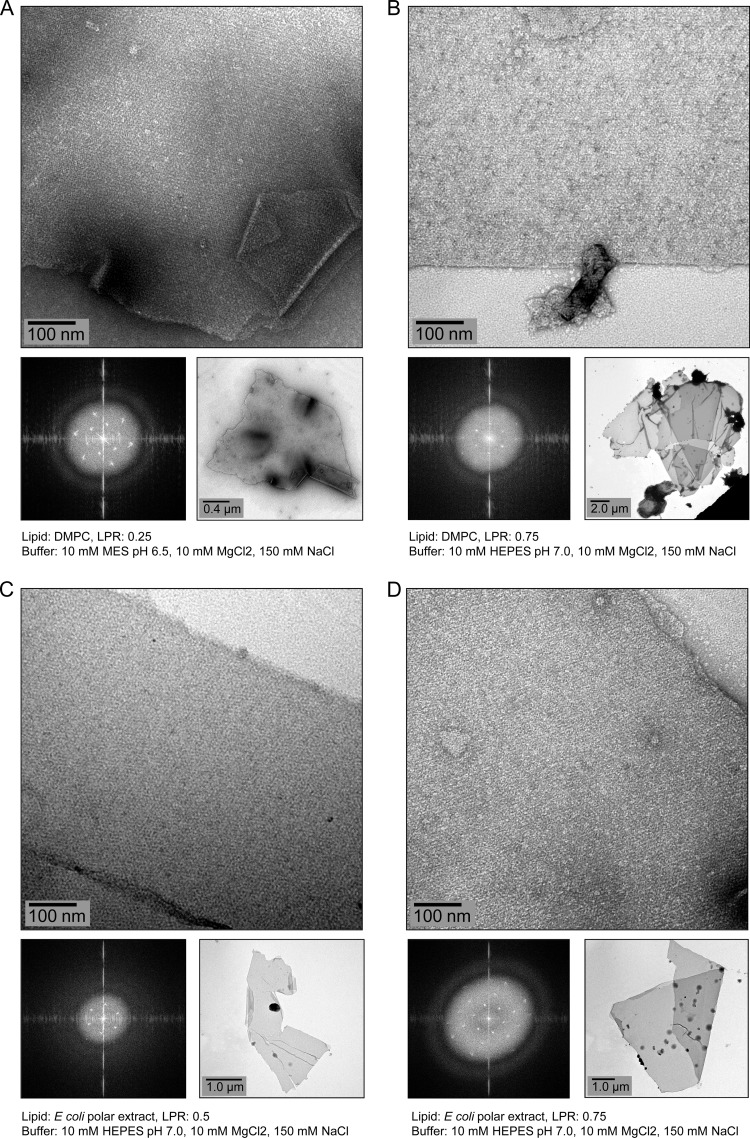
Electron micrographs of negatively stained 2D crystals of membrane-reconstituted PpAlkB-SII obtained after 4 weeks of dialysis of the DDM-purified protein containing DMPC (A and B) or E. coli polar lipids (C and D) against the indicated buffers.
Fig 6
Fig 6
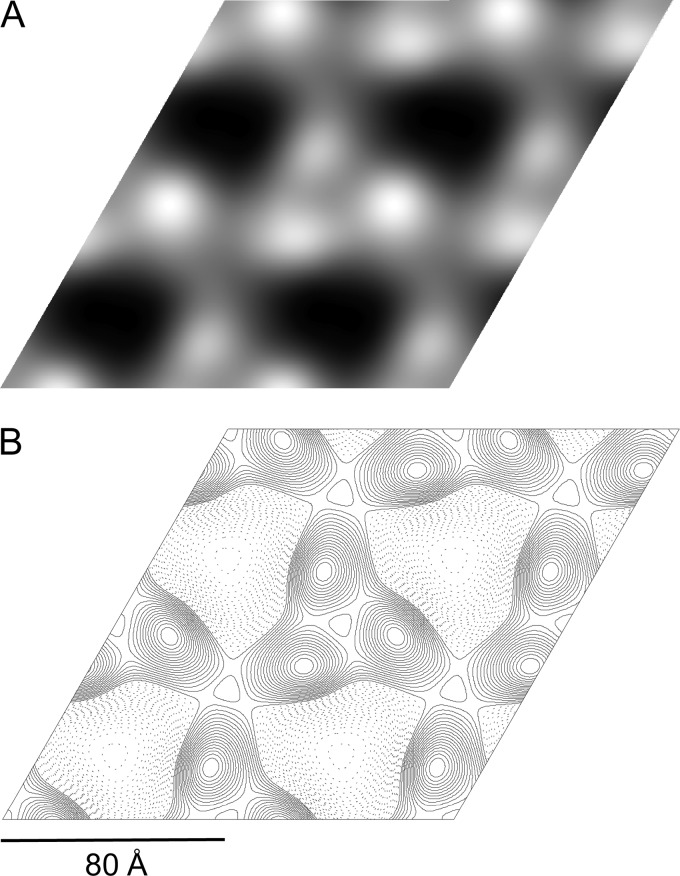
Reconstruction of the 2D PpAlkB-SII crystal. (A) Merged map showing 2-by-2 unit cells (protein is seen as white over a dark background). (B) Reconstruction map after application of p3 symmetry.

References

    1. Ayala M, Torres E. 2004. Enzymatic activation of alkanes: constraints and prospective. Appl. Catal. A 272: 1– 13
    1. Cuff JA, Barton GJ. 2000. Application of multiple sequence alignment profiles to improve protein secondary structure prediction. Proteins 40: 502– 511 - PubMed
    1. Eggink G, Lageveen RG, Altenburg B, Witholt B. 1987. Controlled and functional expression of the Pseudomonas oleovorans alkane utilizing system in Pseudomonas putida and Escherichia coli. J. Biol. Chem. 262: 17712– 17718 - PubMed
    1. Gipson B, Zeng X, Stahlberg H. 2007. 2dx_merge: data management and merging for 2D crystal images. J. Struct. Biol. 160: 375– 384 - PMC - PubMed
    1. Gipson B, Zeng X, Zhang ZY, Stahlberg H. 2007. 2dx—user-friendly image processing for 2D crystals. J. Struct. Biol. 157: 64– 72 - PubMed

Publication types

MeSH terms

LinkOut - more resources