


Therapeutic misconception in research subjects: development and validation of a measure
- PMID: 22942217
- PMCID: PMC3690536
- DOI: 10.1177/1740774512456455
Therapeutic misconception in research subjects: development and validation of a measure
Abstract
Background: Therapeutic misconception (TM), which occurs when research subjects fail to appreciate the distinction between the imperatives of clinical research and ordinary treatment, may undercut the process of obtaining meaningful consent to clinical research participation. Previous studies have found that TM is widespread, but progress in addressing TM has been stymied by the absence of a validated method for assessing its presence.
Purpose: The goal of this study was to develop and validate a theoretically grounded measure of TM, assess its diagnostic accuracy, and test previous findings regarding TM's prevalence.
Methods: A total of 220 participants were recruited from clinical trials at four academic medical centers in the United States. Participants completed a 28-item Likert-type questionnaire to assess the presence of beliefs associated with TM, and a semistructured TM interview designed to elicit their perceptions of the nature of the clinical trial in which they were participating. Data from the questionnaires were subjected to factor analysis, and items with poor factor loadings were excluded. This resulted in a 10-item scale, with three strongly correlated factors and excellent internal consistency; the fit indices of the model across 10 training sets were consistent with the original results, suggesting a stable factor solution.
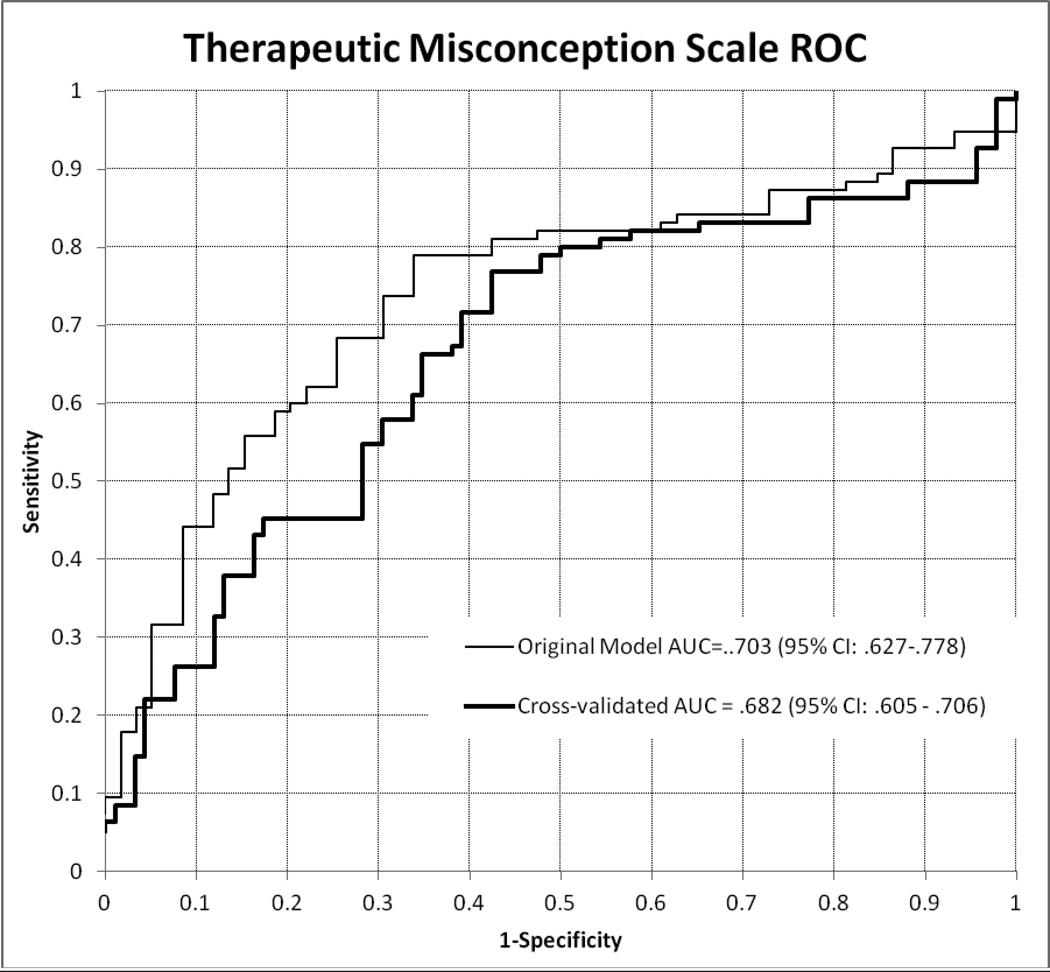
Results: The scale was validated against the TM interview, with significantly higher scores among subjects coded as displaying evidence of TM. Receiver operating curve (ROC) analysis based on a 10-fold internal cross-validation yielded area under the ROC (AUC) = 0.682 for any evidence of TM. When sensitivity (0.72) and specificity (0.61) were both optimized, positive predictive value was 0.65 and negative predictive value was 0.68, with a positive likelihood ratio of 1.89 and a negative likelihood ratio of 0.47. In all, 50.5% (n = 101) of the participants manifested evidence of TM on the TM interview, a somewhat lower rate than in most previous studies.
Limitations: The predictive value of the scale compared with the 'gold standard' clinical interview is modest, although similar to other instruments based on self-report assessing states of mind rather than discrete symptoms. Thus, although the scale can offer evidence of which subjects are at risk for distortions in their decisions and to what degree, it will not allow researchers to conclude definitively that TM is present in a given subject.
Conclusions: The development of a reliable and valid TM scale, even with modest predictive power, should permit investigators in clinical trials to identify subjects with tendencies to misinterpret the nature of the situation and to provide additional information to them. It should also stimulate research on how best to decrease TM and facilitate meaningful informed consent to clinical research.
Comment in
-
Taking the measure of the therapeutic misconception.Clin Trials. 2012 Dec;9(6):762-4; discussion 765-6. doi: 10.1177/1740774512456778. Clin Trials. 2012. PMID: 23250945 No abstract available.
References
-
- Appelbaum PS, Roth LH, Lidz CW, Benson P, Winslade W. False hopes and best data: Consent to research and the therapeutic misconception. Hastings Cent Rep. 1987;17(2):20–24. - PubMed
-
- Appelbaum PS, Lidz CW, Grisso T. Therapeutic misconception in clinical research: frequency and risk factors. IRB Ethics Hum Res. 2004;26(2):1–8. correction and clarification (2004) 26(5):18. - PubMed
-
- Appelbaum PS, Lidz C. The therapeutic misconception. In: Emanuel EJ, Grady C, Crouch RA, Lie RK, Miller FG, Wendler D, editors. The Oxford textbook of clinical research ethics. New York: Oxford University Press; 2008. pp. 633–644.
-
- Henderson GE, Easter MM, Zimmer C, King NMP, Davis AM, et al. Therapeutic misconception in early phase gene transfer trials. Soc Sci Med. 2006;62:239–253. - PubMed
Publication types
MeSH terms
Grants and funding
LinkOut - more resources
Full Text Sources
