


Barriers to the uptake of evidence from systematic reviews and meta-analyses: a systematic review of decision makers' perceptions
- PMID: 22942232
- PMCID: PMC3437427
- DOI: 10.1136/bmjopen-2012-001220
Barriers to the uptake of evidence from systematic reviews and meta-analyses: a systematic review of decision makers' perceptions
Abstract
Objective: To review the barriers to the uptake of research evidence from systematic reviews by decision makers.
Search strategy: We searched 19 databases covering the full range of publication years, utilised three search engines and also personally contacted investigators. Reference lists of primary studies and related reviews were also consulted.
Selection criteria: Studies were included if they reported on the views and perceptions of decision makers on the uptake of evidence from systematic reviews, meta-analyses and the databases associated with them. All study designs, settings and decision makers were included. One investigator screened titles to identify candidate articles then two reviewers independently assessed the quality and the relevance of retrieved reports.
Data extraction: Two reviewers described the methods of included studies and extracted data that were summarised in tables and then analysed. Using a pre-established taxonomy, the barriers were organised into a framework according to their effect on knowledge, attitudes or behaviour.
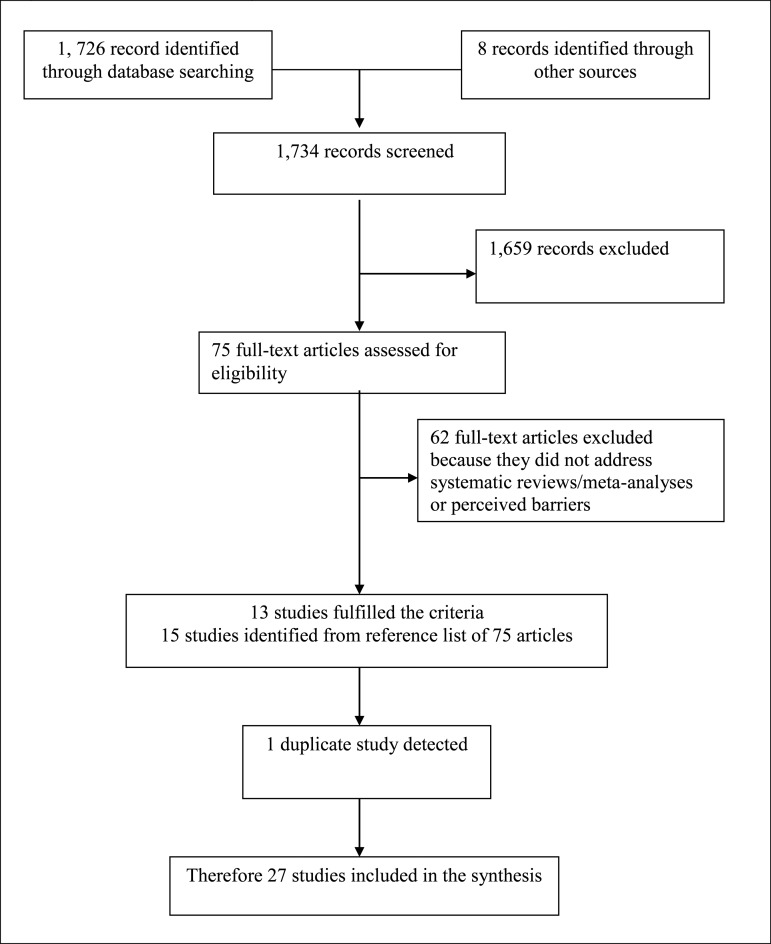
Results: Of 1726 articles initially identified, we selected 27 unique published studies describing at least one barrier to the uptake of evidence from systematic reviews. These studies included a total of 25 surveys and 2 qualitative studies. Overall, the majority of participants (n=10 218) were physicians (64%). The most commonly investigated barriers were lack of use (14/25), lack of awareness (12/25), lack of access (11/25), lack of familiarity (7/25), lack of usefulness (7/25), lack of motivation (4/25) and external barriers (5/25).
Conclusions: This systematic review reveals that strategies to improve the uptake of evidence from reviews and meta-analyses will need to overcome a wide variety of obstacles. Our review describes the reasons why knowledge users, especially physicians, do not call on systematic reviews. This study can inform future approaches to enhancing systematic review uptake and also suggests potential avenues for future investigation.
References
-
- Innvaer S, Vist G, Trommald M, et al. Health policy-makers’ perceptions of their use of evidence: a systematic review. J Health Serv Res Policy 2002;7:239–44 - PubMed
-
- Straus S, Tetroe J, Graham I. Knowledge to action: what it is and what it isn't. In: Straus S, Tetroe J, Graham I, eds. Knowledge translation in health care. UK: Wiley-Blackwell, BMJ Books, 2009
-
- Tetzlaff J, Tricco A, Moher D. Knowledge synthesis. In: Straus S, Tetroe J, Graham I. D, eds. Knowledge translation in health care. UK: Wiley-Blackwell, BMJ Books, 2009
-
- Bennet NL, Casebeer LL, Zheng S, et al. Information seeking behaviours and reflective practice. J Contin Educ Prof 2006;26:120–7 - PubMed
Grants and funding
LinkOut - more resources
Full Text Sources
Miscellaneous
