. 2012 Aug;24(8):3435-46.
doi: 10.1105/tpc.112.102012. Epub 2012 Aug 31.

Ribulose-1,5-bis-phosphate carboxylase/oxygenase accumulation factor1 is required for holoenzyme assembly in maize

Affiliations

Ribulose-1,5-bis-phosphate carboxylase/oxygenase accumulation factor1 is required for holoenzyme assembly in maize

Leila Feiz et al. Plant Cell. 2012 Aug.

Abstract

Most life is ultimately sustained by photosynthesis and its rate-limiting carbon fixing enzyme, ribulose-1,5-bis-phosphate carboxylase/oxygenase (Rubisco). Although the structurally comparable cyanobacterial Rubisco is amenable to in vitro assembly, the higher plant enzyme has been refractory to such manipulation due to poor understanding of its assembly pathway. Here, we report the identification of a chloroplast protein required for Rubisco accumulation in maize (Zea mays), RUBISCO ACCUMULATION FACTOR1 (RAF1), which lacks any characterized functional domains. Maize lines lacking RAF1 due to Mutator transposon insertions are Rubisco deficient and seedling lethal. Analysis of transcripts and proteins showed that Rubisco large subunit synthesis in raf1 plants is not compromised; however, newly synthesized Rubisco large subunit appears in a high molecular weight form whose accumulation requires a specific chaperonin 60 isoform. Gel filtration analysis and blue native gels showed that endogenous and recombinant RAF1 are trimeric; however, following in vivo cross-linking, RAF1 copurifies with Rubisco large subunit, suggesting that they interact weakly or transiently. RAF1 is predominantly expressed in bundle sheath chloroplasts, consistent with a Rubisco accumulation function. Our results support the hypothesis that RAF1 acts during Rubisco assembly by releasing and/or sequestering the large subunit from chaperonins early in the assembly process.


Figures
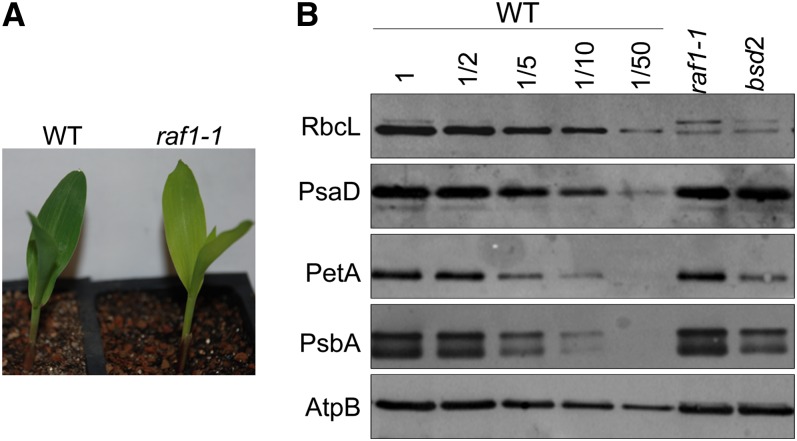
Figure 1.
Figure 1.
A Mu Transposon-Induced Nonphotosynthetic Maize Mutant Specifically Lacks Rubisco. (A) Wild-type (WT) and homozygous raf1-1 plants at the seedling stage. (B) Immunoblot analyses of the Rubisco large subunit and other photosynthetic proteins. Total proteins from equal surface area of the seedling leaf tip or dilutions (as indicated) were analyzed by probing with antibodies raised against the proteins indicated at the left. [See online article for color version of this figure.]
Figure 2.
Figure 2.
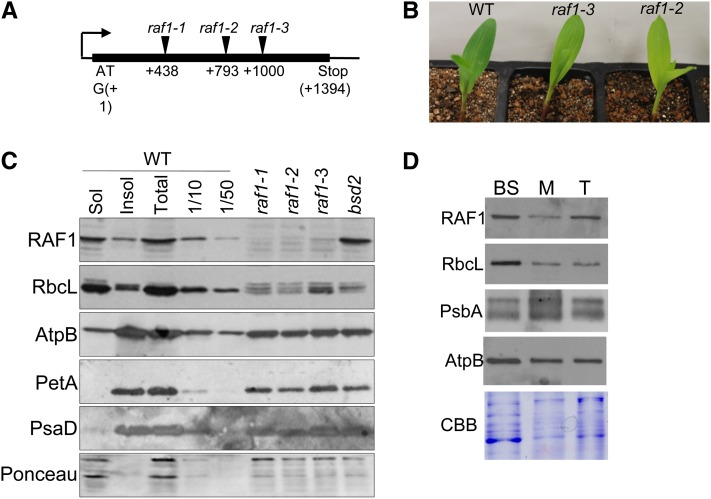
Identification of raf1. (A) GRMZM2G457621 is an intronless locus on chromosome 2. The locations of Mu insertions relative to the translation initiation codon are shown. (B) Ten-day-old seedlings of the indicated genotypes. WT, the wild type. (C) Immunoblot analysis of total, soluble, and insoluble proteins extracted from a wild-type leaf tip and total proteins extracted from an equivalent surface area of raf1 leaves. Antibodies used are shown to the left of each panel; the bottom panel is Ponceau-S staining, used to reflect loading. (D) Immunoblot analysis of bundle sheath–enriched (BS), mesophyll-enriched (M) or total (T) proteins, to detect the proteins shown at the left. CBB, Coomassie blue staining. [See online article for color version of this figure.]
Figure 3.
Figure 3.
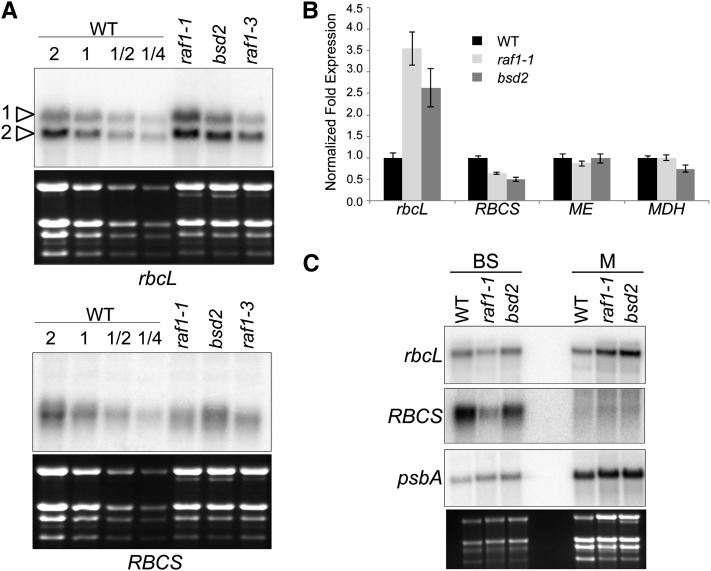
Accumulation of Rubisco Transcripts in raf1 Mutants. (A) Equal amounts (or the indicated dilutions) of total RNA from the mid-section of the second leaf of 10-d-old seedlings was analyzed in the indicated genotypes. Arrowheads indicate the bands corresponding to rbcL primary (1) and processed (2) transcripts. WT, the wild type. (B) Quantitative RT-PCR analysis of rbcL, RBCS, ME (malic enzyme), and MDH (malate dehydrogenase) transcripts. Expression levels are an average of two biological and three technical replicates of each sample, with error bars representing standard errors. The wild-type expression level was set to 1, and samples were normalized to actin mRNA. (C) RNA gel blot analysis was performed on total RNA isolated from bundle sheath (BS) and mesophyll (M) cells.
Figure 4.
Figure 4.
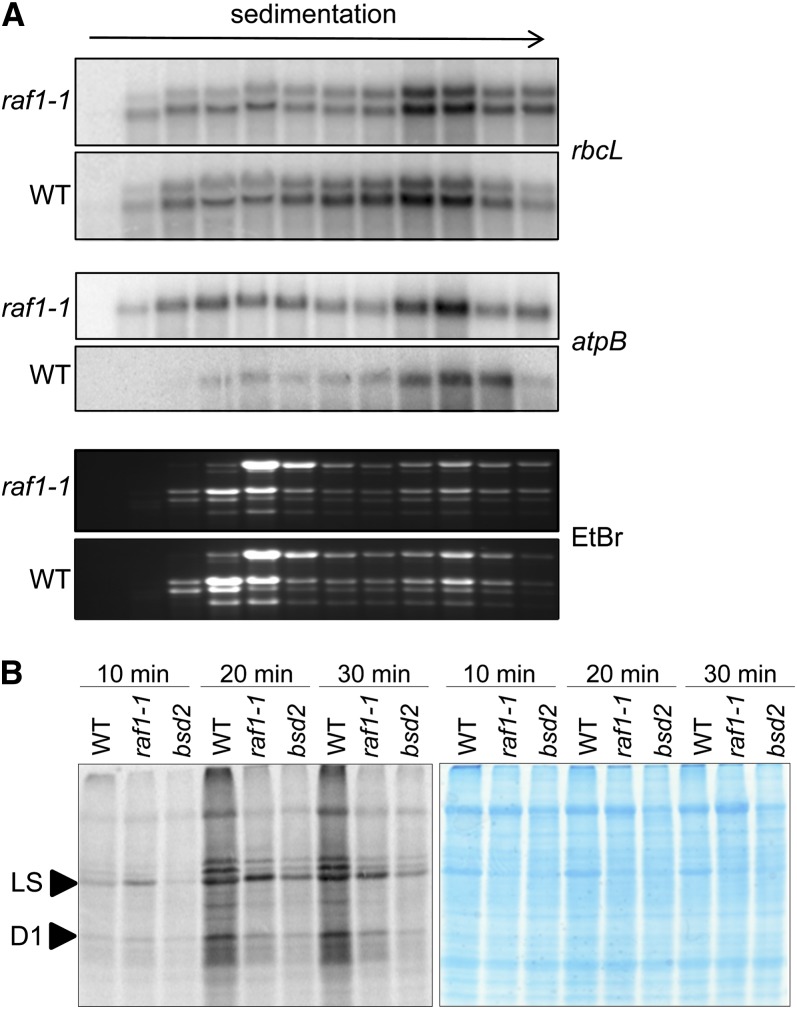
The rbcL Transcript Is Translated in raf1-1. (A) Total polysomal extracts from the apical half of the second and third leaves of raf1-1 and wild-type (WT) 12-d-old seedlings were fractionated in 15 to 55% Suc gradients. RNA was extracted from 12 fractions of equal volume and analyzed by gel blot. EtBr, ethidium bromide. (B) In vivo protein synthesis in 10-d-old leaves of wild-type, raf1-1, and bsd2 seedlings. [35S]Met was incorporated in the presence of cycloheximide, as described in Methods. Total proteins from equal surface areas surrounding the perforations used to introduce the radiolabel were analyzed by SDS-PAGE. The left panel shows autoradiography; the right panel shows Coomassie blue staining of the same gel. [See online article for color version of this figure.]
Figure 5.
Figure 5.
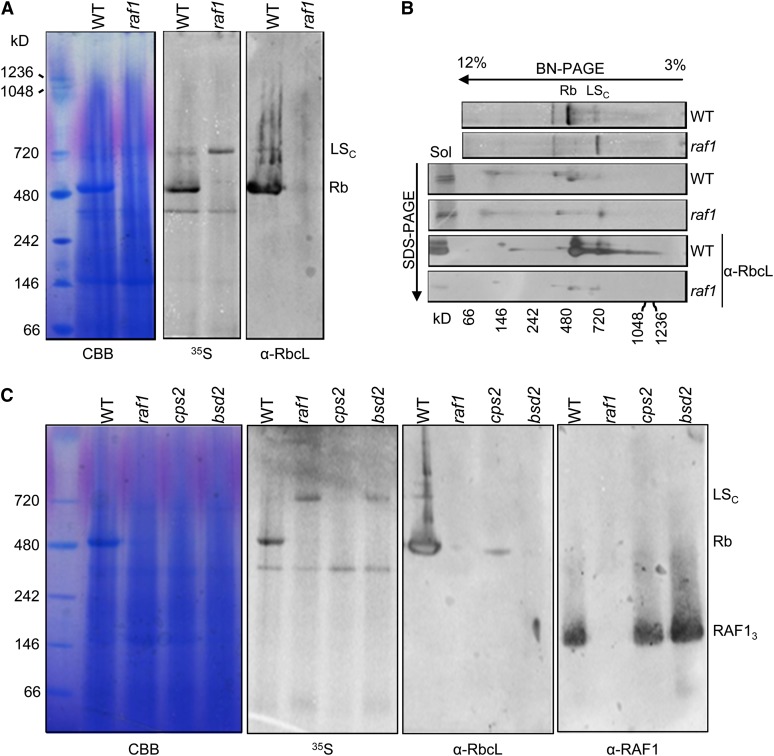
Native Analysis of Newly Synthesized LS. (A) Leaf proteins of 10-d-old wild-type (WT) and raf1-1/raf1-3 seedlings were labeled for 3 h in vivo with [35S]Met. Total proteins from equal surface areas surrounding the perforations used to introduce the radiolabel were separated in a 3 to 12% native gel, which was analyzed by staining (Coomassie blue [CBB]), autoradiography (35S), and immunoblotting for LS (α-RbcL). LSC marks the migration of the putative LS-chaperone complex, and Rb the position of Rubisco holoenzyme. (B) BN-PAGE gel lanes (top two rows, 35S shown) were separated in a second dimension 13% SDS-polyacrylamide gel and analyzed by autoradiography (middle two rows) and immunoblotting for LS (bottom two rows). (C) In vivo–labeled leaf proteins from equal surface areas were analyzed as in (A) from the genotypes given across the top. RAF13 marks the position of the RAF1 trimer. [See online article for color version of this figure.]
Figure 6.
Figure 6.
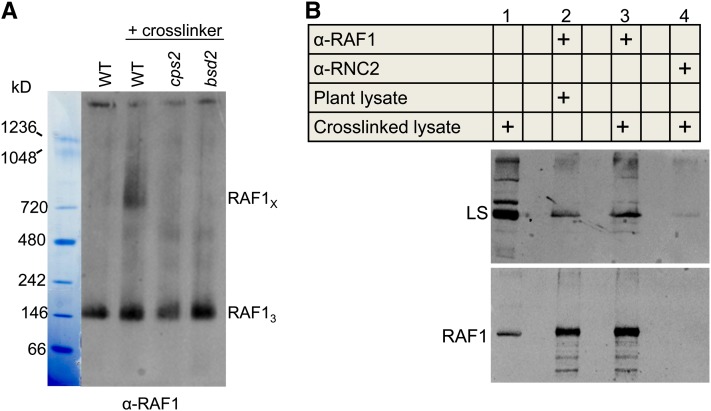
In Planta Cross-Linking Stabilizes a Complex Formed by RAF1. (A) Perforated regions of leaves from 10-d-old wild-type (WT), cps2, and bsd2 seedlings were treated with 1.85% formaldehyde for 40 min. Total soluble proteins from equal surface areas surrounding the perforations were extracted and separated in a 3 to 12% native gel, which was analyzed by immunoblotting for RAF1. RAF1X marks the migration of a putative RAF1 complex, and RAF13 the position of the RAF1 trimer. The result is representative of five independent experiments. (B) Anti-RAF1-protein A affinity beads were used to bind RAF1 from total soluble proteins extracted from cross-linked and non-cross-linked wild-type leaves. Lane 1 was loaded with 0.4% of the input, and the eluates (lanes 2 to 4) were separated in a 13% SDS-polyacrylamide gel and analyzed by immunoblotting for LS and RAF1. To avoid saturating the RAF1 signal, eluates for the RAF1 blot were diluted 120-fold compared with the eluates used for the LS blot. Anti-RNC2-protein A affinity beads were used as a negative control; RNC2 is a nucleolar protein related to RNase III (Comella et al., 2008). Empty lanes were included between those containing samples. [See online article for color version of this figure.]
Figure 7.
Figure 7.
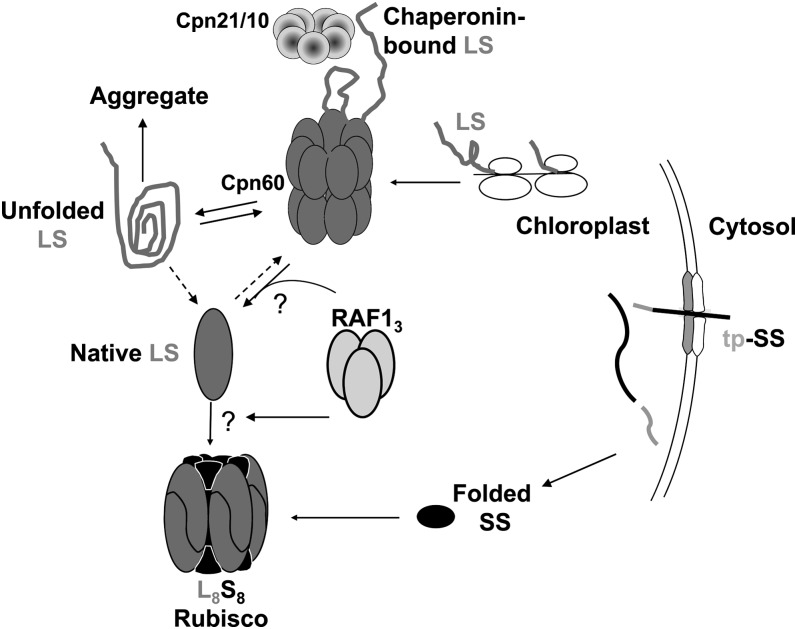
Model for Role of RAF1 in Rubisco Assembly. Counterclockwise from top right; newly synthesized LS interacts with the chaperonin complex, which leads to correct folding (Native LS) or aggregation and proteolysis. Trimeric RAF1 would then act to promote the formation of dimeric and/or octameric LS, perhaps in concert with BSD2 (data not shown). In the absence of RAF1, LS would be unable to escape from the chaperonin cycle, ultimately leading to aggregation and proteolysis. “Chaperonin-bound LS” is equivalent to LSc. See Nishimura et al. (2008) for details of other molecular partners involved in Rubisco biogenesis.

Comment in

References

    1. Andersson I., Backlund A. (2008). Structure and function of Rubisco. Plant Physiol. Biochem. 46: 275–291 - PubMed
    1. Andrews T.J. (1988). Catalysis by cyanobacterial ribulose-bisphosphate carboxylase large subunits in the complete absence of small subunits. J. Biol. Chem. 263: 12213–12219 - PubMed
    1. Avni A., Edelman M., Rachailovich I., Aviv D., Fluhr R. (1989). A point mutation in the gene for the large subunit of ribulose 1,5-bisphosphate carboxylase/oxygenase affects holoenzyme assembly in Nicotiana tabacum. EMBO J. 8: 1915–1918 - PMC - PubMed
    1. Bannai H., Tamada Y., Maruyama O., Nakai K., Miyano S. (2002). Extensive feature detection of N-terminal protein sorting signals. Bioinformatics 18: 298–305 - PubMed
    1. Barkan A. (1993). Nuclear mutants of maize with defects in chloroplast polysome assembly have altered chloroplast RNA metabolism. Plant Cell 5: 389–402 - PMC - PubMed

Publication types

MeSH terms