


Snoring is not associated with all-cause mortality, incident cardiovascular disease, or stroke in the Busselton Health Study
- PMID: 22942501
- PMCID: PMC3413800
- DOI: 10.5665/sleep.2076
Snoring is not associated with all-cause mortality, incident cardiovascular disease, or stroke in the Busselton Health Study
Abstract
Study objectives: To ascertain whether objectively measured snoring increases mortality, cardiovascular disease, or stroke risk over the effects of obstructive sleep apnea and other established risk factors.
Design: Community-based cohort.
Participants: 400 residents of the Western Australian town of Busselton.
Interventions: N/A.
Measurements: Snoring and obstructive sleep apnea were quantified via the percentage of the night spent snoring and the respiratory disturbance index as measured by a single night recording in November-December 1990 by a home sleep apnea monitoring device (MESAM IV), along with a range of cardiovascular disease risk factors. Follow-up for deaths and cardiovascular hospitalizations was ascertained via record linkage until the end of 2007.
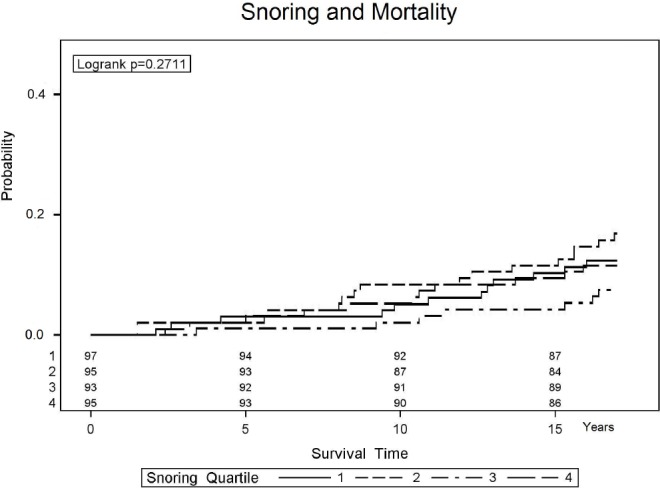
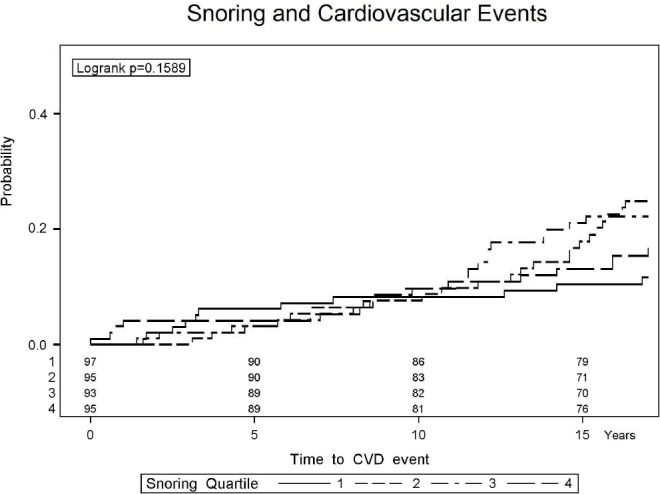
Results: Our analytical sample of 380 people was made up of the 397 people for whom the authors had follow-up data, minus 17 people who reported a previous stroke or heart attack at baseline (n = 380/400 = 95% of cohort). Snoring was observed for a mean/median of 32.0/27.4% of the night (standard deviation = 23.9%; range = 0-97.2%). There were 46 deaths, 68 cardiovascular events, and 24 strokes during 17 yr of follow-up. Snoring as either a categoric or continuous variable was not significantly associated with death, incident cardiovascular disease, or stroke in both unadjusted Cox regression models and in models that adjusted for obstructive sleep apnea and other risk factors.
Conclusions: No measure of snoring was associated with all-cause mortality, or incident cardiovascular disease or stroke over 17 yr in this community-based sample.
Keywords: Survival; population; sleep disordered breathing.
Figures


Comment in
-
Noise in the signal or bad vibrations?Sleep. 2012 Sep 1;35(9):1193-4. doi: 10.5665/sleep.2062. Sleep. 2012. PMID: 22942494 Free PMC article. No abstract available.
-
Snoring without OSA and health consequences: the jury is still out.Sleep. 2013 Apr 1;36(4):613. doi: 10.5665/sleep.2560. Sleep. 2013. PMID: 23565009 Free PMC article. No abstract available.
-
The burden of proof lies with the prosecution: is snoring guilty?Sleep. 2013 Apr 1;36(4):615. doi: 10.5665/sleep.2562. Sleep. 2013. PMID: 23565010 Free PMC article. No abstract available.
