


Annual Research Review: Mental health and resilience in HIV/AIDS-affected children-- a review of the literature and recommendations for future research
- PMID: 22943414
- PMCID: PMC3656822
- DOI: 10.1111/j.1469-7610.2012.02613.x
Annual Research Review: Mental health and resilience in HIV/AIDS-affected children-- a review of the literature and recommendations for future research
Abstract
Background: To date, research on mental health in HIV-affected children (children who have an HIV-positive caregiver or live with the virus themselves) has focused on risk factors associated with the disease. However, simultaneous identification of factors that contribute to resilience in the face of risks is also needed. A greater understanding of modifiable protective processes that contribute to resilience in the mental health of children affected by HIV can inform the design of interventions that bolster naturally occurring supports and contribute to early prevention or better management of risks.
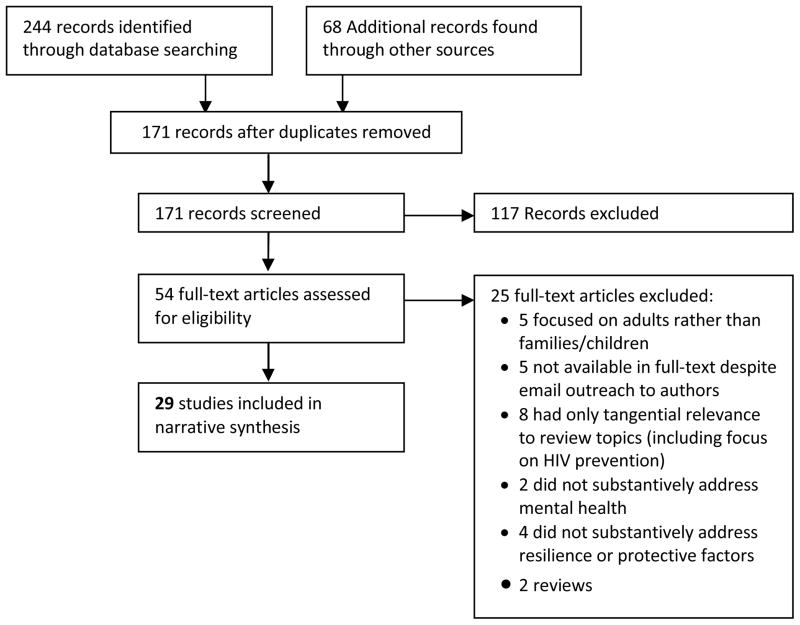
Methods: We reviewed the recent literature on mental health and resilience in children and adolescents affected by HIV/AIDS. Literature searches of PsycInfo and PubMed were conducted during July-December 2011 consistent with Preferred Reporting Items for Systematic Reviews and Meta-Analyses (PRISMA) standards. Qualitative and quantitative studies were included for review if primary research questions pertained to mental health and coping or protective processes in children and families affected by HIV/AIDS. All studies subject to full review were evaluated for quality using a modified Systematic Assessment of Quality in Observational Research (SAQOR) rating system.
Results: One hundred and seventy one unique studies were returned from online searches of the literature and bibliography mining. Of these, 29 were evaluated as pertaining directly to mental health and resilience in families and children living with HIV/AIDS. Eight studies presented qualitative analyses. Ten quantitative studies examined individual resources contributing to child resilience and four quantitative studies looked at family-level resources. Ten studies also investigated community level interactions. Four presented findings from resilience-focused interventions.
Conclusions: There is a clear need for rigorous research on mental health and resilience in HIV-affected children and adolescents. The evidence base would greatly benefit from more standardized and robust approaches to thinking about resilience from an ecological perspective inclusive of resources at multiple levels and their interactions.
© 2012 The Authors. Journal of Child Psychology and Psychiatry © 2012 Association for Child and Adolescent Mental Health.
Conflict of interest statement
No conflicts of interest for any authors are declared.
Figures
References
-
- Anderson M, Elam G, Gerver S, Solarin I, Fenton K, Easterbrook P. HIV/AIDS-related stigma and discrimination: Accounts of HIV-positive Caribbean people in the United Kingdom. Social Science & Medicine. 2008;67(5):790–798. - PubMed
-
- Benard B. ERIC/EECE Digest, EDO-PS-95-9. 1995. Fostering Resilience in Children.
Publication types
MeSH terms
Grants and funding
LinkOut - more resources
Full Text Sources
Medical
