Cardiac fibroblasts, fibrosis and extracellular matrix remodeling in heart disease
- PMID: 22943504
- PMCID: PMC3464725
- DOI: 10.1186/1755-1536-5-15
Cardiac fibroblasts, fibrosis and extracellular matrix remodeling in heart disease
Abstract
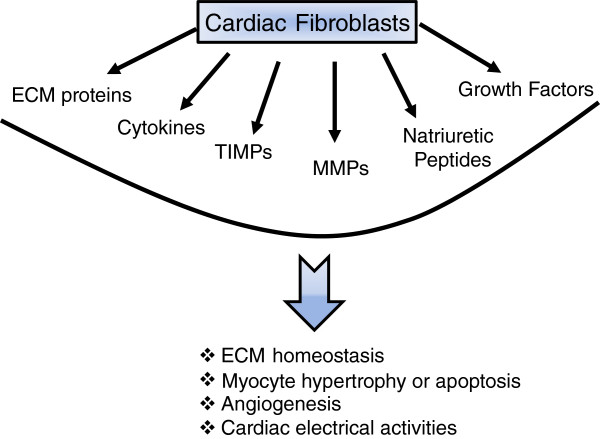
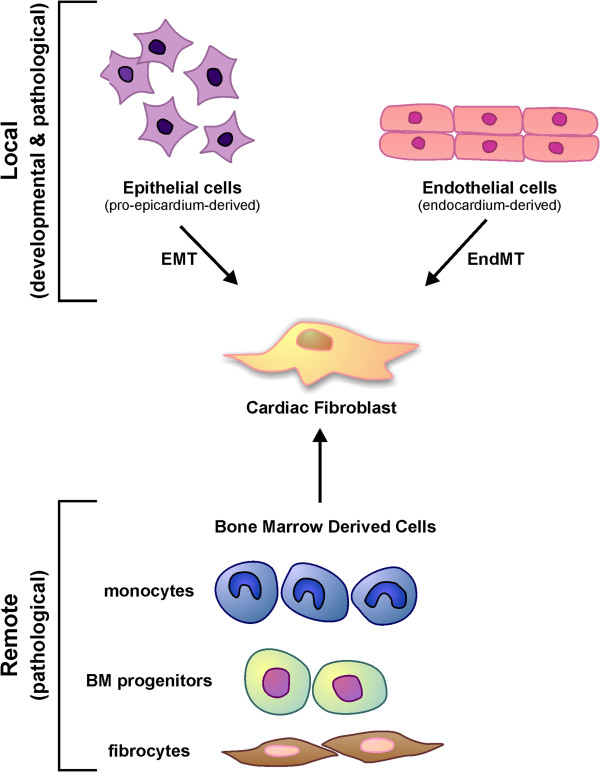
Fibroblasts comprise the largest cell population in the myocardium. In heart disease, the number of fibroblasts is increased either by replication of the resident myocardial fibroblasts, migration and transformation of circulating bone marrow cells, or by transformation of endothelial/epithelial cells into fibroblasts and myofibroblasts. The primary function of fibroblasts is to produce structural proteins that comprise the extracellular matrix (ECM). This can be a constructive process; however, hyperactivity of cardiac fibroblasts can result in excess production and deposition of ECM proteins in the myocardium, known as fibrosis, with adverse effects on cardiac structure and function. In addition to being the primary source of ECM proteins, fibroblasts produce a number of cytokines, peptides, and enzymes among which matrix metalloproteinases (MMPs) and their inhibitors, tissue inhibitor of metalloproteinases (TIMPs), directly impact the ECM turnover and homeostasis. Function of fibroblasts can also in turn be regulated by MMPs and TIMPs. In this review article, we will focus on the function of cardiac fibroblasts in the context of ECM formation, homeostasis and remodeling in the heart. We will discuss the origins and multiple roles of cardiac fibroblasts in myocardial remodeling in different types of heart disease in patients and in animal models. We will further provide an overview of what we have learned from experimental animal models and genetically modified mice with altered expression of ECM regulatory proteins, MMPs and TIMPs.
Figures
Similar articles
-
Tissue inhibitor of metalloproteinases (TIMPs) in heart failure.Heart Fail Rev. 2012 Sep;17(4-5):693-706. doi: 10.1007/s10741-011-9266-y. Heart Fail Rev. 2012. PMID: 21717224 Review.
-
Myocardial extra-cellular matrix and its regulation by metalloproteinases and their inhibitors.Thromb Haemost. 2005 Feb;93(2):212-9. doi: 10.1160/TH04-08-0522. Thromb Haemost. 2005. PMID: 15711735 Review.
-
Lack of tissue inhibitor of metalloproteinases 2 leads to exacerbated left ventricular dysfunction and adverse extracellular matrix remodeling in response to biomechanical stress.Circulation. 2011 Nov 8;124(19):2094-105. doi: 10.1161/CIRCULATIONAHA.111.030338. Epub 2011 Oct 10. Circulation. 2011. PMID: 21986284
-
Extracellular matrix communication and turnover in cardiac physiology and pathology.Compr Physiol. 2015 Apr;5(2):687-719. doi: 10.1002/cphy.c140045. Compr Physiol. 2015. PMID: 25880510 Review.
-
Heterogeneous effects of tissue inhibitors of matrix metalloproteinases on cardiac fibroblasts.Am J Physiol Heart Circ Physiol. 2005 Feb;288(2):H461-8. doi: 10.1152/ajpheart.00402.2004. Am J Physiol Heart Circ Physiol. 2005. PMID: 15650153
Cited by
-
Innate Immunity Effector Cells as Inflammatory Drivers of Cardiac Fibrosis.Int J Mol Sci. 2020 Sep 28;21(19):7165. doi: 10.3390/ijms21197165. Int J Mol Sci. 2020. PMID: 32998408 Free PMC article. Review.
-
Association of alcohol consumption with circulating biomarkers of atrial fibrillation-related pathways in a population at high cardiometabolic risk.medRxiv [Preprint]. 2023 Dec 5:2023.12.05.23299449. doi: 10.1101/2023.12.05.23299449. medRxiv. 2023. PMID: 38106131 Free PMC article. Preprint.
-
Transcriptomic Signatures of End-Stage Human Dilated Cardiomyopathy Hearts with and without Left Ventricular Assist Device Support.Int J Mol Sci. 2022 Feb 12;23(4):2050. doi: 10.3390/ijms23042050. Int J Mol Sci. 2022. PMID: 35216165 Free PMC article.
-
Hydrogen Sulfide Protects Human Cardiac Fibroblasts Against H2O2-induced Injury Through Regulating Autophagy-Related Proteins.Cell Transplant. 2018 Aug;27(8):1222-1234. doi: 10.1177/0963689718779361. Epub 2018 Jul 19. Cell Transplant. 2018. PMID: 30022684 Free PMC article.
-
Current challenges in the treatment of cardiac fibrosis: Recent insights into the sex-specific differences of glucose-lowering therapies on the diabetic heart: IUPHAR Review 33.Br J Pharmacol. 2023 Nov;180(22):2916-2933. doi: 10.1111/bph.15820. Epub 2022 Mar 10. Br J Pharmacol. 2023. PMID: 35174479 Free PMC article. Review.
References
-
- Camelliti P, Borg TK, Kohl P. Structural and functional characterisation of cardiac fibroblasts. Cardiovasc Res. 2005;65:40–51. - PubMed
-
- Hill JA, Olson EN. Cardiac plasticity. N Engl J Med. 2008;358:1370–1380. - PubMed
-
- Koitabashi N, Kass DA. Reverse remodeling in heart failure – mechanisms and therapeutic opportunities. Nat Rev Cardiol. 2012;9:147–157. - PubMed
LinkOut - more resources
Full Text Sources
Other Literature Sources