. 2012 Sep;62(4):491-9.
doi: 10.1016/j.yhbeh.2012.08.006. Epub 2012 Aug 27.

Acute genistein treatment mimics the effects of estradiol by enhancing place learning and impairing response learning in young adult female rats

Affiliations

Acute genistein treatment mimics the effects of estradiol by enhancing place learning and impairing response learning in young adult female rats

Samantha L Pisani et al. Horm Behav. 2012 Sep.

Abstract

Endogenous estrogens have bidirectional effects on learning and memory, enhancing or impairing cognition depending on many variables, including the task and the memory systems that are engaged. Moderate increases in estradiol enhance hippocampus-sensitive place learning, yet impair response learning that taps dorsal striatal function. This memory modulation likely occurs via activation of estrogen receptors, resulting in altered neural function. Supplements containing estrogenic compounds from plants are widely consumed despite limited information about their effects on brain function, including learning and memory. Phytoestrogens can enter the brain and signal through estrogen receptors to affect cognition. Enhancements in spatial memory and impairments in executive function have been found following treatment with soy phytoestrogens, but no tests of actions on striatum-sensitive tasks have been made to date. The present study compared the effects of acute exposure to the isoflavone genistein with the effects of estradiol on performance in place and response learning tasks. Long-Evans rats were ovariectomized, treated with 17β-estradiol benzoate, genistein-containing sucrose pellets, or vehicle (oil or plain sucrose pellets) for 2 days prior to behavioral training. Compared to vehicle controls, estradiol treatment enhanced place learning at a low (4.5 μg/kg) but not high dose (45 μg/kg), indicating an inverted pattern of spatial memory facilitation. Treatment with 4.4 mg of genistein over 2 days also significantly enhanced place learning over vehicle controls. For the response task, treatment with estradiol impaired learning at both low and high doses; likewise, genistein treatment impaired response learning compared to rats receiving vehicle. Overall, genistein was found to mimic estradiol-induced shifts in place and response learning, facilitating hippocampus-sensitive learning and slowing striatum-sensitive learning. These results suggest signaling through estrogen receptor β and membrane-associated estrogen receptors in learning enhancements and impairments given the preferential binding of genistein to the ERβ subtype and affinity for GPER.


Figures

Fig. 1
Fig. 1
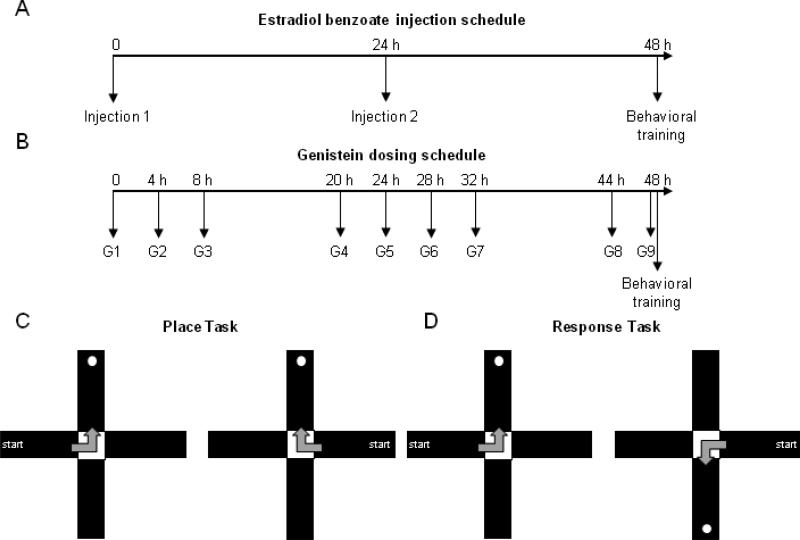
A) Treatment schedule for subcutaneous estradiol benzoate injections. B) Treatment schedule for oral genistein dosing. Graphic representations of the C) place and D) response learning tasks. In the place task, rats must use extra-maze cues to learn to reach the static goal arm. For the response task, extra-maze visual cues are absent and the rat must learn to make an egocentric body turn to reach the food reward.
Fig. 2
Fig. 2
A) Uterine horn wet weights (mg/cm) following 17β-estradiol benzoate treatment. Uterine horns proliferated in a dose-dependent manner. B) Serum estradiol levels (pg/mL) were determined via RIA. Treatment significantly elevated serum estradiol concentrations. C) Uterine horn wet weight in genistein- and sucrose-treated rats. Genistein had no uterotrophic effect. D) Serum genistein concentrations (ng/mL) as determined by LC/MS. Genistein treatment greatly elevated serum levels. E) Serum genistein levels in response to multiple dosings. Light/dark cycle is indicated by the open/shaded bars below the time axis. Blood samples were drawn just prior to and 30 mins following the dosing schedule outlined in Fig. 1B. There was a significant effect of treatment on serum genistein concentrations. Different lower case letters represent significant differences between groups 30 min following the second genistein dose of each day, p < 0.0003.
Fig. 3
Fig. 3
Place learning results. A) Trials to criterion data (9 out of 10, at least 6 consecutively correct) for oil (n = 11), Lo-EB (n = 12) and Hi-EB (n = 11) treated rats. Trials to criterion were lower following treatment with 4.5 μg/kg but not 45 μg/kg EB producing an inverted pattern of neuromodulation. B) Trials to criterion for sucrose (n = 8) and genistein (n = 8) treated rats. Genistein treatment facilitated place learning, similar to the effect of low EB in Fig. 3A. C). Acquisition curves for oil- and EB-treated rats. D). Acquisition curves for sucrose- and genistein-treated rats. There was a significant interaction between genistein treatment and task acquisition. Different lower case letters represent significant differences between groups, p < 0.02.
Fig. 4
Fig. 4
Response learning results. A) Trials to criterion for oil (n = 10), Lo-EB (n = 7) and Hi-EB (n = 6) treated rats. Treatment with both 4.5 μg/kg and 45 μg/kg EB impaired response learning as rats required more trials to reach criterion. B) Trials to criterion data for rats treated with sucrose (n = 9) and genistein (n = 9). Genistein treatment impaired response learning similar to effects observed with EB treatment. C) Acquisition curves for oil- and EB-treated rats. Rats treated with EB acquired the task more slowly than did oil controls. D) Acquisition curves for sucrose- and genistein-treated rats. Genistein treatment impaired performance on the response task, as rats took longer to reach high levels of accuracy. Different lower case letters represent significant differences between groups, p < 0.004.

References

    1. Adlercreutz H. Epidemiology of phytoestrogens. Baillières Clin. Endocrinol. Metab. 1998;12:605–623. - PubMed
    1. Alonso A, González-Pardo H, Garrido P, Conejo NM, Llaneza P, Díaz F, del Rey CG, González C. Acute effects of 17 β-estradiol and genistein on insulin sensitivity and spatial memory in aged ovariectomized female rats. Age (Dordr.) 2010;32:421–434. - PMC - PubMed
    1. Baldi E, Bucherelli C. The inverted “u-shaped” dose-effect relationships in learning and memory: modulation of arousal and consolidation. Nonlinearity Biol. Toxicol. Med. 2005;3:9–21. - PMC - PubMed
    1. Barha CK, Dalton GL, Galea LA. Low doses of 17alpha-estradiol and 17beta-estradiol facilitate, whereas higher doses of estrone and 17alpha- and 17beta-estradiol impair, contextual fear conditioning in adult female rats. Neuropsychopharmacology. 2010;35:547–559. - PMC - PubMed
    1. Bimonte HA, Denenberg VH. Estradiol facilitates performance as working memory load increases. Psychoneuroendocrinology. 1999;24:161–173. - PubMed

Publication types

MeSH terms