Mitophagy: mechanisms, pathophysiological roles, and analysis
- PMID: 22944659
- PMCID: PMC3630798
- DOI: 10.1515/hsz-2012-0119
Mitophagy: mechanisms, pathophysiological roles, and analysis
Abstract
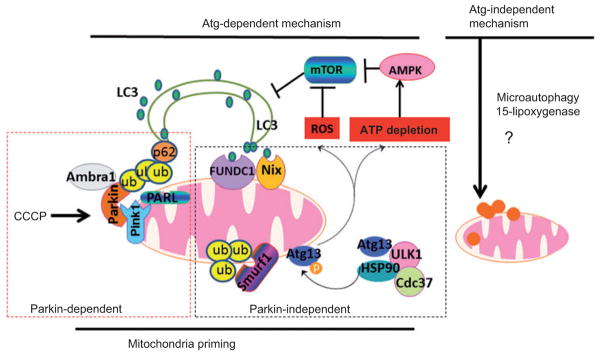
Abstract Mitochondria are essential organelles that regulate cellular energy homeostasis and cell death. The removal of damaged mitochondria through autophagy, a process called mitophagy, is thus critical for maintaining proper cellular functions. Indeed, mitophagy has been recently proposed to play critical roles in terminal differentiation of red blood cells, paternal mitochondrial degradation, neurodegenerative diseases, and ischemia or drug-induced tissue injury. Removal of damaged mitochondria through autophagy requires two steps: induction of general autophagy and priming of damaged mitochondria for selective autophagic recognition. Recent progress in mitophagy studies reveals that mitochondrial priming is mediated either by the Pink1-Parkin signaling pathway or the mitophagic receptors Nix and Bnip3. In this review, we summarize our current knowledge on the mechanisms of mitophagy. We also discuss the pathophysiological roles of mitophagy and current assays used to monitor mitophagy.
Figures

References
-
- Aita VM, Liang XH, Murty VV, Pincus DL, Yu W, Cayanis E, Kalachikov S, Gilliam TC, Levine B. Cloning and genomic organization of beclin 1, a candidate tumor suppressor gene on chromosome 17q21. Genomics. 1999;59:59–65. - PubMed
-
- Al Rawi S, Louvet-Vallee S, Djeddi A, Sachse M, Culetto E, Hajjar C, Boyd L, Legouis R, Galy V. Postfertilization autophagy of sperm organelles prevents paternal mitochondrial DNA transmission. Science. 2011;334:1144–1147. - PubMed
-
- Alberti A, Michelet X, Djeddi A, Legouis R. The autophagosomal protein LGG-2 acts synergistically with LGG-1 in dauer formation and longevity in C. elegans. Autophagy. 2010;6:5. - PubMed
Publication types
MeSH terms
Substances
Grants and funding
LinkOut - more resources
Full Text Sources
Other Literature Sources