


Future trends in global blindness
- PMID: 22944747
- PMCID: PMC3491263
- DOI: 10.4103/0301-4738.100532
Future trends in global blindness
Abstract
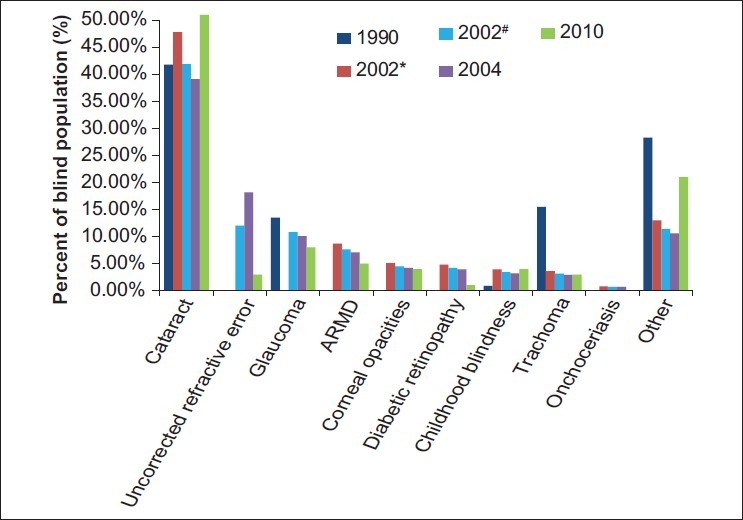
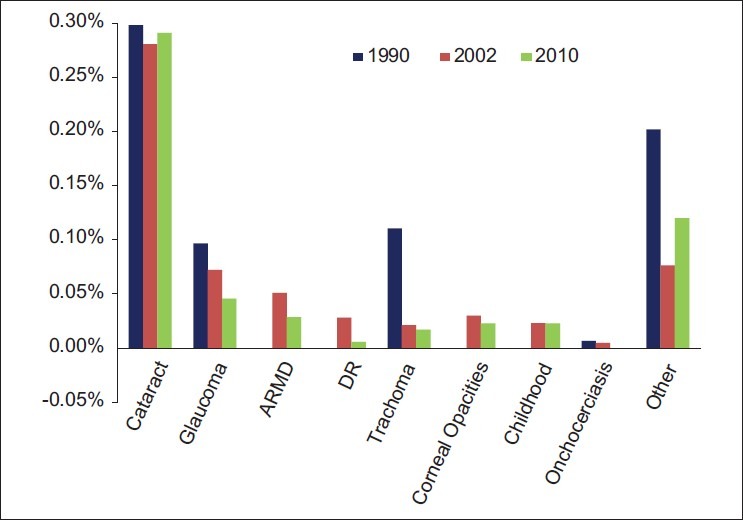
The objective of this review is to discuss the available data on the prevalence and causes of global blindness, and some of the associated trends and limitations seen. A literature search was conducted using the terms "global AND blindness" and "global AND vision AND impairment", resulting in seven appropriate articles for this review. Since 1990 the estimate of global prevalence of blindness has gradually decreased when considering the best corrected visual acuity definition: 0.71% in 1990, 0.59% in 2002, and 0.55% in 2010, corresponding to a 0.73% reduction per year over the 2002-2010 period. Significant limitations were found in the comparability between the global estimates in prevalence or causes of blindness or visual impairment. These limitations arise from various factors such as uncertainties about the true cause of the impairment, the use of different definitions and methods, and the absence of data from a number of geographical areas, leading to various extrapolation methods, which in turn seriously limit comparability. Seminal to this discussion on limitations in the comparability of studies and data, is that blindness has historically been defined using best corrected visual acuity.
Conflict of interest statement
Figures
References
-
- Elimination of avoidable visual disability due to refractive errors. Geneva: WHO; 2000. World Health Organisation. WHO/PBL/0079.
-
- Pascolini D, Mariotti SP. Global estimates of visual impairment: 2010. Br J Ophthalmol. 2012;96:614–8. - PubMed
-
- Lutz W, Sanderson W, Scherbov S. The coming acceleration of global population ageing. Nature. 2008;451:716–9. - PubMed
-
- United Nations Department of Economic and Social Affairs Population Division World Population Prospects: The 2010 Revision. 2011
-
- Thylefors B, Négrel AD, Pararajasegaram R. Epidemiologic aspects of global blindness prevention. Curr Opin Ophthalmol. 1992;3:824–34. - PubMed
Publication types
MeSH terms
LinkOut - more resources
Full Text Sources
