


Can a minimal intervention reduce secondhand smoke exposure among children with asthma from low income minority families? Results of a randomized trial
- PMID: 22945813
- PMCID: PMC3534823
- DOI: 10.1007/s10903-012-9713-4
Can a minimal intervention reduce secondhand smoke exposure among children with asthma from low income minority families? Results of a randomized trial
Abstract
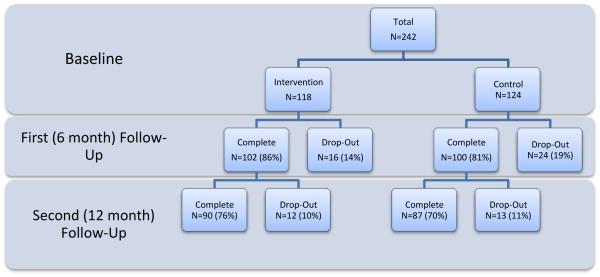
We report on the results of a low-intensity behavioral intervention to reduce second hand smoke (SHS) exposure of children with asthma from low income minority households in Los Angeles, California. In this study, 242 child/adult dyads were randomized to a behavioral intervention (video, workbook, minimal counseling) or control condition (brochure). Main outcome measures included child's urine cotinine and parental reports of child's hours of SHS exposure and number of household cigarettes smoked. Implementation of household bans was also considered. No differences in outcomes were detected between intervention and control groups at follow-up. Limitations included high attrition and low rates of collection of objective measures (few children with urine cotinine samples). There continues to be a need for effective culturally and linguistically appropriate strategies that support reduction of household SHS exposure among children with asthma in low income, minority households.
Figures
References
-
- Akinbami LJ, Moorman JE, Garbe PL, Sondik EJ. Status of childhood asthma in the United States, 1980-2007. Pediatrics. 2009;123(Suppl 3):S131–S145. - PubMed
-
- Bryant-Stephens T. Asthma disparities in urban environments. J Allergy Clin Immunol. 2009;123(6):1199–1206. - PubMed
-
- U.S. Department of Health and Human Services . The Health Consequences of Involuntary Exposure to Tobacco Smoke: A Report of the Surgeon General. U.S. Department of Health and Human Services, Centers for Disease Control and Prevention, Coordinating Center for Health Promotion, National Center for Chronic Disease Prevention and Health Promotion, Office on Smoking and Health; Atlanta, GA: 2006.
Publication types
MeSH terms
Substances
Grants and funding
LinkOut - more resources
Full Text Sources
Medical
