


Runaway sexual selection without genetic correlations: social environments and flexible mate choice initiate and enhance the Fisher process
- PMID: 22946795
- PMCID: PMC3627302
- DOI: 10.1111/j.1558-5646.2012.01647.x
Runaway sexual selection without genetic correlations: social environments and flexible mate choice initiate and enhance the Fisher process
Abstract
Female mating preferences are often flexible, reflecting the social environment in which they are expressed. Associated indirect genetic effects (IGEs) can affect the rate and direction of evolutionary change, but sexual selection models do not capture these dynamics. We incorporate IGEs into quantitative genetic models to explore how variation in social environments and mate choice flexibility influence Fisherian sexual selection. The importance of IGEs is that runaway sexual selection can occur in the absence of a genetic correlation between male traits and female preferences. Social influences can facilitate the initiation of the runaway process and increase the rate of trait elaboration. Incorporating costs to choice do not alter the main findings. Our model provides testable predictions: (1) genetic covariances between male traits and female preferences may not exist, (2) social flexibility in female choice will be common in populations experiencing strong sexual selection, (3) variation in social environments should be associated with rapid sexual trait divergence, and (4) secondary sexual traits will be more elaborate than previously predicted. Allowing feedback from the social environment resolves discrepancies between theoretical predictions and empirical data, such as why indirect selection on female preferences, theoretically weak, might be sufficient for preferences to become elaborated.
© 2012 The Author(s). Evolution© 2012 The Society for the Study of Evolution.
Figures
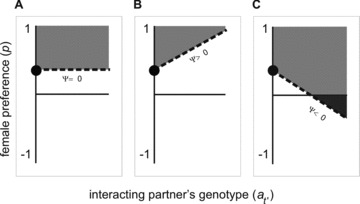
 , is portrayed on the x-axis. The y-axis shows female preference, p, defined as the difference between the male trait value she chooses and the average male trait,
  . The inherent preference of females is the y-intercept given by ap (solid circle). We illustrate females with inherent preferences for greater than average male trait values, which should be prevalent under directional and open-ended preferences. The change in acceptable trait values (dashed line) is dictated by Ψ. (a) Ψ= 0. Female preference does not change across the range of male phenotypes in the social environment. (b) Ψ > 0. Social interactions with larger male traits increase female preferences. (c) Ψ < 0. Social experience decreases female preference. The light shaded areas above the dashed lines indicate the male trait values, relative to the average, that a female will accept given her inherent preference and the social environment experienced. Dark shading in (c) indicates conditions in which females accept below average males.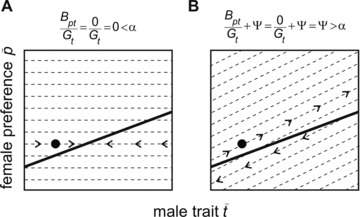
References
-
- Agrawal AF, Brodie ED, III, Wade MJ. On indirect genetic effects in structured populations. Am. Nat. 2001;158:308–323. - PubMed
-
- Bailey NW. Mate choice plasticity in the field cricket Teleogryllus oceanicus: effects of social experience in multiple modalities. Behav. Ecol. Sociobiol. 2011;65:2269–2278.