


Multi-ion distributions in the cytoplasmic domain of inward rectifier potassium channels
- PMID: 22947859
- PMCID: PMC3414900
- DOI: 10.1016/j.bpj.2012.06.023
Multi-ion distributions in the cytoplasmic domain of inward rectifier potassium channels
Abstract
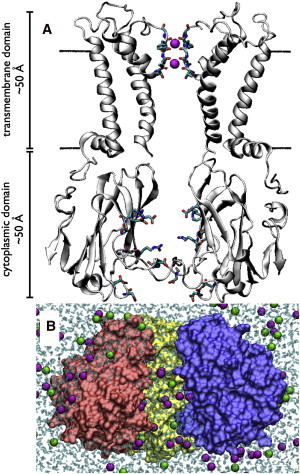
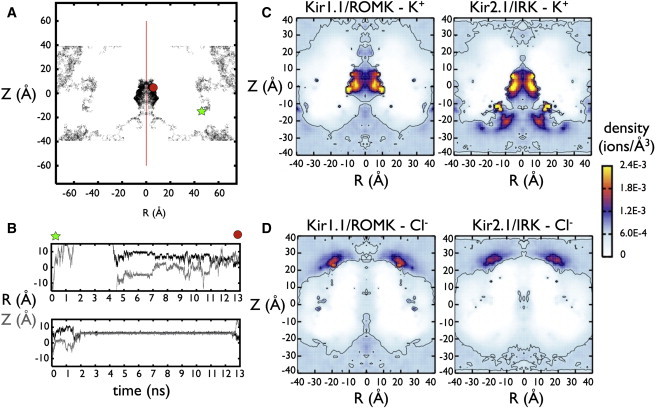
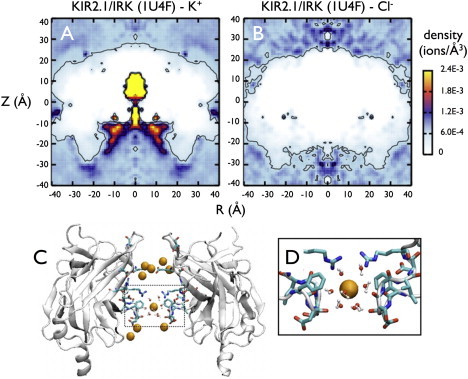
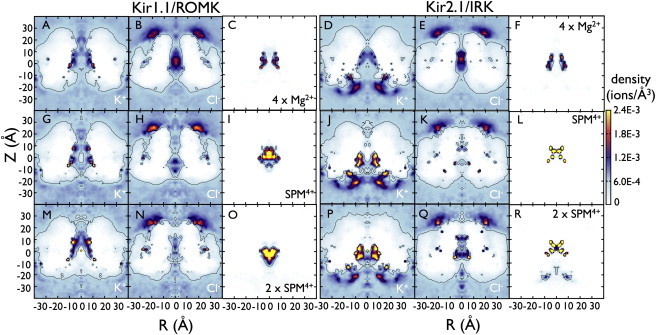
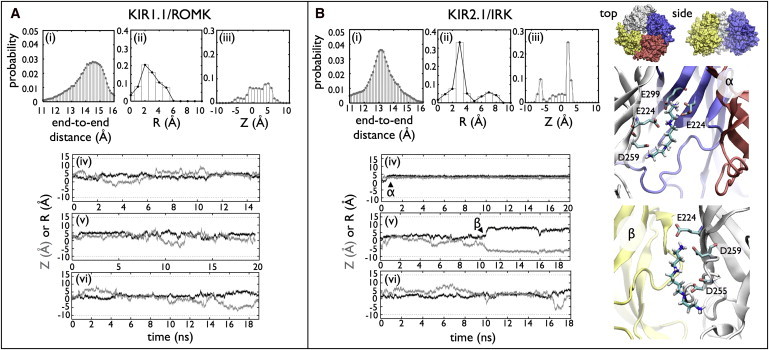
Inward rectifier potassium (Kir) channels act as cellular diodes, allowing unrestricted flow of potassium (K(+)) into the cell while preventing currents of large magnitude in the outward direction. The rectification mechanism by which this occurs involves a coupling between K(+) and intracellular blockers-magnesium (Mg(2+)) or polyamines-that simultaneously occupy the permeation pathway. In addition to the transmembrane pore, Kirs possess a large cytoplasmic domain (CD) that provides a favorable electronegative environment for cations. Electrophysiological experiments have shown that the CD is a key regulator of both conductance and rectification. In this study, we calculate and compare averaged equilibrium probability densities of K(+) and Cl(-) in open-pore models of the CDs of a weak (Kir1.1-ROMK) and a strong (Kir2.1-IRK) rectifier through explicit-solvent molecular-dynamics simulations in ~1 M KCl. The CD of both channels concentrates K(+) ions greater than threefold inside the cytoplasmic pore while IRK shows an additional K(+) accumulation region near the cytoplasmic entrance. Simulations carried out with Mg(2+) or spermine (SPM(4+)) show that these ions interact with pore-lining residues, shielding the surface charge and reducing K(+) in both channels. The results also show that SPM(4+) behaves differently inside these two channels. Although SPM(4+) remains inside the CD of ROMK, it diffuses around the entire volume of the pore. In contrast, this polyatomic cation finds long-lived conformational states inside the IRK pore, interacting with residues E224, D259, and E299. The strong rectifier CD is also capable of sequestering an additional SPM(4+) at the cytoplasmic entrance near a cluster of negative residues D249, D274, E275, and D276. Although understanding the actual mechanism of rectification blockade will require high-resolution structural information of the blocked state, these simulations provide insight into how sequence variation in the CD can affect the multi-ion distributions that underlie the mechanisms of conduction, rectification affinity, and kinetics.
Copyright © 2012 Biophysical Society. Published by Elsevier Inc. All rights reserved.
Figures
References
-
- Matsuda H., Saigusa A., Irisawa H. Ohmic conductance through the inwardly rectifying K channel and blocking by internal Mg2+ Nature. 1987;325:156–159. - PubMed
-
- Lopatin A.N., Makhina E.N., Nichols C.G. Potassium channel block by cytoplasmic polyamines as the mechanism of intrinsic rectification. Nature. 1994;372:366–369. - PubMed
-
- Ficker E., Taglialatela M., Brown A.M. Spermine and spermidine as gating molecules for inward rectifier K+ channels. Science. 1994;266:1068–1072. - PubMed
-
- Kuo A., Gulbis J.M., Doyle D.A. Crystal structure of the potassium channel KirBac1.1 in the closed state. Science. 2003;300:1922–1926. - PubMed
Publication types
MeSH terms
Substances
Grants and funding
LinkOut - more resources
Full Text Sources
