Relationship of sympathetic activity to bone microstructure, turnover, and plasma osteopontin levels in women
- PMID: 22948767
- PMCID: PMC3485606
- DOI: 10.1210/jc.2012-2381
Relationship of sympathetic activity to bone microstructure, turnover, and plasma osteopontin levels in women
Abstract
Context: Studies in rodents have demonstrated that sympathetic activity reduces bone formation and bone mass; these effects are mediated by the noncollagenous matrix protein, osteopontin.
Objective: The objective of the study was to relate sympathetic activity (measured using microneurography at the peroneal nerve) to bone microstructure (assessed by high resolution peripheral quantitative computed tomography), bone turnover, and plasma osteopontin levels.
Design, setting, and patients: Twenty-three women aged 20-72 yr (10 premenopausal and 13 postmenopausal) were studied in the Clinical Research Unit.
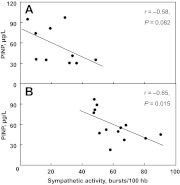
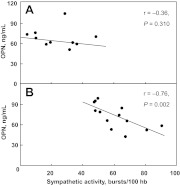
Results: Sympathetic activity (bursts per 100 heart beats) was 2.4-fold higher in postmenopausal as compared with premenopausal women (P < 0.001). In the two groups combined and after age adjustment, sympathetic activity was inversely correlated with trabecular bone volume fraction (r = -0.55, P < 0.01) and thickness (r = -0.59, P < 0.01) and positively correlated with trabecular separation (r = 0.45, P < 0.05). Sympathetic activity was negatively correlated with serum amino-terminal propeptide of type I collagen in postmenopausal women (r = -0.65, P = 0.015), with a similar trend in premenopausal women (r = -0.58, P = 0.082). Sympathetic activity was also negatively correlated with plasma osteopontin levels (r = -0.43, P = 0.045), driven mainly by the correlation in postmenopausal women (r = -0.76, P = 0.002).
Conclusion: These findings represent the first demonstration in humans of a relationship between sympathetic activity and bone microstructure and circulating levels of amino-terminal propeptide of type I collagen and osteopontin. Given the critical role of osteopontin in mediating the effects of β-adrenergic signaling on bone, the inverse association between sympathetic activity and plasma osteopontin levels may reflect a negative feedback loop to limit the deleterious effects of sympathetic activity on bone metabolism. Based on the higher sympathetic activity observed in postmenopausal women, additional human studies are needed to define the role of increased sympathetic activity in mediating postmenopausal bone loss.
Figures
Comment in
-
The skeleton and the sympathetic nervous system: it's about time!J Clin Endocrinol Metab. 2012 Nov;97(11):3908-11. doi: 10.1210/jc.2012-3205. J Clin Endocrinol Metab. 2012. PMID: 23129593 Free PMC article. No abstract available.
References
-
- Takeda S, Elefteriou F, Levasseur R, Liu X, Zhao L, Parker KL, Armstrong D, Ducy P, Karsenty G. 2002. Leptin regulates bone formation via the sympathetic nervous system. Cell 111:305–317 - PubMed
-
- Elefteriou F, Ahn JD, Takeda S, Starbuck M, Yang X, Liu X, Kondo H, Richards WG, Bannon TW, Noda M, Clement K, Vaisse C, Karsenty G. 2005. Leptin regulation of bone resorption by the sympathetic nervous system and CART. Nature 434:514–520 - PubMed
-
- Nagao M, Feinstein TN, Ezura Y, Hayata T, Notomi T, Saita Y, Hanyu R, Hemmi H, Izu Y, Takeda S, Wang K, Rittling S, Nakamoto T, Kaneko K, Kurosawa H, Karsenty G, Denhardt DT, Vilardaga JP, Noda M. 2011. Sympathetic control of bone mass regulated by osteopontin. Proc Natl Acad Sci USA 108:17767–17772 - PMC - PubMed
-
- Moore RE, Smith CK, 2nd, Bailey CS, Voelkel EF, Tashjian AH., Jr 1993. Characterization of β-adrenergic receptors on rat and human osteoblast-like cells and demonstration that beta-receptor agonists can stimulate bone resorption in organ culture. Bone Miner 23:301–315 - PubMed
-
- Kellenberger S, Muller K, Richener H, Bilbe G. 1998. Formoterol and isoproterenol induce c-fos gene expression in osteoblast-like cells by activating β2-adrenergic receptors. Bone 22:471–478 - PubMed
Publication types
MeSH terms
Substances
Grants and funding
LinkOut - more resources
Full Text Sources
Medical
Research Materials