


Neurocognitive function and CNS integrity in adult survivors of childhood hodgkin lymphoma
- PMID: 22949149
- PMCID: PMC3462045
- DOI: 10.1200/JCO.2012.42.6841
Neurocognitive function and CNS integrity in adult survivors of childhood hodgkin lymphoma
Abstract
Purpose: Long-term survivors of childhood Hodgkin lymphoma (HL) are at risk for cardiopulmonary complications and CNS stroke, although neurocognitive function has not been previously examined. The aim of this study was to examine neurocognitive and brain imaging outcomes in adult survivors of childhood HL.
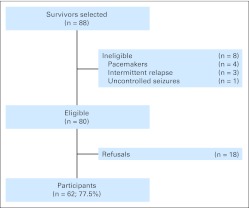
Patients and methods: In all, 62 adult survivors (mean age, 42.2 years; standard deviation [SD], 4.77; mean age at diagnosis, 15.1 years; SD, 3.30) were identified by stratified random selection from a large cohort treated with either high-dose (≥ 30 Gy) thoracic radiation (n = 38) or lower-dose (< 30 Gy) thoracic radiation combined with anthracycline (n = 24). Patients underwent neurocognitive evaluations, brain magnetic resonance imaging (MRI), echocardiograms, pulmonary function tests, and physical examinations.
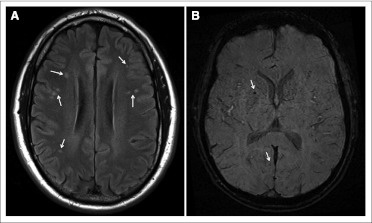
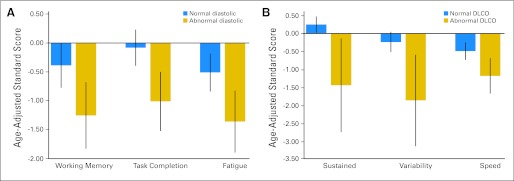
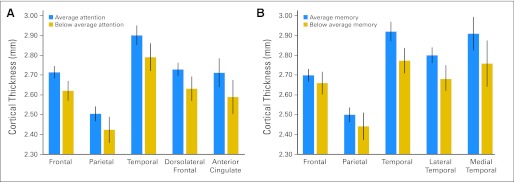
Results: Compared with national age-adjusted norms, HL survivors demonstrated lower performance on sustained attention (P = .004), short-term memory (P = .001), long-term memory (P = .006), working memory (P < .001), naming speed (P < .001), and cognitive fluency (P = .007). MRI revealed leukoencephalopathy in 53% of survivors, and 37% had evidence of cerebrovascular injury. Higher thoracic radiation dose was associated with impaired cardiac diastolic function (E/E'; ratio of peak mitral flow velocity of early rapid filling [E] to early diastolic velocity of the mitral annulus [E']; P = .003), impaired pulmonary function (diffusing capacity of lungs for carbon monoxide [DL(co)(corr); P = .04), and leukoencephalopathy (P = .02). Survivors with leukoencephalopathy demonstrated reduced cognitive fluency (P = .001). Working memory impairment was associated with E/E', although impaired sustained attention and naming speed were associated with DL(co)(corr). Neurocognitive performance was associated with academic and vocational functioning.
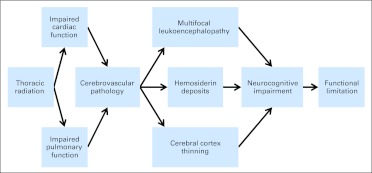
Conclusion: These results suggest that adult long-term survivors of childhood HL are at risk for neurocognitive impairment, which is associated with radiologic indices suggestive of reduced brain integrity and which occurs in the presence of symptoms of cardiopulmonary dysfunction.
Trial registration: ClinicalTrials.gov NCT00760656.
Conflict of interest statement
Authors' disclosures of potential conflicts of interest and author contributions are found at the end of this article.
Figures
References
-
- Bowers DC, McNeil DE, Liu Y, et al. Stroke as a late treatment effect of Hodgkin's disease: A report from the Childhood Cancer Survivor Study. J Clin Oncol . 2005;23:6508–6515. - PubMed
-
- Mertens AC, Yasui Y, Liu Y, et al. Pulmonary complications in survivors of childhood and adolescent cancer: A report from the Childhood Cancer Survivor Study. Cancer . 2002;95:2431–2441. - PubMed
-
- Jeerakathil T, Wolf PA, Beiser A, et al. Stroke risk profile predicts white matter hyperintensity volume: The Framingham Study. Stroke. 2004;35:1857–1861. - PubMed
-
- Debette S, Bauters C, Leys D, et al. Prevalence and determinants of cognitive impairment in chronic heart failure patients. Congest Heart Fail . 2007;13:205–208. - PubMed
Publication types
MeSH terms
Substances
Associated data
Grants and funding
LinkOut - more resources
Full Text Sources
Medical
