


Energetics of life on the deep seafloor
- PMID: 22949638
- PMCID: PMC3458337
- DOI: 10.1073/pnas.1208976109
Energetics of life on the deep seafloor
Abstract
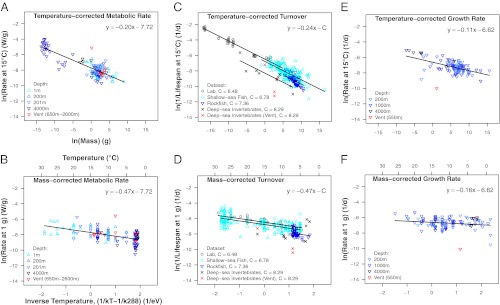
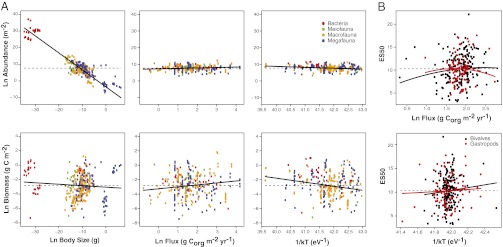
With frigid temperatures and virtually no in situ productivity, the deep oceans, Earth's largest ecosystem, are especially energy-deprived systems. Our knowledge of the effects of this energy limitation on all levels of biological organization is very incomplete. Here, we use the Metabolic Theory of Ecology to examine the relative roles of carbon flux and temperature in influencing metabolic rate, growth rate, lifespan, body size, abundance, biomass, and biodiversity for life on the deep seafloor. We show that the relative impacts of thermal and chemical energy change across organizational scales. Results suggest that individual metabolic rates, growth, and turnover proceed as quickly as temperature-influenced biochemical kinetics allow but that chemical energy limits higher-order community structure and function. Understanding deep-sea energetics is a pressing problem because of accelerating climate change and the general lack of environmental regulatory policy for the deep oceans.
Conflict of interest statement
The authors declare no conflict of interest.
Figures
References
-
- Lane N, Martin W. The energetics of genome complexity. Nature. 2010;467:929–934. - PubMed
-
- Brown JH, Gillooly JF, Allen AP, Savage VM, West GB. Toward a metabolic theory of ecology. Ecology. 2004;85:1771–1789.
-
- Freckleton RP, Harvey PH, Pagel M. Bergmann’s rule and body size in mammals. Am Nat. 2003;161:821–825. - PubMed
Publication types
MeSH terms
LinkOut - more resources
Full Text Sources
Other Literature Sources
