


The role of free radicals in the aging brain and Parkinson's Disease: convergence and parallelism
- PMID: 22949875
- PMCID: PMC3431873
- DOI: 10.3390/ijms130810478
The role of free radicals in the aging brain and Parkinson's Disease: convergence and parallelism
Abstract
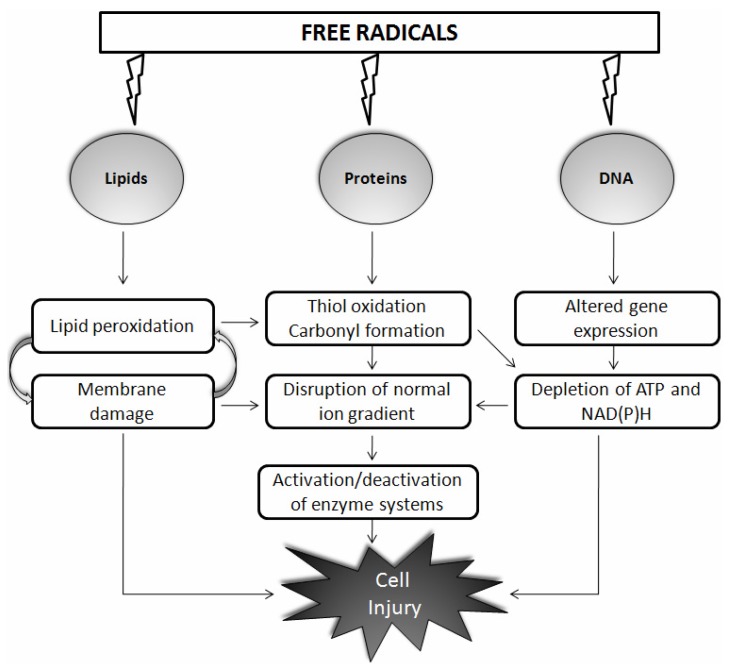
Free radical production and their targeted action on biomolecules have roles in aging and age-related disorders such as Parkinson's disease (PD). There is an age-associated increase in oxidative damage to the brain, and aging is considered a risk factor for PD. Dopaminergic neurons show linear fallout of 5-10% per decade with aging; however, the rate and intensity of neuronal loss in patients with PD is more marked than that of aging. Here, we enumerate the common link between aging and PD at the cellular level with special reference to oxidative damage caused by free radicals. Oxidative damage includes mitochondrial dysfunction, dopamine auto-oxidation, α-synuclein aggregation, glial cell activation, alterations in calcium signaling, and excess free iron. Moreover, neurons encounter more oxidative stress as a counteracting mechanism with advancing age does not function properly. Alterations in transcriptional activity of various pathways, including nuclear factor erythroid 2-related factor 2, glycogen synthase kinase 3β, mitogen activated protein kinase, nuclear factor kappa B, and reduced activity of superoxide dismutase, catalase and glutathione with aging might be correlated with the increased incidence of PD.
Keywords: Parkinson’s disease; aging; free radicals; mitochondrial dysfunction; nrf2; α-synuclein.
Figures

References
-
- Brand M.D., Affourtit C., Esteves T.C., Green K., Lambert A.J., Miwa S., Pakay J.L., Parker N. Mitochondrial superoxide: Production, biological effects, and activation of uncoupling proteins. Free Radic. Biol. Med. 2004;37:755–767. - PubMed
-
- Thannickal V.J., Fanburg B.L. Reactive oxygen species in cell signaling. Am. J. Physiol. Lung. Cell. Mol. Physiol. 2000;279:L1005–L1028. - PubMed
-
- Forman H.J., Torres M. Reactive oxygen species and cell signaling: Respiratory burst in macrophage signaling. Am. J. Respir. Crit. Care Med. 2002;166:S4–S8. - PubMed
-
- Rhee S.G. Redox signaling: Hydrogen peroxide as intracellular messenger. Exp. Mol. Med. 1999;31:53–59. - PubMed
Publication types
MeSH terms
Substances
LinkOut - more resources
Full Text Sources
Medical
