


Integrating pathology and radiology disciplines: an emerging opportunity?
- PMID: 22950414
- PMCID: PMC3523019
- DOI: 10.1186/1741-7015-10-100
Integrating pathology and radiology disciplines: an emerging opportunity?
Abstract
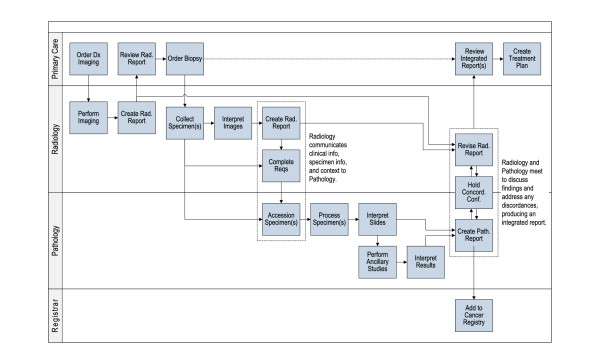
Pathology and radiology form the core of cancer diagnosis, yet the workflows of both specialties remain ad hoc and occur in separate "silos," with no direct linkage between their case accessioning and/or reporting systems, even when both departments belong to the same host institution. Because both radiologists' and pathologists' data are essential to making correct diagnoses and appropriate patient management and treatment decisions, this isolation of radiology and pathology workflows can be detrimental to the quality and outcomes of patient care. These detrimental effects underscore the need for pathology and radiology workflow integration and for systems that facilitate the synthesis of all data produced by both specialties. With the enormous technological advances currently occurring in both fields, the opportunity has emerged to develop an integrated diagnostic reporting system that supports both specialties and, therefore, improves the overall quality of patient care.
Figures
References
-
- Berg W, Hruban R, Kumar D, Singh H, Brem R, Gatewood O. Lessons from mammographic-histopathologic correlation of large-core needle breast biopsy. Radiographics. 1996;16:1111–1130. - PubMed
-
- Mihalik JE, Krupka L, Davenport R, Tucker L, Toevs C, Smith RS. The rate of imaging-histologic discordance of benign breast disease: a multidisciplinary approach to the management of discordance at a large university-based hospital. Am J Surg. 2010;199:319–323. doi: 10.1016/j.amjsurg.2009.11.004. - DOI - PubMed
-
- Office of the Assistant Secretary for Planning and Evaluation; US Department of Health and Human Services. The Importance of Radiology and Pathology Communication in the Diagnosis and Staging of Cancer: Mammography as a Case Study. Washington, DC; 2010.
-
- International Breast Consensus Conference. Image-detected breast cancer: state of the art diagnosis and treatment. J Am Coll Surg. 2001;193:297–302. - PubMed
-
- Tucker F. New era pathologic techniques in the diagnosis and reporting of breast cancers. Semin Breast Dis. 2008;11:140–147. doi: 10.1053/j.sembd.2009.04.010. - DOI
MeSH terms
LinkOut - more resources
Full Text Sources
Other Literature Sources
Medical
