


Human selection of elk behavioural traits in a landscape of fear
- PMID: 22951744
- PMCID: PMC3479801
- DOI: 10.1098/rspb.2012.1483
Human selection of elk behavioural traits in a landscape of fear
Abstract
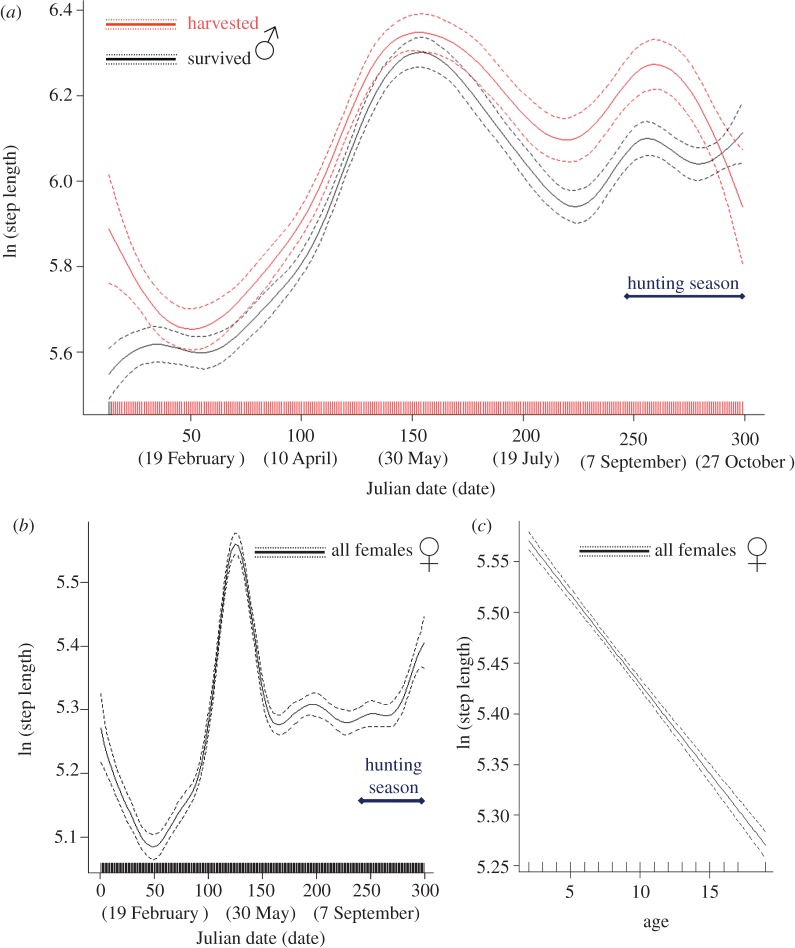
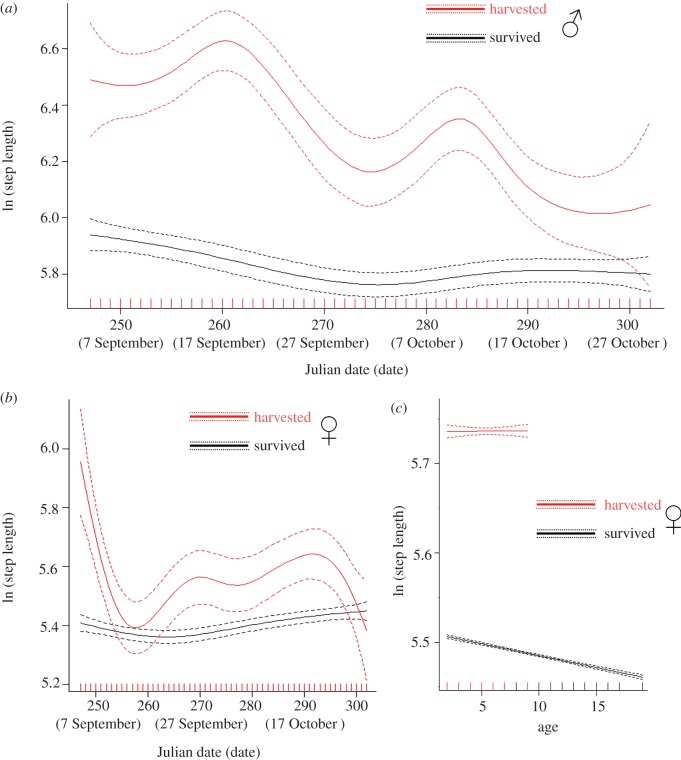
Among agents of selection that shape phenotypic traits in animals, humans can cause more rapid changes than many natural factors. Studies have focused on human selection of morphological traits, but little is known about human selection of behavioural traits. By monitoring elk (Cervus elaphus) with satellite telemetry, we tested whether individuals harvested by hunters adopted less favourable behaviours than elk that survived the hunting season. Among 45 2-year-old males, harvested elk showed bolder behaviour, including higher movement rate and increased use of open areas, compared with surviving elk that showed less conspicuous behaviour. Personality clearly drove this pattern, given that inter-individual differences in movement rate were present before the onset of the hunting season. Elk that were harvested further increased their movement rate when the probability of encountering hunters was high (close to roads, flatter terrain, during the weekend), while elk that survived decreased movements and showed avoidance of open areas. Among 77 females (2-19 y.o.), personality traits were less evident and likely confounded by learning because females decreased their movement rate with increasing age. As with males, hunters typically harvested females with bold behavioural traits. Among less-experienced elk (2-9 y.o.), females that moved faster were harvested, while elk that moved slower and avoided open areas survived. Interestingly, movement rate decreased as age increased in those females that survived, but not in those that were eventually harvested. The latter clearly showed lower plasticity and adaptability to the local environment. All females older than 9 y.o. moved more slowly, avoided open areas and survived. Selection on behavioural traits is an important but often-ignored consequence of human exploitation of wild animals. Human hunting could evoke exploitation-induced evolutionary change, which, in turn, might oppose adaptive responses to natural and sexual selection.
Figures
References
-
- Futuyma D. J. 2001. Evolutionary biology. Sunderland, MA: Sineauer Associates
-
- Palumbi S. R. 2001. Evolution: humans as the world's greatest evolutionary force. Science 293, 1786–1790 10.1126/science.293.5536.1786 (doi:10.1126/science.293.5536.1786) - DOI - PubMed
-
- Hendry A. P., Farrugia T. J., Kinnison M. T. 2008. Human influences on rates of phenotypic change in wild animal populations. Mol. Ecol. 17, 20–29 10.1111/j.1365-294X.2007.03428.x (doi:10.1111/j.1365-294X.2007.03428.x) - DOI - PubMed
-
- Darimont C. T., Carlson S. M., Kinnison M. T., Paquet P. C., Reimchen T. E., Wilmers C. C. 2009. Human predators outpace other agents of trait change in the wild. Proc. Natl Acad. Sci. USA 106, 952–954 10.1073/pnas.0809235106 (doi:10.1073/pnas.0809235106) - DOI - PMC - PubMed
-
- Yoshida T., Jones L. E., Ellner S. P., Fussmann G. F., Hairston N. G. 2003. Rapid evolution drives ecological dynamics in a predator–prey system. Nature 424, 303–306 10.1038/nature01767 (doi:10.1038/nature01767) - DOI - PubMed
Publication types
MeSH terms
LinkOut - more resources
Full Text Sources
Research Materials
