. 2012 Oct 9;53(11):7034-42.
doi: 10.1167/iovs.12-10025.

Menthol activation of corneal cool cells induces TRPM8-mediated lacrimation but not nociceptive responses in rodents

Affiliations

Menthol activation of corneal cool cells induces TRPM8-mediated lacrimation but not nociceptive responses in rodents

Ashlee Robbins et al. Invest Ophthalmol Vis Sci. .

Abstract

Purpose: Stimulation to the cornea via noxious chemical and mechanical means evokes tearing, blinking, and pain. In contrast, mild cooling of the ocular surface has been reported to increase lacrimation via activation of corneal cool primary afferent neurons. The purpose of our study was to determine whether menthol induces corneal cool cell activity and lacrimation via the transient receptor potential melastatin-8 (TRPM8) channel without evoking nociceptive responses.

Methods: Tear measurements were made using a cotton thread in TRPM8 wild type and knockout mice after application of menthol (0.05-50 mM) to the cornea. In additional studies, nocifensive responses (eye swiping and lid closure) were quantified following cornea menthol application. Trigeminal ganglion electrophysiologic single unit recordings were performed in rats to determine the effect of low and high concentrations of menthol on corneal cool cells.

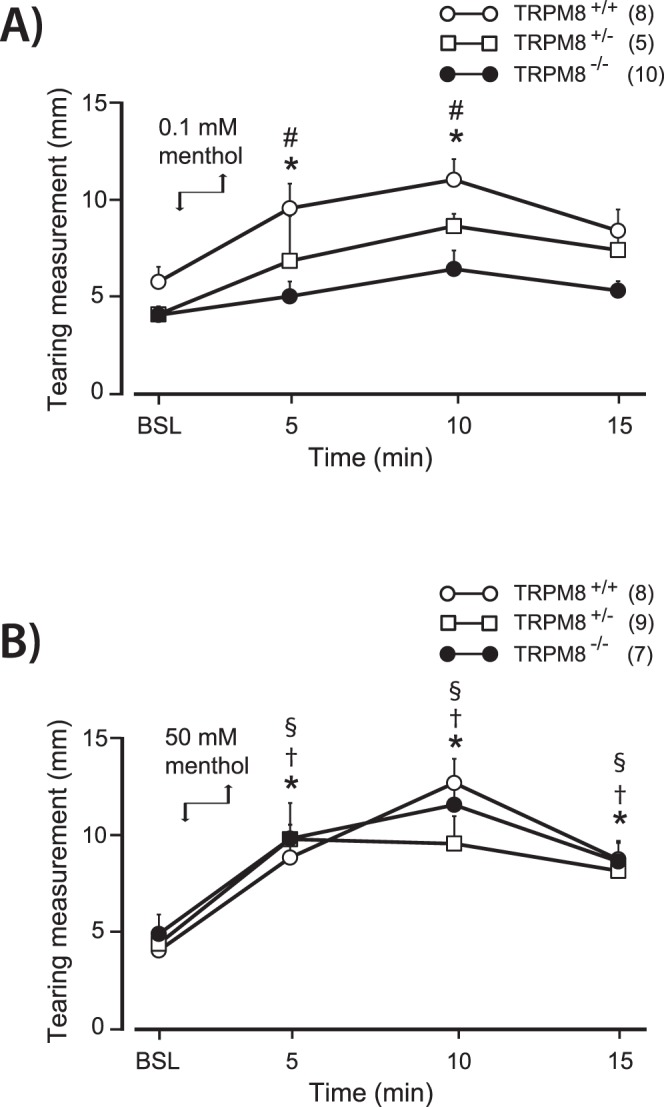
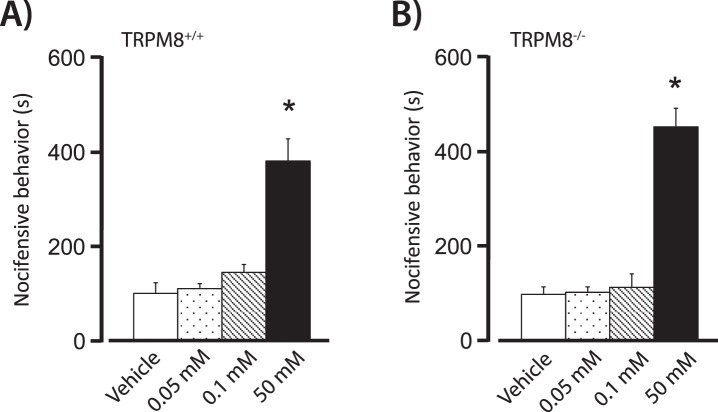
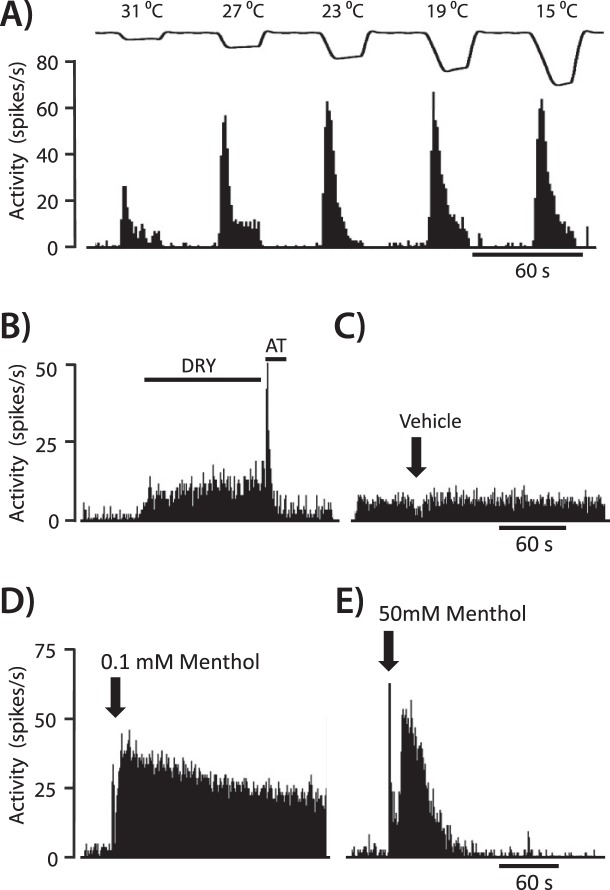
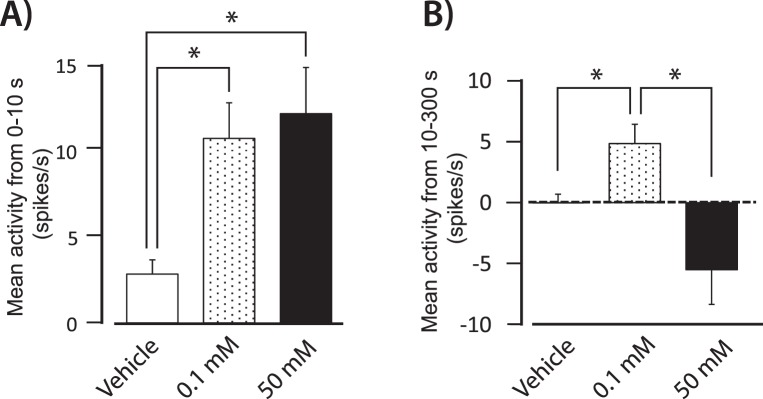
Results: At low concentrations, menthol increased tear production in TRPM8 wild type and heterozygous animals, but had no effect in TRPM8 knockout mice, while nocifensive responses remained unaffected. At the highest concentration, menthol (50 mM) increased tearing and nocifensive responses in TRPM8 wild type and knockout animals. A low concentration of menthol (0.1 mM) increased cool cell activity, yet a high concentration of menthol (50 mM) had no effect.

Conclusions: These studies indicated that low concentrations of menthol can increase lacrimation via TRPM8 channels without evoking nocifensive behaviors. At high concentrations, menthol can induce lacrimation and nocifensive behaviors in a TRPM8 independent mechanism. The increase in lacrimation is likely due to an increase in cool cell activity.


Conflict of interest statement

Disclosure: A. Robbins, None; M. Kurose, None; B.J. Winterson, None; I.D. Meng, None

Figures

Figure 1.
Figure 1.
Tearing evoked by menthol applied to the cornea in TRPM8+/+, TRPM8+/−, and TRPM8−/− mice. Evoked tears were measured over a 15-minute period after drug removal. Menthol was applied directly to the eye (downward arrow) and removed with a Kimwipe after 2 minutes (upward arrow). Measurements were taken using cotton phenol red threads. (A) 0.1 mM menthol produced an increase in tearing in TRPM8+/+ mice with peak tearing occurring at 10 minutes after menthol application. The same concentration of menthol did not change tearing in TRPM8−/− mice. (B) 50 mM menthol produced an increase in tearing in TRPM8+/+, TRPM8+/−, and TRPM8−/− mice. At this concentration, no significant difference was observed between genotypes at any time point. BSL, values from the third and final baseline tear measurement before application of menthol to the eye. *P < 0.05 for the TRPM8+/+ group compared to baseline values. #P < 0.05 for the TRPM8+/+ group compared to TRPM8−/− mice at the same time point. †P < 0.05 for the TRPM8+/− group compared to baseline values. §P < 0.05 for the TRPM8−/− group compared to baseline values. Number of animals in each group is indicated in parentheses.
Figure 2.
Figure 2.
Ocular nocifensive behaviors quantified after application of menthol to the eye in (A) TRPM8+/+ mice and (B) TRPM8−/− mice. Increased nocifensive behaviors were evoked by 50 mM menthol in TRPM8+/+ and TRPM8−/− mice. Eye-wiping or eye closure behaviors were assessed for 15 minutes after application of mineral oil vehicle, or 0.05 mM, 0.1 mM, and 50 mM menthol. Nocifensive behaviors are reported as the total amount of time spent executing the behaviors. In TRPM8+/+ animals, n = 10/group and in TRPM8−/− animals, n = 6, 4, 5, 4 for mineral oil vehicle, 0.05 mM, 0.1 mM, and 50 mM menthol, respectively. *P < 0.05 versus all other treatment groups.
Figure 3.
Figure 3.
An example of a corneal cool cell, demonstrating increased neuronal discharge evoked by (A) cooling and (B) drying of the ocular surface. The “DRY” condition was created by removal of excess artificial tears (AT) with a Kimwipe. (C) Activity was not affected after application of the menthol vehicle solution (mineral oil). (D) Application of 0.1 mM menthol caused an immediate and sustained increase in activity. (E) In contrast, 50 mM menthol evoked an initial increase in activity that quickly returned to baseline values.
Figure 4.
Figure 4.
(A) Average neuronal activity during the first 10 seconds after application of mineral oil (n = 17), 0.1 mM menthol (n = 14), and 50 mM menthol (n = 5) to the eye. The 0.1 and 50 mM menthol evoked greater activity compared to the vehicle control. (B) Average activity from 10 to 300 seconds after vehicle, and 0.1 and 50 mM menthol. Actvity after 0.1 mM menthol was greater compared to vehicle and 50 mM menthol. The change in activity was determined by subtracting the average baseline activity for 30 seconds before drug application from the average activity following drug application. *P < 0.05.

References

    1. Barabino S, Dana MR. Dry eye syndromes. Chem Immunol Allergy. 2007;92:176–184 - PubMed
    1. Abelson MB, Ousler GW III, Maffei C. Dry eye in 2008. Curr Opin Ophthalmol. 2009;20:282–286 - PubMed
    1. Mathers WD. Why the eye becomes dry: a cornea and lacrimal gland feedback model. CLAO J. 2000;26:159–165 - PubMed
    1. van Bijsterveld OP, Kruize AA, Bleys RL. Central nervous system mechanisms in Sjögren's syndrome. Br J Ophthalmol. 2003;87:128–130 - PMC - PubMed
    1. Dartt DA. Dysfunctional neural regulation of lacrimal gland secretion and its role in the pathogenesis of dry eye syndromes. Ocul Surf. 2004;2:76–91 - PubMed

Publication types