


Smoking cessation interventions following acute coronary syndrome: a missed opportunity?
- PMID: 22952289
- PMCID: PMC4475793
- DOI: 10.1177/2047487312460517
Smoking cessation interventions following acute coronary syndrome: a missed opportunity?
Abstract
Background: It is recommended that general practitioners (GPs) offer cessation advice and pharmacological interventions to smokers with acute coronary syndrome (ACS). The study objective was to describe the extent to which this is done, and to describe outcomes by smoking status.
Design: Patients aged 30+ hospitalised for troponin-positive ACS from 2002 to 2009, discharged home alive, were identified in the Myocardial Ischaemia National Audit Project registry. Patient data were linked to the General Practice Research Database, Hospital Episode Statistics, and Office of National Statistics mortality data, enabling a unique perspective of longitudinal smoking data. Patients who smoked prior to the hospitalisation had GP interventions and quitting status established in the 3 months following discharge, and were followed up for major clinical outcomes.
Methods: The outcomes evaluated included death, repeat ACS, stroke, heart failure, and major adverse cardiac events (MACE).
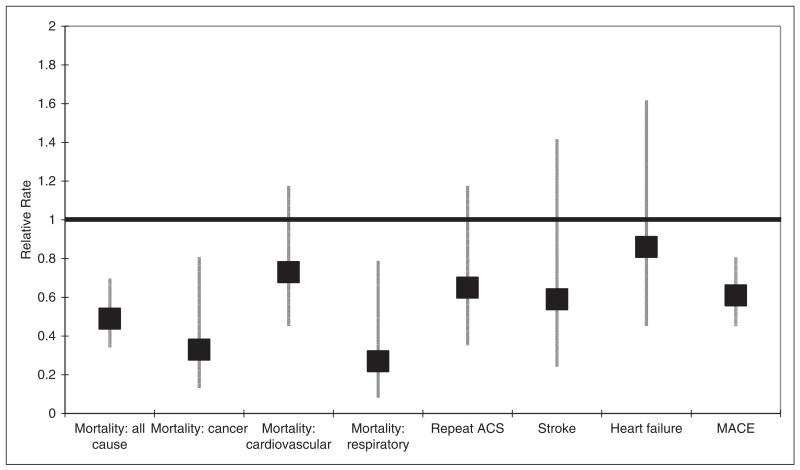
Results: Of the 4834 patients included, 965 (20%) were smokers at the time of their ACS. After the ACS event, only 225 (24%) received any GP smoking intervention within 3 months, with 82 (9%) receiving advice only, and 143 (15%) receiving a pharmacological intervention. Patients who quit (320; 33%) were at a decreased risk of mortality (relative risk (RR) 0.49; 95% confidence interval (CI) 0.35-0.69) and MACE (RR 0.61; 0.46-0.80) compared with patients who did not.
Conclusions: Whilst a high proportion of patients with ACS are smokers, there is a low level of GP cessation intervention following hospital discharge. This missed opportunity of patient care is important given the decreased risk of mortality and MACE found amongst those who quit.
Keywords: Smoking; acute coronary syndrome; cessation; general practice; heart failure; mortality; stroke.
© The European Society of Cardiology 2012 Reprints and permissions: sagepub.co.uk/journalsPermissions.nav.
Figures
References
-
- Critchley J, Capewell D. Mortality risk reduction associated with smoking cessation in patients with coronary artery disease – a systematic review. JAMA. 2003;290:86–97. - PubMed
-
- Colivicchi F, Mocini D, Tubaro M, et al. Effect of smoking relapse on outcome after acute coronary syndromes. Am J Cardiol. 2011;108:804–808. - PubMed
-
- National Institute for Health and Clinical Excellence . MI: secondary prevention. 2007. (NICE clinical guideline 48).
-
- Ashenden R, Silagy C, Weller D. A systematic review of the effectiveness of promoting lifestyle change in general practice. Fam Pract. 1997;14:160–176. - PubMed
-
- Silagy C. Nicotine replacement therapy for smoking cessation. Cochrane Database Syst Rev. 2000;(3) CD000146. - PubMed
Publication types
MeSH terms
Grants and funding
LinkOut - more resources
Full Text Sources
Medical
