


Workplace measurements by the US Occupational Safety and Health Administration since 1979: descriptive analysis and potential uses for exposure assessment
- PMID: 22952385
- PMCID: PMC3589950
- DOI: 10.1093/annhyg/mes055
Workplace measurements by the US Occupational Safety and Health Administration since 1979: descriptive analysis and potential uses for exposure assessment
Erratum in
-
Workplace measurements by the U.S. Occupational Safety and Health Administration since 1979: Descriptive analysis and potential uses for exposure assessment.Ann Occup Hyg. 2013 Jun;57(5):681-3. doi: 10.1093/annhyg/met027. Ann Occup Hyg. 2013. PMID: 23946941 Free PMC article.
Abstract
Background: Inspectors from the US Occupational Safety and Health Administration (OSHA) have been collecting industrial hygiene samples since 1972 to verify compliance with Permissible Exposure Limits. Starting in 1979, these measurements were computerized into the Integrated Management Information System (IMIS). In 2010, a dataset of over 1 million personal sample results analysed at OSHA's central laboratory in Salt Lake City [Chemical Exposure Health Data (CEHD)], only partially overlapping the IMIS database, was placed into public domain via the internet. We undertook this study to inform potential users about the relationship between this newly available OSHA data and IMIS and to offer insight about the opportunities and challenges associated with the use of OSHA measurement data for occupational exposure assessment.
Methods: We conducted a literature review of previous uses of IMIS in occupational health research and performed a descriptive analysis of the data recently made available and compared them to the IMIS database for lead, the most frequently sampled agent.
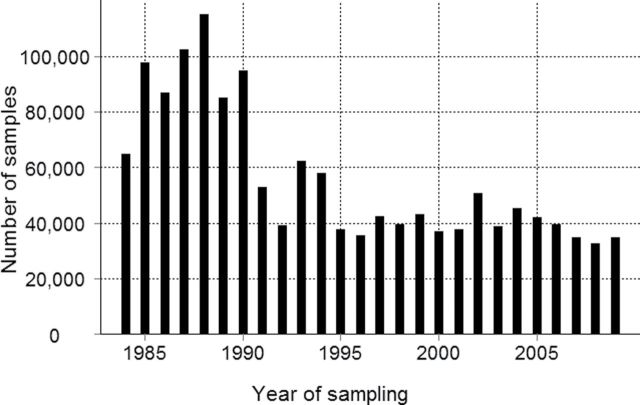
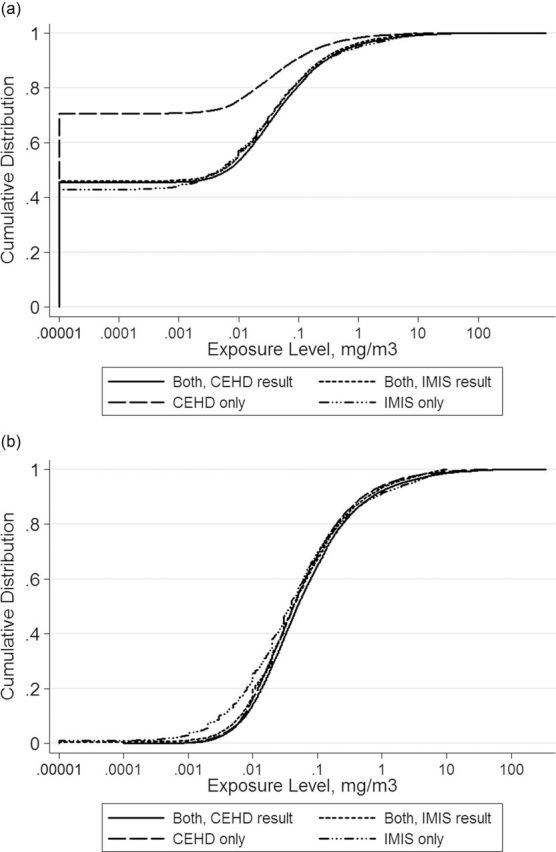
Results: The literature review yielded 29 studies reporting use of IMIS data, but none using the CEHD data. Most studies focused on a single contaminant, with silica and lead being most frequently analysed. Sixteen studies addressed potential bias in IMIS, mostly by examining the association between exposure levels and ancillary information. Although no biases of appreciable magnitude were consistently reported across studies and agents, these assessments may have been obscured by selective under-reporting of non-detectable measurements. The CEHD data comprised 1 450 836 records from 1984 to 2009, not counting analytical blanks and erroneous records. Seventy eight agents with >1000 personal samples yielded 1 037 367 records. Unlike IMIS, which contain administrative information (company size, job description), ancillary information in the CEHD data is mostly analytical. When the IMIS and CEHD measurements of lead were merged, 23 033 (39.2%) records were in common to both IMIS and CEHD datasets, 10 681 (18.2%) records were only in IMIS, and 25 012 (42.6%) records were only in the CEHD database. While IMIS-only records represent data analysed in other laboratories, CEHD-only records suggest partial reporting of sampling results by OSHA inspectors into IMIS. For lead, the percentage of non-detects in the CEHD-only data was 71% compared to 42% and 46% in the both-IMIS-CEHD and IMIS-only datasets, respectively, suggesting differential under-reporting of non-detects in IMIS.
Conclusions: IMIS and the CEHD datasets represent the biggest source of multi-industry exposure data in the USA and should be considered as a valuable source of information for occupational exposure assessment. The lack of empirical data on biases, adequate interpretation of non-detects in OSHA data, complicated by suspected differential under-reporting, remain the principal challenges to the valid estimation of average exposure conditions. We advocate additional comparisons between IMIS and CEHD data and discuss analytical strategies that may play a key role in meeting these challenges.
Figures
References
-
- Boiano JM, Hull RD. (2001). Development of a National Occupational Exposure Survey and Database associated with NIOSH hazard surveillance initiatives. Appl Occup Environ Hyg; 16: 128–34 - PubMed
-
- Burns DK, Beaumont PL. (1989). The HSE National Exposure Database–(NEDB). Ann Occup Hyg; 33: 1–14 - PubMed
-
- Chu H, Nie L, Kensler TW. (2008). A Bayesian approach estimating treatment effects on biomarkers containing zeros with detection limits. Stat Med; 27: 2497–508 - PubMed
-
- Clark NJ. (1990). Validation of sampling data from the Occupational Safety and Health Administration (OSHA) Integrated Management Information System (IMIS). Am Ind Hyg Assoc J; 51: A799 - PubMed
-
- Coble JB, Lees PS, Matanoski G. (2001). Time trends in exposure measurements from OSHA compliance inspections of the pulp and paper industry. Appl Occup Environ Hyg; 16: 263–70 - PubMed
Publication types
MeSH terms
Grants and funding
LinkOut - more resources
Full Text Sources
Medical
