Review
doi: 10.1101/cshperspect.a006114.
Subversion of cell signaling by pathogens
Affiliations
- PMID: 22952390
- PMCID: PMC3428769
- DOI: 10.1101/cshperspect.a006114
Item in Clipboard
Review
Subversion of cell signaling by pathogens
Cold Spring Harb Perspect Biol.
.
Abstract
Pathogens exploit several eukaryotic signaling pathways during an infection. They have evolved specific effectors and toxins to hijack host cell machinery for their own benefit. Signaling molecules are preferentially targeted by pathogens because they globally regulate many cellular processes. Both viruses and bacteria manipulate and control pathways that regulate host cell survival and shape, including MAPK signaling, G-protein signaling, signals controlling cytoskeletal dynamics, and innate immune responses.
Figures

Bacterial secretion systems. Bacteria use several different mechanisms to secrete molecules into the extracellular space and to translocate molecules into a host cell. Toxins, including peptides and proteins, are typically secreted through a type I or II secretion system. Effectors are translocated through a type III or IV secretion system, whereas DNA is only transferred through the type IV secretion system.

Corruption of MAPK and NFκB signaling pathways by bacterial effectors. Yersinia YopJ is an acetyltransferase that acetylates and inhibits MAPKK and IKKβ activation by blocking phosphorylation. Similarly, Vibrio VopA/P blocks activation of MAPKK. Lethal factor (LF) from B. anthracis, the causal agent of Anthrax, is a metalloprotease that inhibits MAPKK by proteolysis. OspF is a phosphothreonine lyase that irreversibly dephosphorylates MAPK by elimination of a phosphate group from activated MAPK.
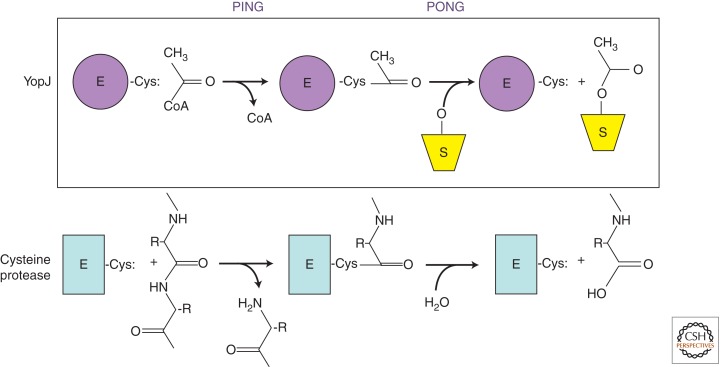
Catalytic triads: same chemistry, different substrates. Yersinia YopJ is proposed to use a ping-pong mechanism whereby its catalytic cysteine attacks acetyl-CoA to form a covalent acetyl-enzyme intermediate, followed by a subsequent attack by its second substrate, a hydroxyl on MAPKK, to transfer the acetyl group to MAPKK. A cysteine protease uses the same mechanism with a peptide to form a covalent acetyl-enzyme intermediate. The second substrate in this reaction is water and leads to cleavage of a peptide bond.
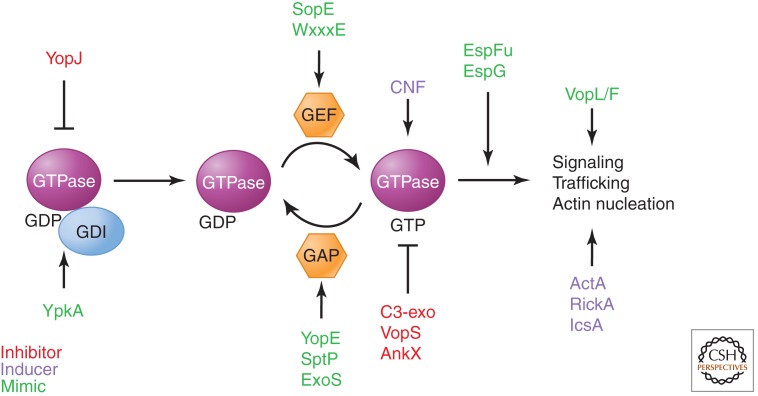
Multilevel regulation of small G proteins by bacterial effectors. Small G proteins cycle on and off membranes, exchange guanine nucleotides (GDP to GTP) for activation, hydrolyze GTP for inactivation, and stimulate downstream signaling pathways. Bacterial pathogens have evolved toxins and effector proteins to usurp nearly every aspect of small G-protein function, using molecular mimicry as well as novel stimulatory and inhibitory mechanisms.
References
-
- Alto NM, Shao F, Lazar CS, Brost RL, Chua G, Mattoo S, McMahon SA, Ghosh P, Hughes TR, Boone C, et al. 2006. Identification of a bacterial type III effector family with G protein mimicry functions. Cell 124: 133–145 - PubMed
-
- Andor A, Trulzsch K, Essler M, Roggenkamp A, Wiedemann A, Heesemann J, Aepfelbacher M 2001. YopE of Yersinia, a GAP for Rho GTPases, selectively modulates Rac-dependent actin structures in endothelial cells. Cell Microbiol 3: 301–310 - PubMed
-
- Black DS, Bliska JB 2000. The RhoGAP activity of the Yersinia pseudotuberculosis cytotoxin YopE is required for antiphagocytic function and virulence. Mol Microbiol 37: 515–527 - PubMed
-
- Broberg CA, Zhang L, Gonzalez H, Laskowski-Arce MA, Orth K 2010. A Vibrio effector protein is an inositol phosphatase and disrupts host cell membrane integrity. Science 329: 1660–1662 - PubMed
Publication types
MeSH terms
Substances
Grants and funding
LinkOut - more resources
Full Text Sources