Review
doi: 10.1101/cshperspect.a013011.
Herpes simplex viruses: mechanisms of DNA replication
Affiliations
- PMID: 22952399
- PMCID: PMC3428768
- DOI: 10.1101/cshperspect.a013011
Item in Clipboard
Review
Herpes simplex viruses: mechanisms of DNA replication
Cold Spring Harb Perspect Biol.
.
Abstract
Herpes simplex virus (HSV) encodes seven proteins necessary for viral DNA synthesis-UL9 (origin-binding protein), ICP8 (single-strand DNA [ssDNA]-binding protein), UL30/UL42 (polymerase), and UL5/UL8/UL52 (helicase/primase). It is our intention to provide an up-to-date analysis of our understanding of the structures of these replication proteins and how they function during HSV replication. The potential roles of host repair and recombination proteins will also be discussed.
Figures
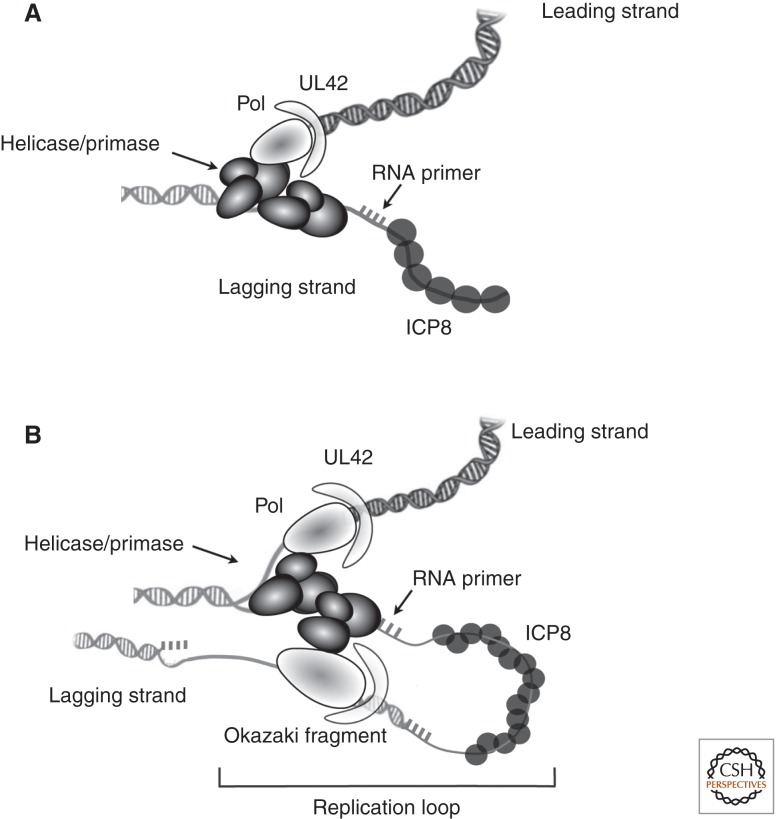
Organization of the HSV-1 replication fork. (A) Herpes simplex virus (HSV) replication fork. Two heterotrimeric complexes of the helicase-primase (H/P) (dark gray spheres with white centers) are shown at the replication fork. This model is based on a recent report that to achieve efficient primase activity at a forked substrate, two (or more) heterotrimers of the helicase-primase complex are required (Chen et al. 2011). In this diagram, a duplex DNA molecule is unwound by one molecule of H/P. The HSV polymerase (white shapes with gray centers in which UL30 is shown as an oval and UL42 as a crescent) performs leading-strand DNA synthesis on the top strand. On the bottom strand the second molecule of H/P is shown laying down an RNA primer depicted as hatched bars. The single-strand DNA (ssDNA) extruded behind the helicase is coated by the ssDNA-binding protein ICP8 (uniformly dark gray circles). (B) Coupled leading- and lagging-strand synthesis. Coupled leading- and lagging-strand DNA synthesis was recently reconstituted in vitro and requires HSV polymerase, helicase-primase, and ICP8 (Stengel and Kuchta 2011). In this model, coupled leading- and lagging-strand DNA synthesis requires two heterotrimers of helicase/primase and two molecules of the DNA polymerase. The leading- and lagging-strand polymerase molecules are proposed to communicate with each other mediated by interactions between UL30 and the UL5 and UL8 subunits of the H/P (reviewed in the text). A replication loop is formed in the lagging strand to align it with the leading strand. The lagging-strand DNA polymerase initiates Okazaki fragment synthesis using RNA primers (hatched bars).
References
-
- Appleton BA, Loregian A, Filman DJ, Coen DM, Hogle JM 2004. The cytomegalovirus DNA polymerase subunit UL44 forms a C clamp-shaped dimer. Mol Cell 15: 233–244 - PubMed
-
- Appleton BA, Brooks J, Loregian A, Filman DJ, Coen DM, Hogle JM 2006. The crystal structure of the cytomegalovirus DNA polymerase subunit with the C-terminus from the catalytic subunit: Differences in structure and function relative to unliganded UL44. J Biol Chem 281: 5224–5232 - PubMed
-
- Aslani A, Olsson M, Elias P 2002. ATP-dependent unwinding of a minimal origin of DNA replication by the origin-binding protein and the single-strand DNA-binding protein ICP8 from herpes simplex virus type I. J Biol Chem 277: 41204–41212 - PubMed
Publication types
MeSH terms
Substances
Grants and funding
LinkOut - more resources
Full Text Sources
Other Literature Sources