. 2012;7(8):e43124.
doi: 10.1371/journal.pone.0043124. Epub 2012 Aug 28.

Toll-like receptor (TLR2 and TLR4) polymorphisms and chronic obstructive pulmonary disease

Collaborators, Affiliations

Toll-like receptor (TLR2 and TLR4) polymorphisms and chronic obstructive pulmonary disease

Simona E Budulac et al. PLoS One. 2012.

Abstract

Toll-like receptors (TLRs) participate in the defence against bacterial infections that are common in patients with Chronic Obstructive Pulmonary Disease (COPD). We studied all tagging SNPs in TLR2 and TLR4 and their associations with the level and change over time of both FEV(1) and sputum inflammatory cells in moderate-to-severe COPD. Nine TLR2 SNPs and 17 TLR4 SNPs were genotyped in 110 COPD patients. Associations of SNPs with lung function and inflammatory cells in induced sputum were analyzed cross-sectionally with linear regression and longitudinally with linear mixed-effect models. Two SNPs in TLR2 (rs1898830 and rs11938228) were associated with a lower level of FEV(1) and accelerated decline of FEV(1) and higher numbers of sputum inflammatory cells. None of the TLR4 SNPs was associated with FEV(1) level. Eleven out of 17 SNPs were associated with FEV(1) decline, including rs12377632 and rs10759931, which were additionally associated with higher numbers of sputum inflammatory cells at baseline and with increase over time. This is the first longitudinal study showing that tagging SNPs in TLR2 and TLR4 are associated with the level and decline of lung function as well as with inflammatory cell numbers in induced sputum in COPD patients, suggesting a role in the severity and progression of COPD.


Conflict of interest statement

Competing Interests: The authors have read the journal's policy and have the following conflicts: SEB has no competing interests. DSP received funding for research from AstraZeneca, GSK, Nycomed. Travel to ERS or ATS has been partially funded by AstraZeneca, GSK, Chiesi, Nycomed. DSP has been consultant to AstraZeneca, Boehringer Ingelheim, Chiesi, GSK, Nycomed, TEVA. PSH has received unrestricted research grants for the Department of Pulmonology (Leiden University Medical Center) from Amgen, Boehringer Ingelheim, Centocor, Galapagos and GlaxoSmithKline. TSL has no competing interests. JMV has no competing interests. HMB has no competing interests. WT has received an unrestricted grant from Glaxo-SmithKline and a sponsored grant from Netherlands Asthma Funds. This does not alter the authors' adherence to all the PLoS ONE policies on sharing data and materials.

Figures

Figure 1
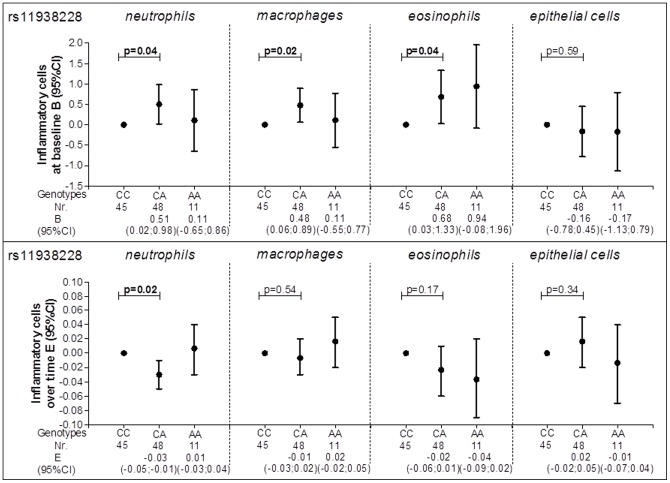
Figure 1. rs11938228 and inflammatory cells in induced sputum.
Circles represent the regression coefficient (estimate) and vertical bars the 95% confidence interval (CI); Nr. = number of subjects; Wild type was set as the reference category (CC); At baseline analyses are adjusted for age, gender, height, packyears and smoking status; Over time analyses are adjusted for age, gender, height, smoking status, the corresponding initial baseline variable, treatment, the period when there is a change in treatment and its interaction with treatment and the interaction of all variables with time.
Figure 2
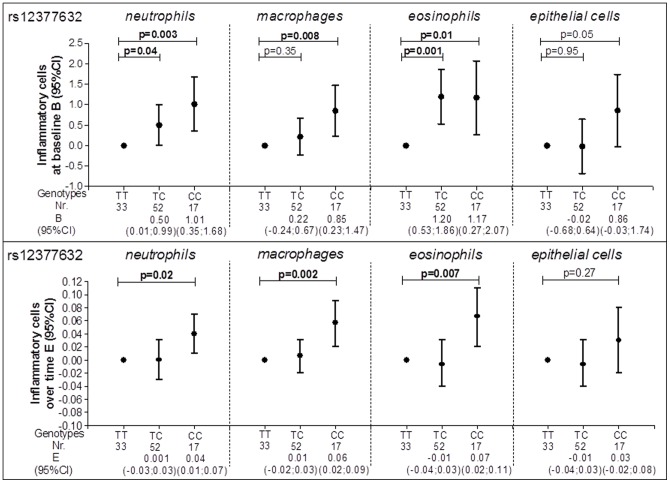
Figure 2. rs12377632 and inflammatory cells in induced sputum.
Circles represent the regression coefficient (estimate) and vertical bars the 95% confidence interval (CI); Nr. = number of subjects; Wild type was set as the reference category (TT); At baseline analyses are adjusted for age, gender, height, packyears and smoking status; Over time analyses are adjusted for age, gender, height, smoking status, the corresponding initial baseline variable, treatment, the period when there is a change in treatment and its interaction with treatment and the interaction of all variables with time.
Figure 3
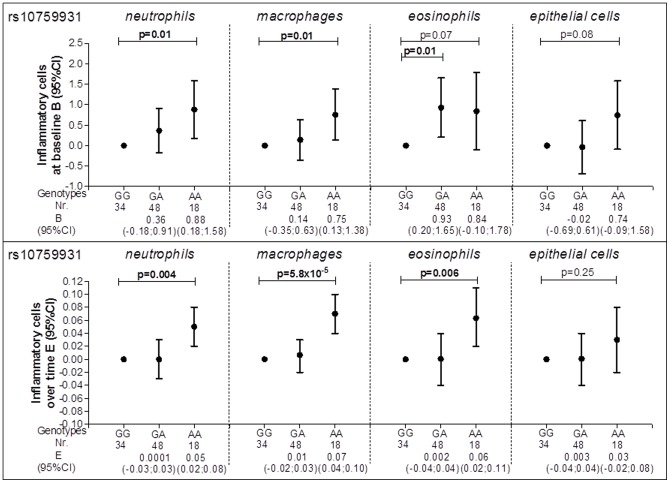
Figure 3. rs10759931 and inflammatory cells in induced sputum.
Circles represent the regression coefficient (estimate) and vertical bars the 95% confidence interval (CI); Nr. = number of subjects; Wild type was set as the reference category (GG); At baseline analyses are adjusted for age, gender, height, packyears and smoking status; Over time analyses are adjusted for age, gender, height, smoking status, the corresponding initial baseline variable, treatment, the period when there is a change in treatment and its interaction with treatment and the interaction of all variables with time.

References

    1. Schleimer RP (2005) Innate immune responses and chronic obstructive pulmonary disease: “Terminator” or “Terminator 2”? Proc Am Thorac Soc 2: 342–346. - PMC - PubMed
    1. Janeway CA Jr, Medzhitov R (2002) Innate immune recognition. Annu Rev Immunol 20: 197–216. - PubMed
    1. Kurt-Jones EA, Mandell L, Whitney C, Padgett A, Gosselin K, et al. (2002) Role of toll-like receptor 2 (TLR2) in neutrophil activation: GM-CSF enhances TLR2 expression and TLR2-mediated interleukin 8 responses in neutrophils. Blood 100: 1860–1868. - PubMed
    1. Baines KJ, Simpson JL, Gibson PG (2011) Innate immune responses are increased in chronic obstructive pulmonary disease. PLoS One 26: e18426. - PMC - PubMed
    1. von Scheele I, Larsson K, Dahlen B, Billing B, Skedinger M, et al. (2011) Toll-like receptor expression in smokers with and without COPD. Respir Med 105 8:1222–30. - PubMed

Publication types