


Conservative treatment, plate fixation, or prosthesis for proximal humeral fracture. A prospective randomized study
- PMID: 22954329
- PMCID: PMC3520878
- DOI: 10.1186/1471-2474-13-167
Conservative treatment, plate fixation, or prosthesis for proximal humeral fracture. A prospective randomized study
Abstract
Background: Proximal humerus fracture is the third most common fracture type after hip and distal radius fracture in elderly patients. A comprehensive study by Palvanen et al. demonstrated an increase in the annual fracture rate of 13.7% per year over the past 33 years. Should this trend continue, the fracture rate would triple over the next three decades. The increasing incidence of low-energy fractures raises questions about the optimal treatment in terms of functional outcome, pain, and rehabilitation time, as well as the economical impact. Despite the high incidence and costs of proximal humerus fractures, there is currently no valid scientific evidence for the best treatment method. Several publications, including a Cochrane review outline the need for high-quality, well-designed randomized controlled trials.
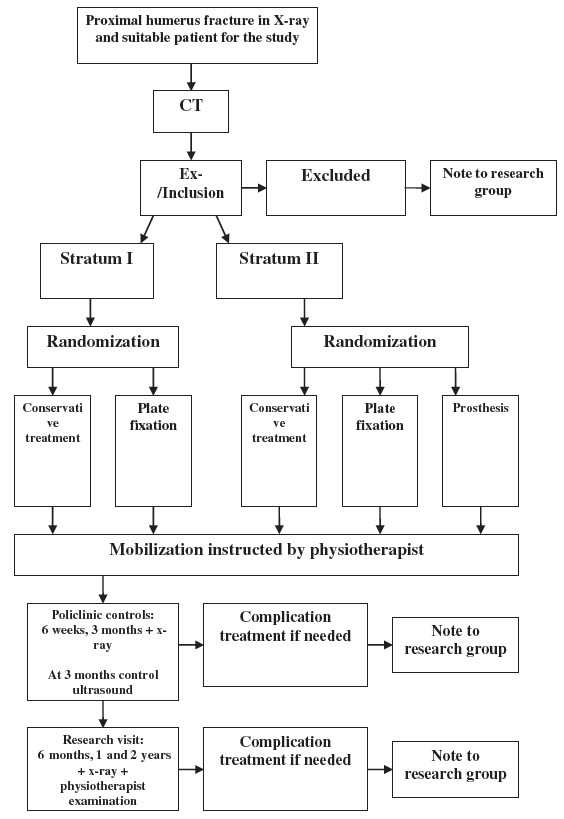
Methods/design: The study is a prospective, randomized, national multi-center trial. The hypothesis of the trial is that surgical treatment of displaced proximal humerus fractures achieves better functional outcome, pain relief, and patient satisfaction compared to conservative treatment. The trial is designed to compare conservative and surgical treatment of proximal humerus fractures in patients 60 years and older. The trial includes two strata. Stratum I compares surgical treatment with locking plates to conservative treatment for two-part fractures. Stratum II compares multi-fragmented fractures, including three- and four-part fractures. The aim of Stratum II is to compare conservative treatment, surgical treatment with the Philos locking plate, and hemiarthroplasty with an Epoca prosthesis. The primary outcome measure will be the Disabilities of the Arm, Shoulder and Hand (DASH) score and the secondary outcome measures will be the EuroQol-5D (EQ-5D) value, OSS, Constant-Murley Score, VAS, and 15D.Recruiting time will be 3 years. The results will be analyzed after the 2-year follow-up period.
Discussion: This publication presents a prospective, randomized, national multi-center trial. It gives details of patient flow, randomization, aftercare and also ways of analysis of the material and ways to present and publish the results.
Trial registration: ClinicalTrials.gov identifier: NCT01246167.
Figures
References
-
- Seeley DG, Browner WS, Nevitt MC, Genant HK, Scott JC, Cummings SR. Which fractures are associated with low appendicular bone mass in elderly women? The Study of Osteoporotic Fractures Research Group. Ann Intern Med. 1991;115(11):837–842. - PubMed
Publication types
MeSH terms
Associated data
LinkOut - more resources
Full Text Sources
Medical
Miscellaneous
