


Efficacy of antiepileptic drugs in adults predicts efficacy in children: a systematic review
- PMID: 22955136
- PMCID: PMC4098824
- DOI: 10.1212/WNL.0b013e31826d5ec0
Efficacy of antiepileptic drugs in adults predicts efficacy in children: a systematic review
Abstract
Objective: Due to the challenges inherent in performing clinical trials in children, a systematic review of published clinical trials was performed to determine whether the efficacy of antiepileptic drugs (AEDs) in adults can be used to predict the efficacy of AEDs in the pediatric population.
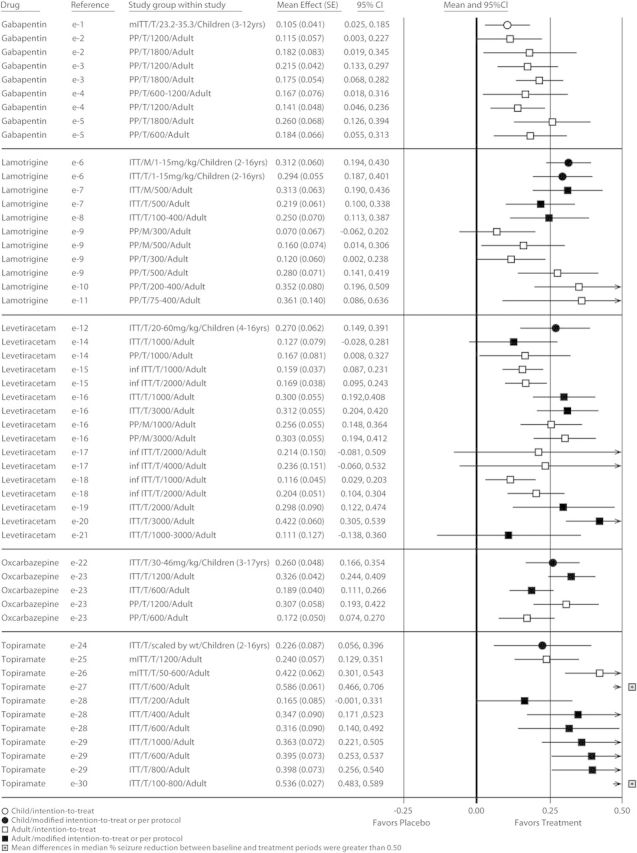
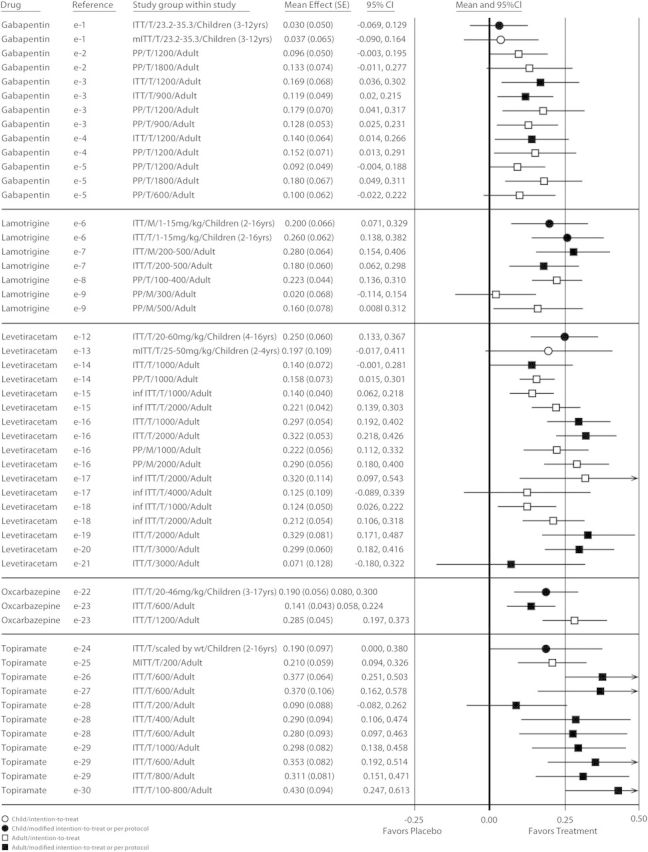
Methods: Medline/PubMed, EMBASE, and Cochrane library searches (1970-January 2010) were conducted for clinical trials of partial-onset seizures (POS) and primary generalized tonic-clonic seizures (PGTCS) in adults and in children <2 and 2-18 years. Independent epidemiologists used standardized search and study evaluation criteria to select eligible trials. Forest plots were used to investigate the relative strength of placebo-subtracted effect measures.
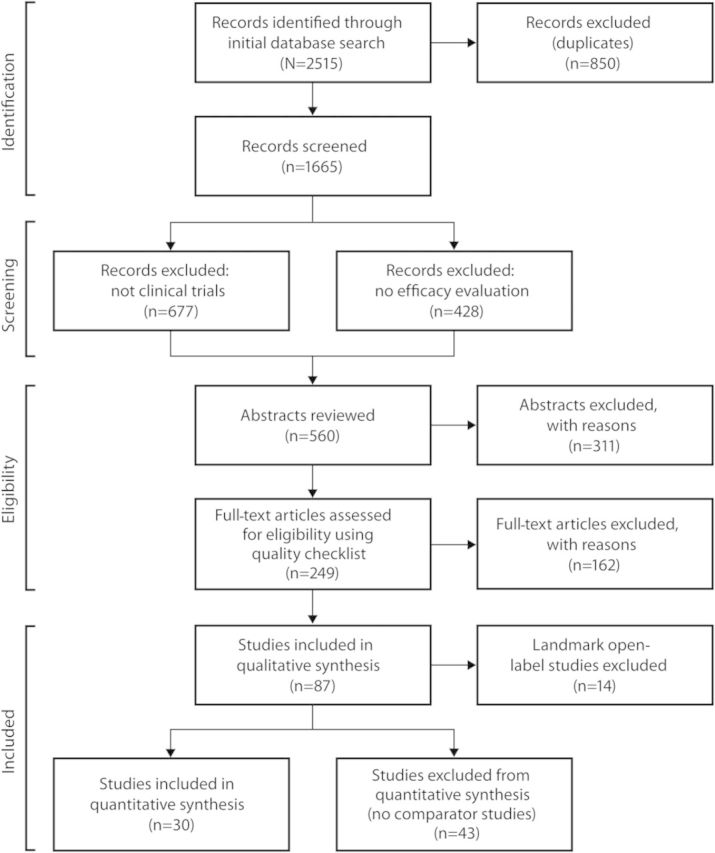
Results: Among 30 adjunctive therapy POS trials in adults and children (2-18 years) that met evaluation criteria, effect measures were consistent between adults and children for gabapentin, lamotrigine, levetiracetam, oxcarbazepine, and topiramate. Placebo-subtracted median percent seizure reduction between baseline and treatment periods (ranging from 7.0% to 58.6% in adults and from 10.5% to 31.2% in children) was significant for 40/46 and 6/6 of the treatment groups studied. The ≥50% responder rate (ranging from 2.0% to 43.0% in adults and from 3.0% to 26.0% in children) was significant for 37/43 and 5/8 treatment groups. In children <2 years, an insufficient number of trials were eligible for analysis.
Conclusions: This systematic review supports the extrapolation of efficacy results in adults to predict a similar adjunctive treatment response in 2- to 18-year-old children with POS.
Figures
Comment in
-
Efficacy of antiepileptic drugs in adults vs children: does one size fit all?Neurology. 2012 Oct 2;79(14):1420-1. doi: 10.1212/WNL.0b013e31826d601d. Epub 2012 Sep 5. Neurology. 2012. PMID: 22955137 No abstract available.
References
-
- Rocchi F, Tomasi P.The development of medicines for children: part of a series on pediatric pharmacology, guest edited by Gianvincenzo Zuccotti, Emilio Clementi, and Massimo Molteni.Pharmacol Res 2011;64:169–175 - PubMed
-
- ICH Topic E 11 Clinical Investigation of Medicinal Products in the Paediatric Population: Note for Guidance on Clinical Investigation of Medicinal Products in the Paediatric Population (CPMP/ICH/2711/99). [Accessed December 1, 2011]. Available at: www.ema.europa.eu/pdfs/human/ich/271199en.pdf.
-
- Chiron C, Dulac O, Pons G.Antiepileptic drug development in children: considerations for a revisited strategy.Drugs 2008;68:17–25 - PubMed
-
- Jadad AR, Moore RA, Carroll D, et al. Assessing the quality of reports of randomized clinical trials: is blinding necessary? Control Clin Trials 1996;17:1–12 - PubMed
Publication types
MeSH terms
Substances
LinkOut - more resources
Full Text Sources
Other Literature Sources
Medical
Miscellaneous
