. 2012 Oct 25;120(17):3510-8.
doi: 10.1182/blood-2012-03-415448. Epub 2012 Sep 6.

Targeting JAK1/2 and mTOR in murine xenograft models of Ph-like acute lymphoblastic leukemia

Affiliations

Targeting JAK1/2 and mTOR in murine xenograft models of Ph-like acute lymphoblastic leukemia

Shannon L Maude et al. Blood. .

Abstract

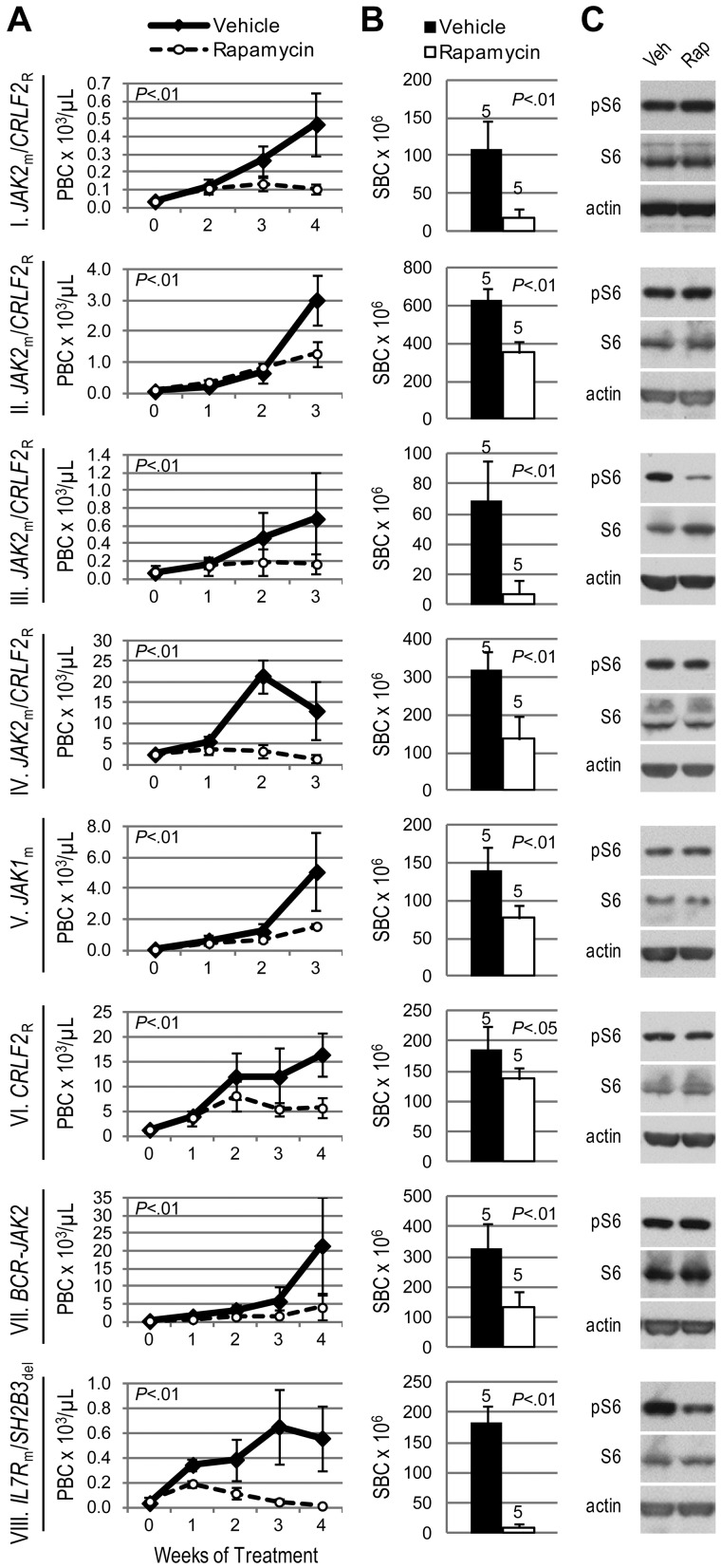
CRLF2 rearrangements, JAK1/2 point mutations, and JAK2 fusion genes have been identified in Philadelphia chromosome (Ph)-like acute lymphoblastic leukemia (ALL), a recently described subtype of pediatric high-risk B-precursor ALL (B-ALL) which exhibits a gene expression profile similar to Ph-positive ALL and has a poor prognosis. Hyperactive JAK/STAT and PI3K/mammalian target of rapamycin (mTOR) signaling is common in this high-risk subset. We, therefore, investigated the efficacy of the JAK inhibitor ruxolitinib and the mTOR inhibitor rapamycin in xenograft models of 8 pediatric B-ALL cases with and without CRLF2 and JAK genomic lesions. Ruxolitinib treatment yielded significantly lower peripheral blast counts compared with vehicle (P < .05) in 6 of 8 human leukemia xenografts and lower splenic blast counts (P < .05) in 8 of 8 samples. Enhanced responses to ruxolitinib were observed in samples harboring JAK-activating lesions and higher levels of STAT5 phosphorylation. Rapamycin controlled leukemia burden in all 8 B-ALL samples. Survival analysis of 2 representative B-ALL xenografts demonstrated prolonged survival with rapamycin treatment compared with vehicle (P < .01). These data demonstrate preclinical in vivo efficacy of ruxolitinib and rapamycin in this high-risk B-ALL subtype, for which novel treatments are urgently needed, and highlight the therapeutic potential of targeted kinase inhibition in Ph-like ALL.


Figures
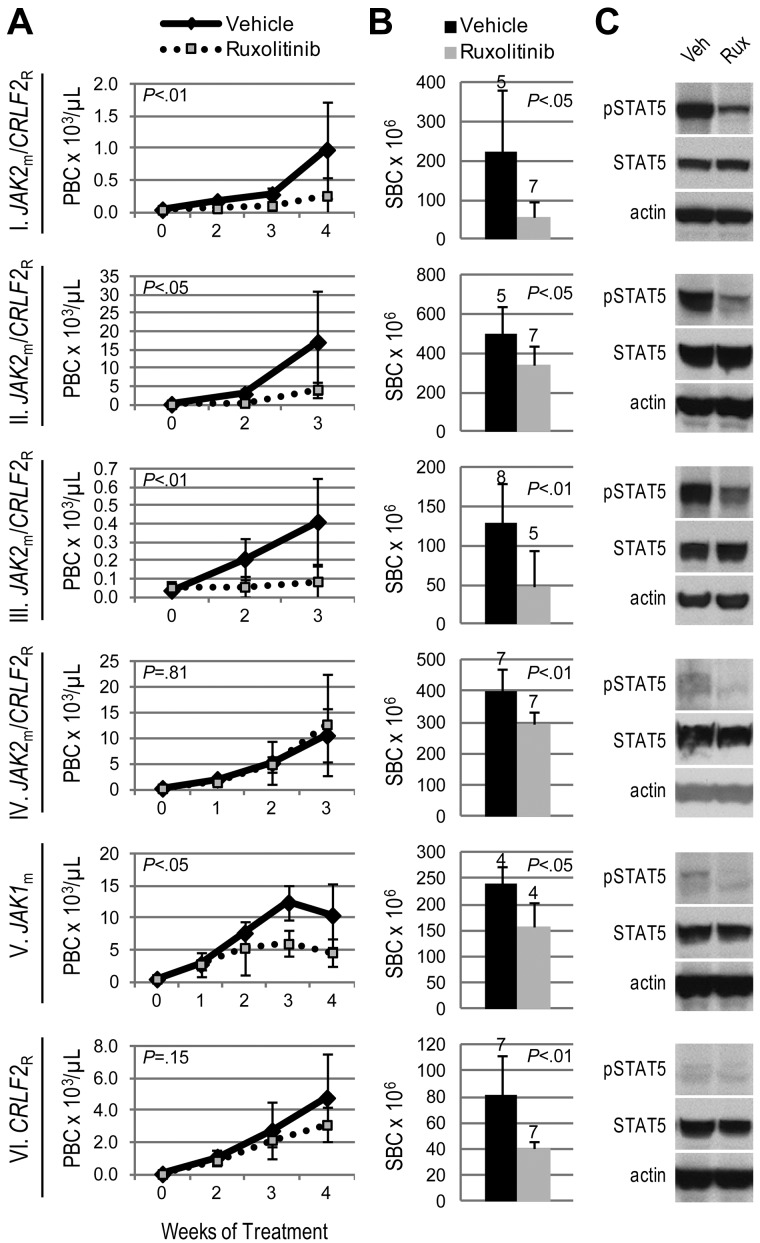
Figure 1
Figure 1
Efficacy of ruxolitinib in xenograft models of Ph-like ALL. Genetic lesions are indicated to the left of each row. (A) Peripheral blast count (PBC) over time in JAK-mutated (JAKm) or wild-type (JAKwt) and CRLF2-rearranged (CRLF2R) or nonrearranged (CRLF2NR) ALL xenografts. Graphed are means and SDs with PBC × 103 per microliter on the vertical axis and weeks of treatment on the horizontal axis; n indicated in panel B. (B) Splenic blast count (SBC) at sacrifice. Means and SDs are graphed with the vertical axis representing absolute SBC × 106; n for each arm indicated above bar. (C) Levels of phosphorylated STAT5 (pSTAT5) by immunoblot. Xenografts were treated with ruxolitinib (rux) or vehicle (veh) for 72 hours, spleens were harvested, and protein lysates subjected to immunoblot for pSTAT5, total STAT5, and actin.
Figure 2
Figure 2
Activity of ruxolitinib in ALL xenografts with JAK/STAT pathway activation. Genetic lesions are indicated to the left of each row. (A) Peripheral blast count (PBC) over time. Graphed are means and SDs with PBC × 103 per microliter on the vertical axis and weeks of treatment on the horizontal axis; n indicated in panel B. (B) Splenic blast count (SBC) at sacrifice. Means and SDs are graphed with the vertical axis representing absolute SBC × 106; n for each arm indicated above bar. (C) Levels of phosphorylated STAT5 (pSTAT5) by immunoblot. Xenografts were treated with ruxolitinib (rux) or vehicle (veh) for 72 hours, spleens were harvested, and protein lysates subjected to immunoblot for pSTAT5, total STAT5, and actin. (D) Comparison of basal levels of pSTAT5 in vehicle-treated xenografts. A representative immunoblot for pSTAT5, total STAT5, and actin is shown on the left, and quantitation of pSTAT5 signal intensity (normalized to actin signal intensity and graphed relative to xenograft V) in 3 vehicle-treated xenografts is shown on the right.
Figure 3
Figure 3
Efficacy of rapamycin in xenograft models of Ph-like ALL. Genetic lesions are indicated to the left of each row. (A) Peripheral blast count (PBC) over time in ALL xenografts. Graphed are means and SDs with PBC × 103 per microliter on the vertical axis and weeks of treatment on the horizontal axis; n indicated in panel B. (B) Splenic blast count (SBC) at sacrifice. Means and SDs are graphed with the vertical axis representing absolute SBC × 106; n for each arm indicated above bar. (C) Levels of phosphorylated ribosomal protein S6 (pS6) by immunoblot. Xenografts were treated with rapamycin (rap) or vehicle (veh) for 72 hours, spleens were harvested, and protein lysates subjected to immunoblot for pS6, total S6, and actin.
Figure 4
Figure 4
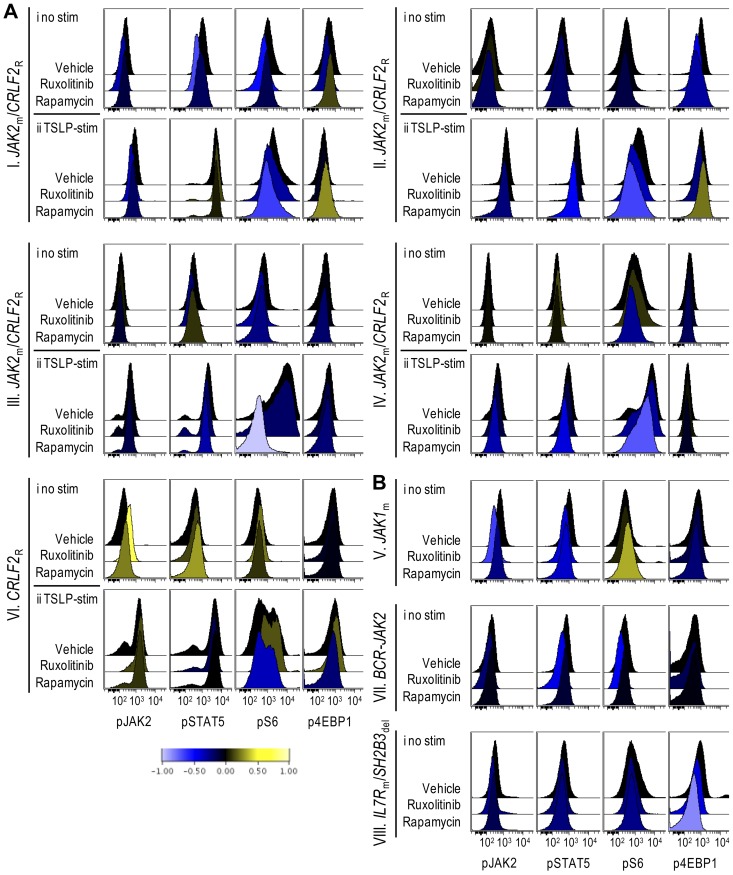
Phosphoflow analysis of in vivo target inhibition. ALL xenografts were treated with vehicle, ruxolitinib, or rapamycin for 72 hours, spleens were harvested, and cells were gated on CD10+/CD19+/TSLPR+ populations (CRLF2R xenografts) or CD10+/CD19+ populations (CRLF2NR xenografts) and analyzed by phosphoflow cytometry for levels of phosphorylated (p)JAK2, STAT5, S6, and 4EBP1. Data were arcsinh-transformed and are represented as histograms of median fluorescent intensities. Down-regulation and up-regulation of phosphorylation relative to vehicle controls are represented by shift to the left (blue) and right (yellow), respectively, on the horizontal axis per the colorimetric scale (bottom). (A) Histograms of (i) unstimulated and (ii) TSLP-stimulated CRLF2R xenografts. (B) Histograms of unstimulated CRLF2NR xenografts.
Figure 5
Figure 5
Rapamycin prolongs survival of JAK-mutated ALL xenografts. Kaplan-Meier survival analysis of xenografts (A) IV and (B) V, demonstrating percent surviving (vertical axis) from the start of treatment (horizontal axis represents days of treatment) with rapamycin (n = 5) or vehicle (n = 5). Median survival of each arm and P values, determined by log-rank test, are indicated.

References

    1. Hunger SP, Lu X, Devidas M, et al. Improved survival for children and adolescents with acute lymphoblastic leukemia between 1990 and 2005: a report from the Children's Oncology Group. J Clin Oncol. 2012;30(14):1663–1669. - PMC - PubMed
    1. Den Boer ML, van Slegtenhorst M, De Menezes RX, et al. A subtype of childhood acute lymphoblastic leukaemia with poor treatment outcome: a genome-wide classification study. Lancet Oncol. 2009;10(2):125–134. - PMC - PubMed
    1. Zhang J, Mullighan CG, Harvey RC, et al. Key pathways are frequently mutated in high-risk childhood acute lymphoblastic leukemia: a report from the Children's Oncology Group. Blood. 2011;118(11):3080–3087. - PMC - PubMed
    1. Mullighan CG, Su X, Zhang J, et al. Deletion of IKZF1 and prognosis in acute lymphoblastic leukemia. N Engl J Med. 2009;360(5):470–480. - PMC - PubMed
    1. Mullighan CG, Goorha S, Radtke I, et al. Genome-wide analysis of genetic alterations in acute lymphoblastic leukaemia. Nature. 2007;446(7137):758–764. - PubMed

Publication types

MeSH terms