


Compassion meditation enhances empathic accuracy and related neural activity
- PMID: 22956676
- PMCID: PMC3541495
- DOI: 10.1093/scan/nss095
Compassion meditation enhances empathic accuracy and related neural activity
Abstract
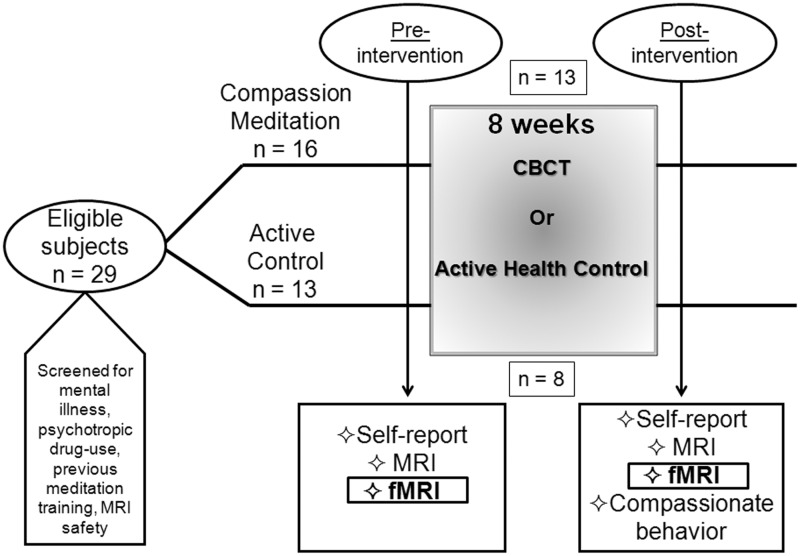
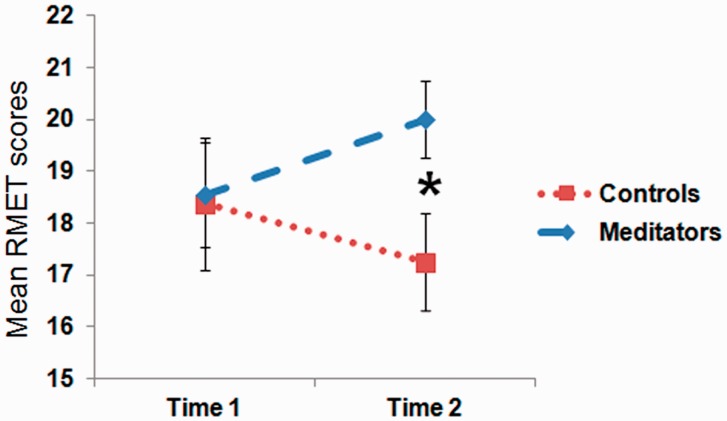
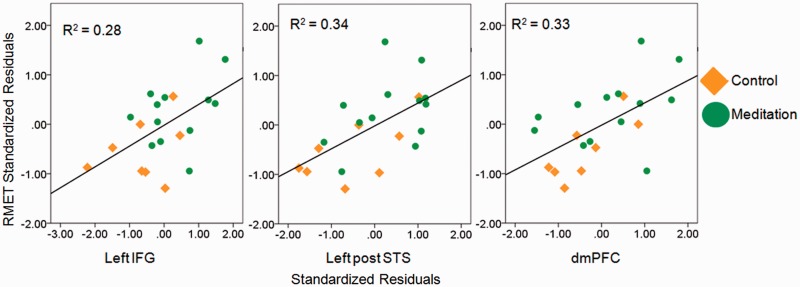
The ability to accurately infer others' mental states from facial expressions is important for optimal social functioning and is fundamentally impaired in social cognitive disorders such as autism. While pharmacologic interventions have shown promise for enhancing empathic accuracy, little is known about the effects of behavioral interventions on empathic accuracy and related brain activity. This study employed a randomized, controlled and longitudinal design to investigate the effect of a secularized analytical compassion meditation program, cognitive-based compassion training (CBCT), on empathic accuracy. Twenty-one healthy participants received functional MRI scans while completing an empathic accuracy task, the Reading the Mind in the Eyes Test (RMET), both prior to and after completion of either CBCT or a health discussion control group. Upon completion of the study interventions, participants randomized to CBCT and were significantly more likely than control subjects to have increased scores on the RMET and increased neural activity in the inferior frontal gyrus (IFG) and dorsomedial prefrontal cortex (dmPFC). Moreover, changes in dmPFC and IFG activity from baseline to the post-intervention assessment were associated with changes in empathic accuracy. These findings suggest that CBCT may hold promise as a behavioral intervention for enhancing empathic accuracy and the neurobiology supporting it.
Figures

References
-
- Adams RB, Jr, Rule NO, Franklin RG, Jr, et al. Cross-cultural reading the mind in the eyes: an fMRI investigation. Journal of Cognitive Neuroscience. 2010;22(1):97–108. - PubMed
-
- Allison T, Puce A, McCarthy G. Social perception from visual cues: role of the STS region. Trends in Cognitive Science. 2000;4:267–78. - PubMed
-
- Baron-Cohen S. Mindblindness: An Essay on Autism and Theory of Mind. Cambridge, MA: The MIT Press; 1995.
-
- Baron-Cohen S, Ring H, Chitnis X, et al. fMRI of parents of children with Asperger syndrome: a pilot study. Brain and Cognition. 2006;61(1):122–30. - PubMed
-
- Baron-Cohen S, Ring HA, Wheelwright S, et al. Social intelligence in the normal and autistic brain: an fMRI study. European Journal of Neuroscience. 1999;11(6):1891–8. - PubMed
Publication types
MeSH terms
Grants and funding
LinkOut - more resources
Full Text Sources
Medical
