. 2012 Jul;2(7):1458-67.
doi: 10.1002/ece3.268.

Inferring the annual migration patterns of fall armyworm (Lepidoptera: Noctuidae) in the United States from mitochondrial haplotypes

Affiliations

Inferring the annual migration patterns of fall armyworm (Lepidoptera: Noctuidae) in the United States from mitochondrial haplotypes

Rodney N Nagoshi et al. Ecol Evol. 2012 Jul.

Abstract

Spodoptera frugiperda (J. E. Smith) or fall armyworm is an important agricultural pest of a number of crops in the western hemisphere. In the United States, infestations in corn acreages extend from the Mexican to the Canadian border. Because fall armyworm does not survive prolonged freezing, the infestations annually affecting most of North America are migrants from southern Texas and Florida, where winter temperatures are mild and host plants are available. A haplotype method was developed that can distinguish between these two geographically distant overwintering populations, with the potential to delineate the associated migratory pathways. Several years of collections from major corn-producing areas in the southern, central, and eastern United States were used to map the geographical distribution of the fall armyworm haplotypes. From these haplotype profiles, it was possible to develop the most detailed description yet of the annual northward movements of fall armyworm. The consistency of these results with past studies and the implications on our understanding of fall armyworm biology are discussed. A better understanding of fall armyworm populations and their movement is critical for the development of strategies to predict infestation levels and eventually control this pest in the United States.

Keywords: Migration; Spodoptera frugiperda; molecular haplotypes.


Figures
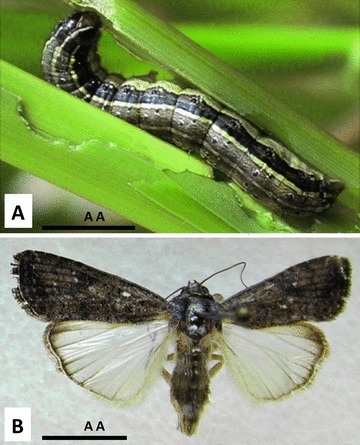
Figure 1
Figure 1
Fall armyworm (Spodoptera frugiperda) larva and adult. (A) Late instar larva feeding on corn (Courtesy: C. Stuhl, USDA-ARS). (B) Adult male from pheromone trap (Courtesy: M. Hay-Roe, USDA-ARS).
Figure 2
Figure 2
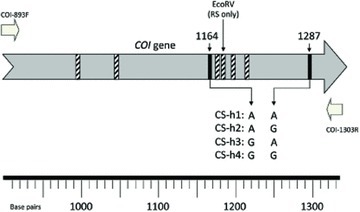
Diagram of the portion of mitochondrial Cytochrome Oxidase I (COI) gene used to identify strain and the individual corn-strain (CS) haplotypes. The putative translational start site of the COI gene was arbitrarily designated as coordinate 0. Short block arrows indicate location and direction of the COI-893F and COI-1303R primers used for PCR amplification and DNA sequencing. Vertical lines within the COI gene identify polymorphic sites with the rice-strain (RS) specific EcoRV site identified. All polymorphic sites except 1287 were used to identify or confirm strain identity. The CS-h haplotypes were determined by the polymorphisms at site 1164 and 1287.
Figure 3
Figure 3
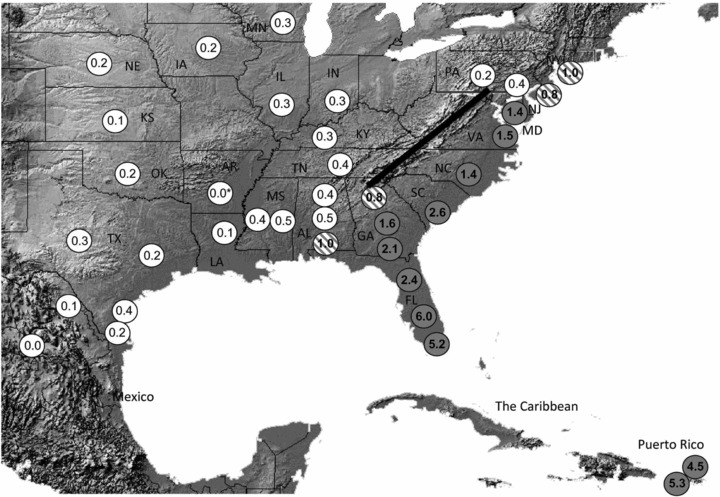
Map summarizing the geographical distribution of h4/h2 haplotype ratios from collections listed in Table 2. Ratios from central and southern Texas and southern Florida representing multiple years from the same locations were averaged. Shaded circles indicate the FL group with ratios >1.0. Open circles depict the TX group defined by ratios <0.6. Circles with diagonal lines identify collections with intermediate ratios. Haplotype ratios for Puerto Rico are from Nagoshi et al. (2010). The asterisk identifies the ratio obtained from 13 specimens collected at several sites in Arkansas. Because of the small sample size, these data were not included in the analyses in Table 2 or 3, but is presented here to show consistency with neighboring areas. Diagonal line follows the major elevations of the Appalachian Mountain range. Map courtesy of the United States Geological Survey.
Figure 4
Figure 4
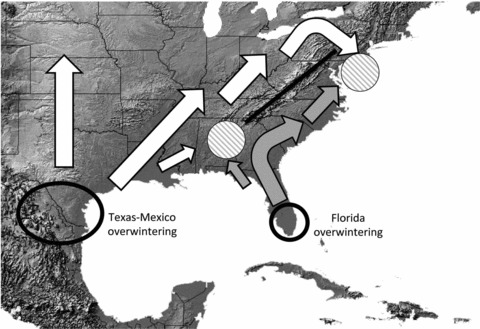
Same map as in Figure 2 showing migratory pathways inferred from the geographical distribution of haplotype ratios. Open ovals estimate the extent of the overwintering range in Texas and Florida. Fall armyworm can overwinter in the Caribbean but whether these populations contribute to those in Florida is a matter of speculation (see text). White arrows indicated putative direction of the migration from the Texas–Mexico overwintering areas. Shaded arrows depict movement from Florida populations. Lined circles approximate locations of “hybrid zones” where the two migratory pathways appear to overlap. Diagonal line follows the major elevations of the Appalachian Mountain range.

References

    1. Drummond AJ, Ashton B, Buxton S, Cheung M, Cooper A, Duran C, Field M, Heled J, Kearse M, Markowitz S, et al. Geneious v5.5. 2010. Available at: http://www.geneious.com.
    1. Fleischer SJ, Harding CL, Blom PE, White J, Grehan J. Spodoptera frugiperda pheromone lures to avoid nontarget captures of Leucania phragmatidicola. J. Econ. Entomol. 2005;98:66–71. - PubMed
    1. Hebert PDN, Cywinska A, Ball SL, DeWaard JR. Biological identifications through DNA barcodes. Proc. R. Soc. Lond. Ser. B. 2003;270:313–321. - PMC - PubMed
    1. Johnson SJ. Insect migration in North America: synoptic-scale transport in a highly seasonal environment. In: Drake VA, Gatehouse AG, editors. Insect migration: tracking resources through space and time. Cambridge, U.K.: Cambridge Univ. Press; 1995. pp. 31–66.
    1. Luginbill P. The fall armyworm. U.S. Dept. Agric. Tech. Bull. 1928;34:1–91.

LinkOut - more resources