


Loss of SUFU function in familial multiple meningioma
- PMID: 22958902
- PMCID: PMC3511996
- DOI: 10.1016/j.ajhg.2012.07.015
Loss of SUFU function in familial multiple meningioma
Abstract
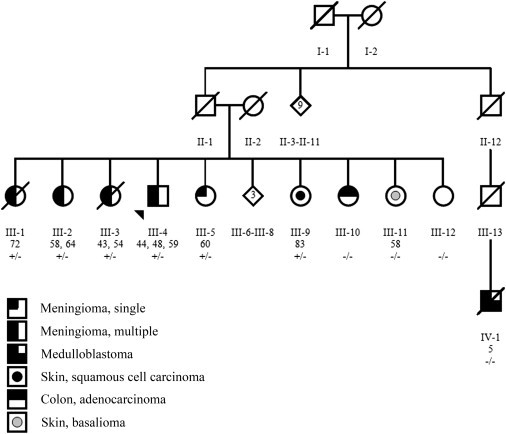
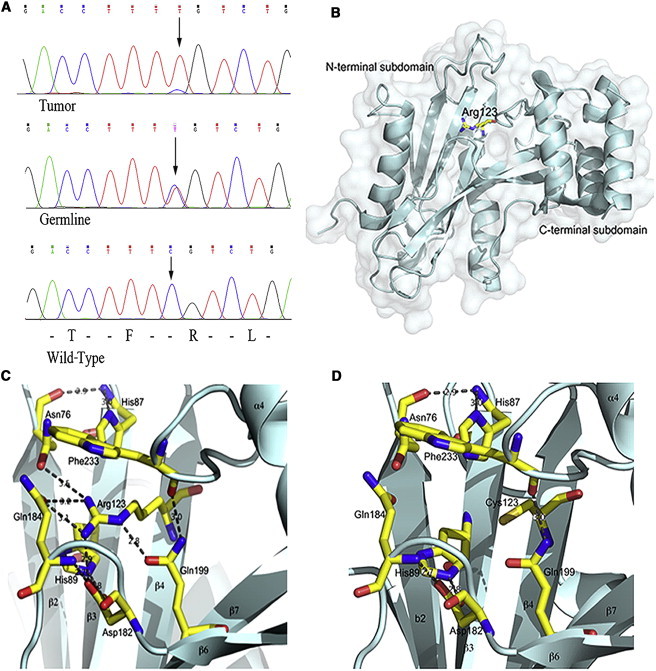
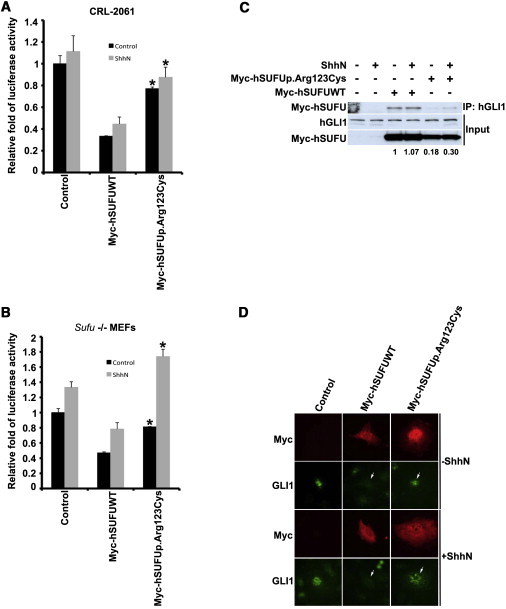
Meningiomas are the most common primary tumors of the CNS and account for up to 30% of all CNS tumors. An increased risk of meningiomas has been associated with certain tumor-susceptibility syndromes, especially neurofibromatosis type II, but no gene defects predisposing to isolated familial meningiomas have thus far been identified. Here, we report on a family of five meningioma-affected siblings, four of whom have multiple tumors. No NF2 mutations were identified in the germline or tumors. We combined genome-wide linkage analysis and exome sequencing, and we identified in suppressor of fused homolog (Drosophila), SUFU, a c.367C>T (p.Arg123Cys) mutation segregating with the meningiomas in the family. The variation was not present in healthy controls, and all seven meningiomas analyzed displayed loss of the wild-type allele according to the classic two-hit model for tumor-suppressor genes. In silico modeling predicted the variant to affect the tertiary structure of the protein, and functional analyses showed that the activity of the altered SUFU was significantly reduced and therefore led to dysregulated hedgehog (Hh) signaling. SUFU is a known tumor-suppressor gene previously associated with childhood medulloblastoma predisposition. Our genetic and functional analyses indicate that germline mutations in SUFU also predispose to meningiomas, particularly to multiple meningiomas. It is possible that other genic mutations resulting in aberrant activation of the Hh pathway might underlie meningioma predisposition in families with an unknown etiology.
Copyright © 2012 The American Society of Human Genetics. Published by Elsevier Inc. All rights reserved.
Figures
References
-
- CBTRUS (2011). CBTRUS Statistical Report: Primary Brain and Central Nervous System Tumors Diagnosed in the United States in 2004–2007. Central Brain Tumor Registry of the United States, www.cbtrus.org. - PubMed
-
- Krampla W., Newrkla S., Pfisterer W., Jungwirth S., Fischer P., Leitha T., Hruby W., Tragl K.H. Frequency and risk factors for meningioma in clinically healthy 75-year-old patients: Results of the Transdanube Ageing Study (VITA) Cancer. 2004;100:1208–1212. - PubMed
-
- Vernooij M.W., Ikram M.A., Tanghe H.L., Vincent A.J., Hofman A., Krestin G.P., Niessen W.J., Breteler M.M., van der Lugt A. Incidental findings on brain MRI in the general population. N. Engl. J. Med. 2007;357:1821–1828. - PubMed
-
- Nahser H.C., Grote W., Löhr E., Gerhard L. Multiple meningiomas. Clinical and computer tomographic observations. Neuroradiology. 1981;21:259–263. - PubMed
Publication types
MeSH terms
Substances
LinkOut - more resources
Full Text Sources
Other Literature Sources
Molecular Biology Databases
Research Materials
Miscellaneous
