


doi: 10.1016/j.bmcl.2012.08.045.
Epub 2012 Aug 21.
Biosynthesis of anti-HCV compounds using thermophilic microorganisms
Affiliations
- PMID: 22959520
- PMCID: PMC7125738
- DOI: 10.1016/j.bmcl.2012.08.045
Item in Clipboard
Biosynthesis of anti-HCV compounds using thermophilic microorganisms
Bioorg Med Chem Lett.
.
Abstract
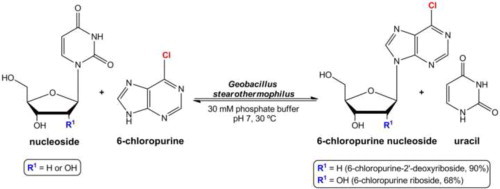
This work describes the application of thermophilic microorganisms for obtaining 6-halogenated purine nucleosides. Biosynthesis of 6-chloropurine-2'-deoxyriboside and 6-chloropurine riboside was achieved by Geobacillus stearothermophilus CECT 43 with a conversion of 90% and 68%, respectively. Furthermore, the selected microorganism was satisfactorily stabilized by immobilization in an agarose matrix. This biocatalyst can be reused at least 70 times without significant loss of activity, obtaining 379mg/L of 6-chloropurine-2'-deoxyriboside. The obtained compounds can be used as antiviral agents.
Copyright © 2012 Elsevier Ltd. All rights reserved.
Figures
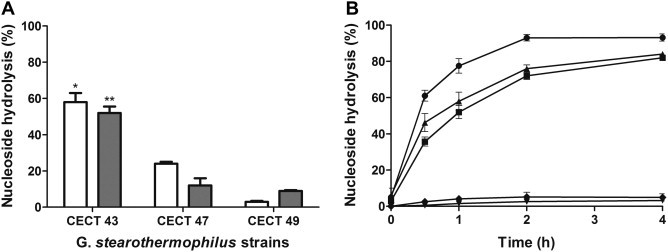
Selection of G. stearothermophilus strain for 6-halogenated purine nucleosides biosynthesis. Hydrolysis reactions were carried out three times using 1 × 10 CFU (colony forming units), 2 mM nucleoside in 0.5 ml of potassium phosphate buffer (30 mM, pH 7) at 55 °C and 200 rpm. The reaction medium without microorganisms was used as control. (A) Hydrolysis of dThd (white) and Urd (gray) using different G. stearothermophilus strains at 1 h of reaction. Significant differences when dThd (∗P <0.001) and Urd (∗∗P <0.001) were used. (B) Hydrolysis of different sugar donors: dThd (triangle), Urd (square), dUrd (circle), araUra (inverted triangle) and ddUrd (rhombus) using G. stearothermophilus CECT 43. Thermophilic microorganisms were kindly supplied by the ‘Colección Española de Cultivos Tipo (CECT)’, Universidad de Valencia (Spain).
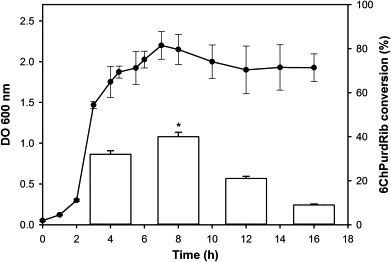
Biosynthesis of 6ChPurdRib at different growth stages. G. stearothermophilus was grown at 55 °C in media contained 10 g/L meat peptone, 5 g/L yeast extract, 5 g/L NaCl and 4 g/L glucose at pH 7, and 1 × 10¹⁰ CFU were collected at several times. Biosynthesis was carried out during 2 h of reaction in 0.5 ml of potassium phosphate buffer (30 mM, pH 7) at 55 °C and 200 rpm using 2 mM 6ChPur and 6 mM dUrd as substrates. All reactions were performed three times and conversion was calculated as: (mmol product/mmol limiting reagent) ∗ 100. Significant differences respect to the other growth times: ∗P <0.001.
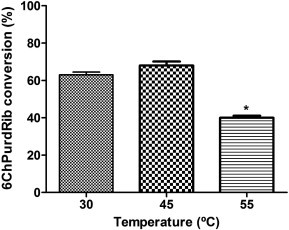
Biosynthesis of 6ChPurdRib at different temperatures. Reactions were carried out three times in 0.5 ml of potassium phosphate buffer (30 mM, pH 7) during 2 h using 1 × 10¹⁰ CFU, 2 mM 6ChPur and 6 mM dUrd at 200 rpm. Conversion was calculated as: (mmol product/mmol limiting reagent) ∗ 100. Significant differences respect to 30 and 45 °C: ∗P <0.001.
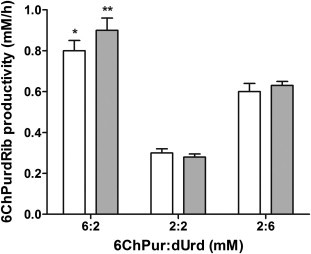
6ChPurdRib productivity using different initial molar ratios of substrates. Reactions were performed during 1 h (white) and 2 h (gray) with 1 × 10¹⁰ CFU at 30 °C in potassium phosphate buffer (30 mM, pH 7) and 200 rpm using 6ChPur and dUrd at different ratios (base/2′-deoxyriboside). All reactions were performed three times and productivity was calculated relative to the limiting reagent concentration. Significant differences at 1 h (∗P <0.001) or 2 h (∗∗P <0.001) of reaction respect to other ratios.
References
-
- Ikejiri M., Ohshima T., Kato K., Toyama M., Murata T., Shimotohno K., Maruyama T. Nucleic Acids Symp. Ser. (Oxf). 2007:439. - PubMed
-
- Pankiewicz K.W., Goldstein B.M. In: Society A.C., editor. Vol. 839. American Chemical Society; Washington, DC: 2003. p. 1. (ACS Symposium Series).
-
- Trelles J.A., Valino A.L., Runza V., Lewkowicz E.S., Iribarren A.M. Biotechnol. Lett. 2005;27:759. - PubMed
Publication types
MeSH terms
Substances
LinkOut - more resources
Full Text Sources
Molecular Biology Databases
