


Gliomas and seizures
- PMID: 22959996
- PMCID: PMC5736012
- DOI: 10.1016/j.mehy.2012.07.037
Gliomas and seizures
Abstract
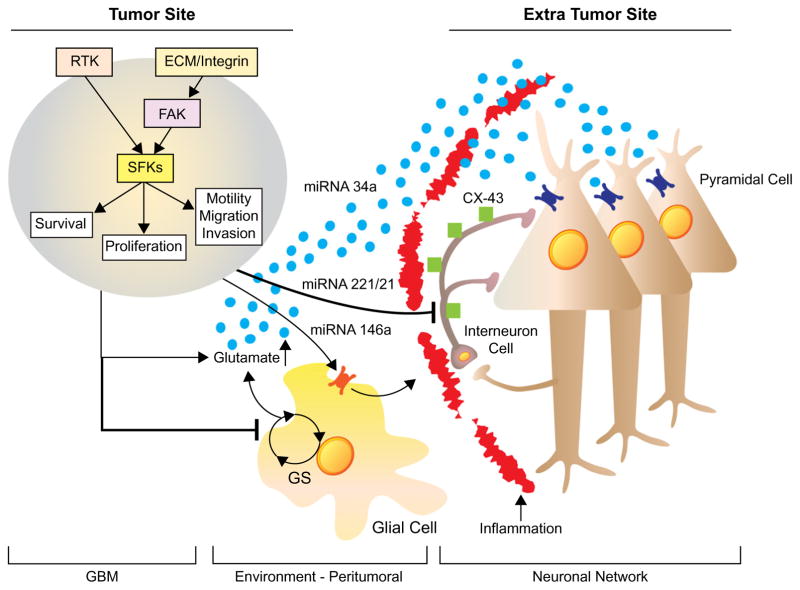
Glial neoplasms account for nearly 50% of all adult primary brain tumors. They originate from glial cells in the brain and/or spinal cord and include low-grade diffuse astrocytomas, anaplastic-astrocytomas, and glioblastomas. Of all brain tumors, glioblastoma multiforme (GBM) is the most aggressive and is characterized by rapid glial cell growth, resistance to radio- and chemo- therapies, and relentless infiltration and spreading throughout the central nervous system (CNS). In glioblastomas, primary tumor growth and CNS invasion are associated with the activation of complex structural molecular and metabolic changes within the tumor tissue, which profoundly affect the surrounding neuronal networks and may in part explain induction of epilepsy. In fact, epileptic seizures are very common among patients with glial tumors, reaching nearly 50% in glioblastoma patients and almost 90% in low-grade astrocytomas. The overall hypothesis presented here discusses the possibility that the aberrant tumor cell metabolism may act directly on neuronal network, and this leads to seizure susceptibility. Further invasion and growth of the malignant glial cells exacerbate this initial pathologic state which promotes recurrent seizures (epileptogenesis).
Copyright © 2012 Elsevier Ltd. All rights reserved.
Conflict of interest statement
None declared. This work was departmentally supported.
Figures
References
-
- Adamson C, Kanu OO, Mehta AI, et al. Glioblastoma multiforme: a review of where we have been and where we are going. Expert Opin Investig Drugs. 2009;18:1061–83. - PubMed
-
- Moots PL, Maciunas RJ, Eisert DR, Parker RA, Laporte K, Abou-Khalil B. The course of seizure disorders in patients with malignant gliomas. Arch Neurol. 1995;52:717–24. - PubMed
-
- Riva M, Salmaggi A, Marchioni E, et al. Tumour-associated epilepsy: clinical impact and the role of referring centres in a cohort of glioblastoma patients. A multicentre study from the Lombardia Neurooncology Group. Neurol Sci. 2006;27:345–51. - PubMed
-
- Ruda R, Trevisan E, Soffietti R. Epilepsy and brain tumors. Curr Opin Oncol. 2010;22:611–20. - PubMed
-
- Rosati A, Marconi S, Pollo B, et al. Epilepsy in glioblastoma multiforme: correlation with glutamine synthetase levels. J Neurooncol. 2009;93:319–24. - PubMed
MeSH terms
Grants and funding
LinkOut - more resources
Full Text Sources
Other Literature Sources
Medical
