. 2012 Sep;24(9):3590-602.
doi: 10.1105/tpc.112.097006. Epub 2012 Sep 7.

IAA-Ala Resistant3, an evolutionarily conserved target of miR167, mediates Arabidopsis root architecture changes during high osmotic stress

Affiliations

IAA-Ala Resistant3, an evolutionarily conserved target of miR167, mediates Arabidopsis root architecture changes during high osmotic stress

Natsuko Kinoshita et al. Plant Cell. 2012 Sep.

Abstract

The functions of microRNAs and their target mRNAs in Arabidopsis thaliana development have been widely documented; however, roles of stress-responsive microRNAs and their targets are not as well understood. Using small RNA deep sequencing and ATH1 microarrays to profile mRNAs, we identified IAA-Ala Resistant3 (IAR3) as a new target of miR167a. As expected, IAR3 mRNA was cleaved at the miR167a complementary site and under high osmotic stress miR167a levels decreased, whereas IAR3 mRNA levels increased. IAR3 hydrolyzes an inactive form of auxin (indole-3-acetic acid [IAA]-alanine) and releases bioactive auxin (IAA), a central phytohormone for root development. In contrast with the wild type, iar3 mutants accumulated reduced IAA levels and did not display high osmotic stress-induced root architecture changes. Transgenic plants expressing a cleavage-resistant form of IAR3 mRNA accumulated high levels of IAR3 mRNAs and showed increased lateral root development compared with transgenic plants expressing wild-type IAR3. Expression of an inducible noncoding RNA to sequester miR167a by target mimicry led to an increase in IAR3 mRNA levels, further confirming the inverse relationship between the two partners. Sequence comparison revealed the miR167 target site on IAR3 mRNA is conserved in evolutionarily distant plant species. Finally, we showed that IAR3 is required for drought tolerance.


Figures
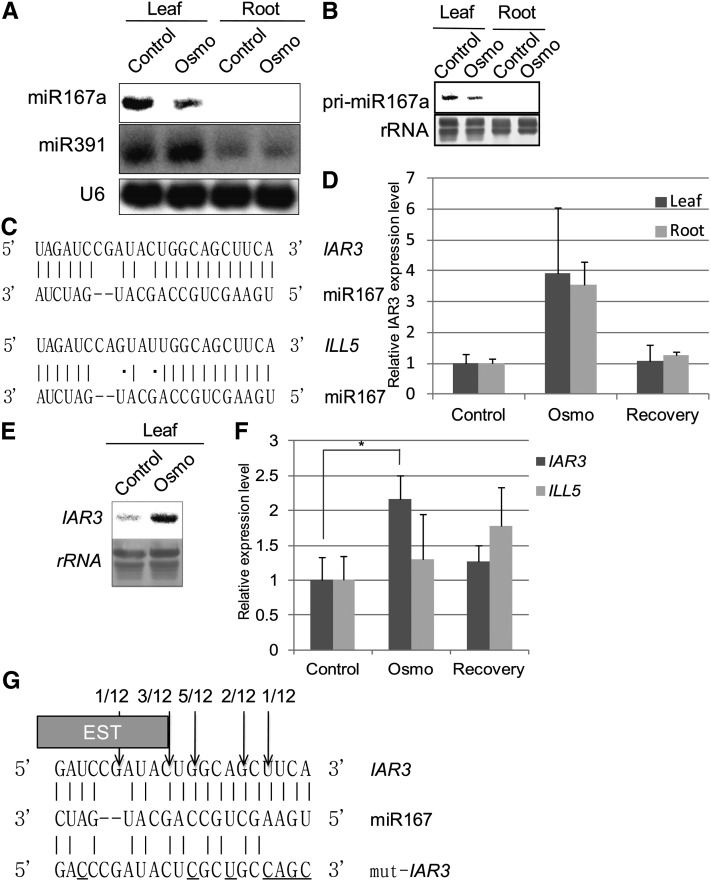
Figure 1.
Figure 1.
The IAR3 mRNA Accumulation Pattern Is Inversely Correlated with That of miR167a/b. (A) RNA gel blot analysis of miR167a/b and miR391 expressions in high osmotic stress (Osmo) and control leaf and root tissues. Conditions were identical to those in Table 1. U6 accumulation is shown as a loading control and each lane contained 20 μg total RNA. (B) RNA gel blot analysis of pre-miR167a expression in control and high osmotic stress (Osmo) leaf and root tissues. 25S rRNA was used as a loading control and each lane contained 10 μg total RNA. (C) Sequence complementarity of miR167a/b with IAR3 and ILL5 mRNAs. Hydrogen bond is shown by a vertical line, G⋅U wobble is shown by a dot, and gap is shown by a dash. (D) Relative expression levels of IAR3 mRNA in high osmotic stress samples (Osmo) compared with control from ATH1 microarray analyses. Microarray analyses were performed using identical samples as deep sequence analyses. In addition, materials that were sampled 24 h after stress conditions were analyzed to observe transient changes. These samples were designated “Recovery.” Bars show se (n = 3). (E) RNA gel blot analysis of the IAR3 mRNA expression pattern in leaf tissue. 25S rRNA was used as a loading control and each lane contained 10ug RNA. (F) Relative expression patterns of IAR3 and ILL5 mRNAs using quantitative RT-PCR with gene-specific primers. Bars show se (n = 3). Asterisks indicate a significant difference between Osmo and mock treatment, based on t test (P < 0.05). (G) The 5′ end of the cleaved product determined by sequencing is indicated by an arrow in the miRNA:mRNA base-pairing diagram, along with the number of clones analyzed. The box shows the end of a truncated IAR3 EST clone (accession number EBENXNS01CL7RN). The bottom sequence shows a mutation strategy to generate the miR167-resistant form of IAR3 without changing its amino acid sequence. Substituted nucleotides are underlined.
Figure 2.
Figure 2.
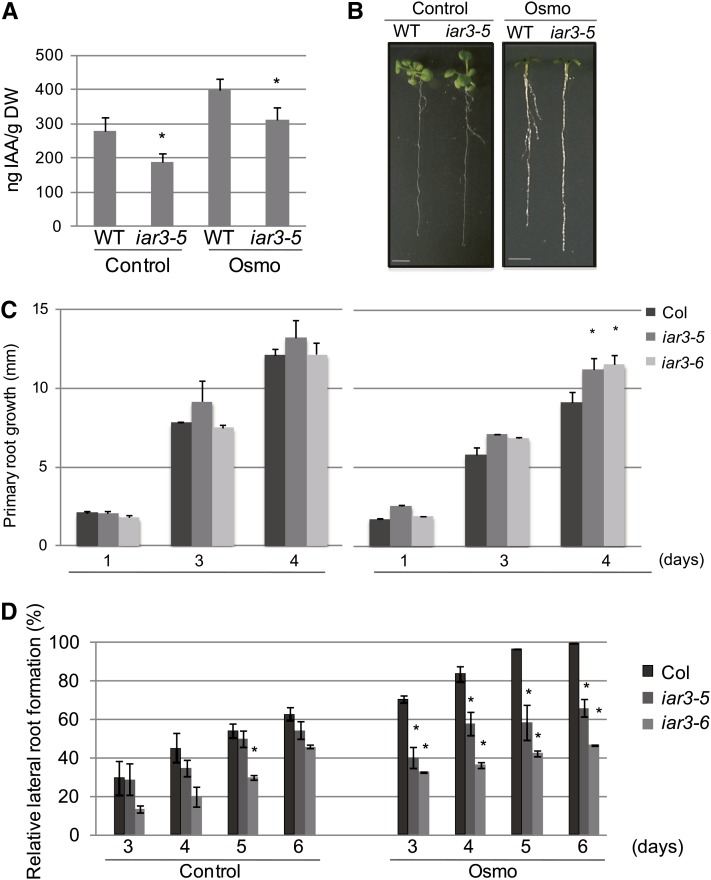
iar3 Mutants Are Insensitive to Osmotic Stress. (A) Measurement of endogenous free IAA levels by liquid chromatography–electrospray ionization–tandem mass spectrometry. Increase in dry weight (DW) due to mannitol uptake was adjusted by dividing the dry weight by the average increase in dry weight under mannitol treatment. Bars show se (n = 23). Asterisks indicate a significant difference between the wild type (WT) and the mutant, based on t test (P < 0.05). (B) Morphology of the wild type (Col) and iar3-5 under high osmotic stress (right) and control (left). Wild-type and iar3-5 plants were grown in control media for 8 d and transferred to the Osmo plate (MS containing 0.25 M mannitol) or control plate (MS alone). Pictures were taken after 1 week (Osmo) or 10 days (Control). Bar = 5 mm. (C) Time-course experiments of the wild type, iar3-5, and iar3-6, quantifying primary root growth (mm) after seedlings were transferred to Osmo or control. Root lengths were analyzed using ImageJ (National Institutes of Health). Bars show se (n ≥ 12). Asterisks indicate a significant difference between the wild type and the mutant, based on t test (P < 0.05). (D) Time-course experiment quantifying lateral root numbers in the wild type, iar3-5, and iar3-6. Experiments were done as in (B). Lateral roots were counted under a stereomicroscope (Leica). Lateral root numbers are represented as percentage of wild-type lateral root numbers in Osmo media at day 6. Bars show se (n ≥ 20). Asterisks indicate a significant difference between the wild type and mutant, based on t test (P < 0.01).
Figure 3.
Figure 3.
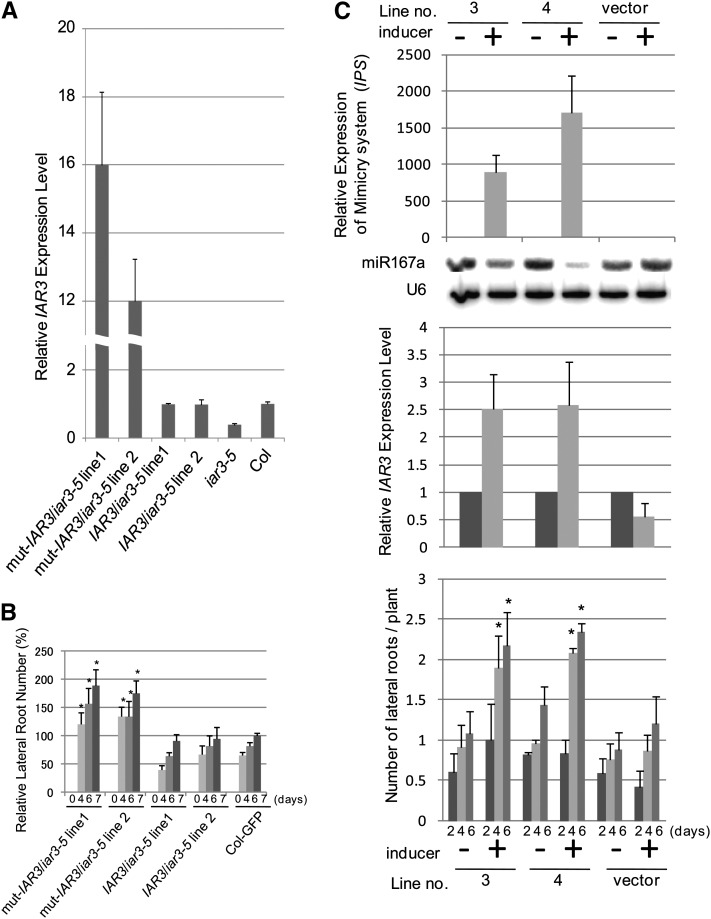
Relationships between miR167, IAR3, and Lateral Root Numbers. (A) Relative expression levels of IAR3 mRNAs using quantitative RT-PCR in IAR3:IAR3/iar3-5, IAR3:mut-IAR3/iar3-5, the wild type, and iar3-5. Bars show se (n = 3). Asterisks indicate a significant difference between the wild type and iar3-5 or transgenic lines based on t test (P < 0.05). (B) Lateral root numbers were analyzed in IAR3:IAR3/iar3-5, IAR3:mut-IAR3/iar3-5, and 35S:GFP (for green fluorescent protein) control plants. Average lateral root numbers of T2 population derived from two independent T1 lines are shown. Antibiotic-resistant plants were transferred to a vertical plate after 1 week and lateral root numbers scored. At day 0 (d0) there were no lateral roots. Bars show se (n ≥ 12). Asterisks indicate a significant difference between IAR3 promoter:mut-IAR3 and 35S:GFP, based on t test (P < 0.05). (C) Transcript levels of target mimicry against miR167 (MIM167, top), miR167a (RNA gel blot), IAR3 (middle panel), and lateral root numbers (bottom) were assessed in two independent MIM167 transgenic lines. Vector control or 2-week-old seedlings were grown in control media for 2 weeks and transferred to media containing 0 or 50 μM β-estradiol. Seedlings were harvested after 5 d for RNA gel blot and quantitative PCR analyses. Bars indicate se (n = 3). Lateral root numbers were counted under a stereomicroscope at 2, 4, and 6 d after seedlings were transferred to media containing 0 or 50 μM β-estradiol. Bars indicate se (n ≥ 12). Asterisks indicate a significant difference between MIM167 and vector control transgenic lines based on t test (P < 0.05).
Figure 4.
Figure 4.
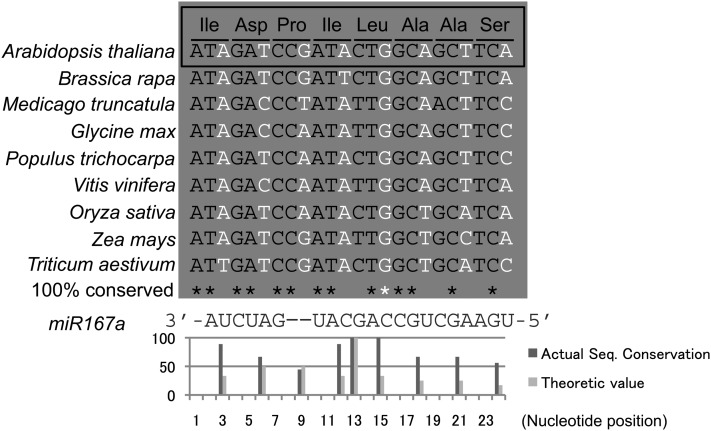
IAR3 Sequence of the miR167 Target Site Is Evolutionarily Conserved. IAR3 sequences of the miR167 target site from Arabidopsis, Brassica rapa, M. truncatula, soybean, Populus trichocarpa, grape (Vitis vinifera), rice, maize, and wheat (Triticum aestivum) are shown. The amino acid sequence is shown on top. Third nucleotide of triplet codon is indicated in white; 100% conserved nucleotide in first or second nucleotide of triplet codon is indicated by a black asterisk; that of a 3rd nucleotide is indicated by a white asterisk. miR167a/b sequence is shown at the bottom. The graph shows the percentage of nucleotide sequence conservation for the third nucleotide of each amino acid, calculated from the species shown in this figure.
Figure 5.
Figure 5.
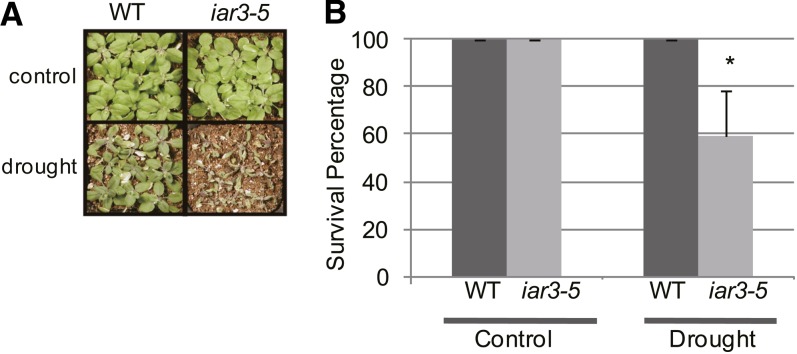
IAR3 Is a Positive Regulator of Drought Tolerance. (A) iar3-5 and wild-type (WT; Col) plants were grown for 2 weeks after soil transfer, with half of the population subjected to drought stress by withholding the water supply and the other half watered normally. Pictures were taken 2.5 weeks after withholding water. (B) Col and iar3-5 plants that survived the drought stress were scored after resuming the water supply. Bars show se (n = 27). Asterisks indicate a significant difference between the wild type and iar3-5, based on t test (P < 0.05).
Figure 6.
Figure 6.
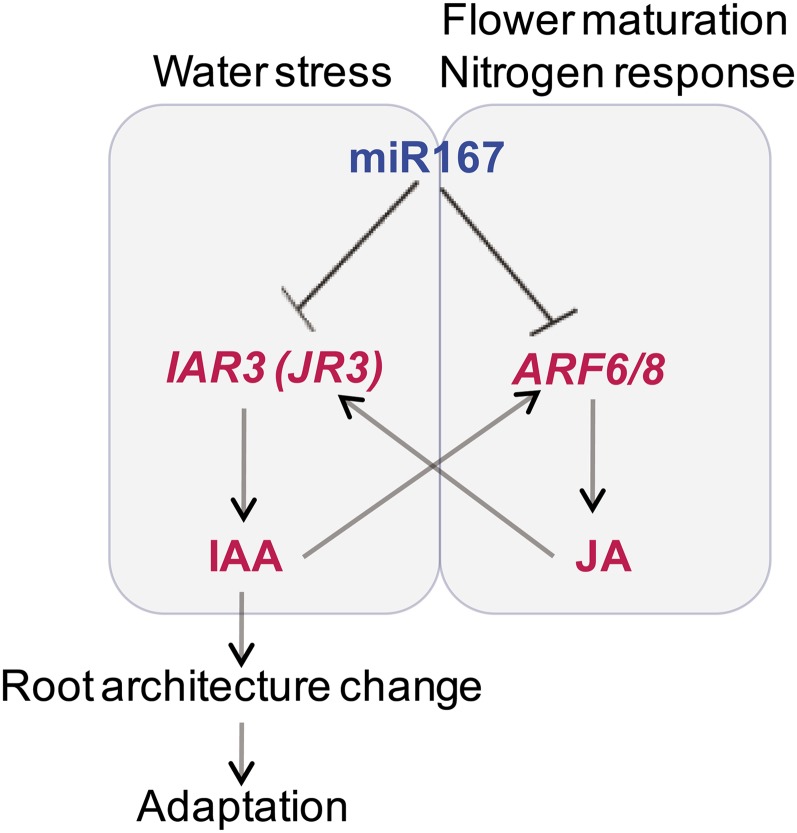
A Working Model of an Integrated View of the First and Secondary Circuits of miR167 Pathways. Blue letters represent lower expression levels, and red letters represent increased mRNA levels. Dotted arrows show possible secondary effects, in which jasmonic acid produced from the ARF6/8 pathway stimulates accumulation of IAR3 mRNA, which is also called JR3. Likewise, auxin released from IAR3 stimulates ARF6/8.

References

    1. Alonso J.M., et al. (2003). Genome-wide insertional mutagenesis of Arabidopsis thaliana. Science 301: 653–657 - PubMed
    1. Arenas-Huertero C., Pérez B., Rabanal F., Blanco-Melo D., De la Rosa C., Estrada-Navarrete G., Sanchez F., Covarrubias A.A., Reyes J.L. (2009). Conserved and novel miRNAs in the legume Phaseolus vulgaris in response to stress. Plant Mol. Biol. 70: 385–401 - PubMed
    1. Aukerman M.J., Sakai H. (2003). Regulation of flowering time and floral organ identity by a microRNA and its APETALA2-like target genes. Plant Cell 15: 2730–2741 - PMC - PubMed
    1. Bartel D.P. (2004). MicroRNAs: Genomics, biogenesis, mechanism, and function. Cell 116: 281–297 - PubMed
    1. Belin C., Megies C., Hauserová E., Lopez-Molina L. (2009). Abscisic acid represses growth of the Arabidopsis embryonic axis after germination by enhancing auxin signaling. Plant Cell 21: 2253–2268 - PMC - PubMed

Publication types

MeSH terms

Associated data